


Why I Don’t Read Ski Test Reports
[Please consider supporting SeniorsSkiing.com with a donation. We appreciate your help. Click here.]
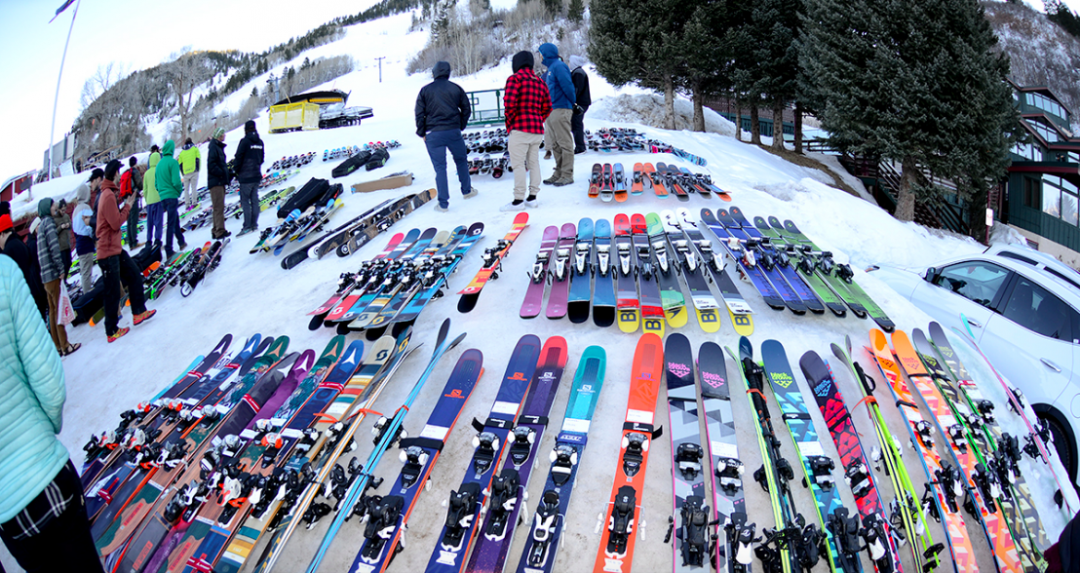
Unlike this ski test, the author masks the ski’s identity. Credit: FreeSkier
Seven Ways To Make Ski Tests More Objective.
Way back in the late 20th Century, while running the SKIpp Testing program for SKI Magazine, John Perryman and I learned the most difficult problem to solve and the biggest variable was the ski tester. In conversations with almost every manufacturer, they said the same thing. So the goal of SKIpp (way back in the 1970s before engineering modeling software was available), was objectivity and processes that minimized tester bias. John created a bench test and then tested the ski on the snow so we could compare the results.
Amazingly, we were successful. We were invited as “consultants” by several manufacturers, to compare SKIpp’s results with theirs. Again, SKIpp was very accurate, more so than some manufacturers would admit.
Most ski testers are really good skiers and as such, they unconsciously adapt their technique to the ski, terrain and conditions and the brand’s design philosophy. This makes objective comparisons very difficult. In the SKipp program on-snow methodology, seven steps were incorporated to reduce the human variable.
One, we did blind testing. The tops and tip logos of each ski were covered with shelf paper before numbering each pair. The tester was not allowed to pick up the ski until he/she “tested” the ski to minimize identification.
Two, we skied the same trail every day that gave us about 1,000 feet of vertical and a chair lift that made yo-yoing possible. The ski area spread fertilizer on a long marked off segment to simulate frozen granular and give us a consistent snow surface to reduce the “snow condition variable.”
Three, each skier filled out a test card which graded a list of mandatory maneuvers/turns. At the beginning of the year’s session, we conducted a clinic on the required maneuvers and how the ski should react.
Four, each tester was allowed only two runs on the ski before grading. We wanted first impressions and found that after two runs, most testers adapted to the ski’s idiosyncrasies.

Ski tester range from racers to intermediates. Controlling tester bias is key.
Five, the testers’ skills ranged from certified ski instructors who either had been racers or coaches to intermediate skiers. Our youngest testers were in their mid-20s (we did have a few teenagers one year) to older skiers in their 50s.
Six, the “racing” models were skied down a 20 gate GS course that had been “fertilized” so the surface was rock hard.
Seven, only 10 skis were tested each day. After 10, the testers had a hard time determining the differences.
We let the testers pick which skis they wanted to ski in the afternoon. Again, the choice and why was recorded. Only then did we allow the ski to be identified. Results were tabulated each evening by hand because Excel, laptops, etc. didn’t exist in the 1970s.
Even with all these precautions, most of us could, after a few weeks of on the snow testing, tell one brand from another. To this day, I can tell a Rossignol from a Dynastar from an Atomic from a Head or K2.
So, when I read the current ski reports filled with jargon such as “edge gripping power” or “discover the amazing effect of (name of manufacturer) new Energy Management Circuit,” my reaction is %$^@*&, and I stop reading. Whatever credibility just evaporated. I’ve been there and writing facts about the ski’s performance instead of hype is, well, boring. But, experience tells me that the reports are more believable. So now you know why I don’t read ski test reports and prefer to “on snow test” them myself.

Question For You: Flat Light Tactics
[Please consider supporting SeniorsSkiing.com with a donation. We appreciate your help. Click here.]
Is Flat Light The Bane Of Your Skiing Experience? Or Just One Of Those Things?

Head for the lodge after this one? Think so. Credit: Jan Brunvand
No contrast, lack of depth perception, no tell-tale marks on the snow, flat light adds another dimension to deal with. Not welcome to many. Tolerable to some.
We’ve had a couple of our more spectacular falls in flat light conditions. Too fast, unexpected terrain. And boom. The lasting result is that whenever we see that gray-white shroud, we tighten up, and more likely than not, head for the bottom and home.
There’s an excellent article by correspondent Marc Liebman on Coping With Flat light in our archives. Check it out here. But what is your way of approaching flat light conditions? Do you have a specific brand of goggles you swear by? What about technique? Changes in how you approach the trail? Let us know. Perhaps you can help up break through our reluctance to head out on flat light.
Question For You: How Do You Manage Flat Light? Tell us how you do it. Or if you just avoid it.
Write a comment in Leave A Reply below.

Women Played Integral Role at One of Nation’s Oldest Ski Areas
[Please consider supporting SeniorsSkiing.com with a donation. We appreciate your help. Click here.]
Janet Davis Mead, June Aker, Verlene Belden All Kept Pico Going And Growing, Despite Obstacles and Challenges.

Janet and Brad Mead started Pico in 1937.
Vermont’s Pico Mountain survived a war, two owners’ deaths, and a neighbor called Killington to become one of the 30 oldest continually operating ski areas in the country.
It’s a feat that was largely driven by women in its first 30 years, a time when the ski industry was known to be “a man’s world.”
Women also played major roles in Pico operations since that time, continuing the strong family influence that began with co-founder Janet Davis Mead.
A feisty woman given to exaggeration, Janet Davis told Brad Mead she had skied at the Lake Placid Club, so he invited her to go skiing.
“I had to follow him down what looked to me then like Mount Everest. I made it, but without poles,” she would write years later, explaining she had thrown them in the bushes, not knowing what they were for.
Her bravado paid off; they married and researched building a ski area.
Envisioning a year-round resort with mountainside homes, aerial tram, swimming pools, ice rinks, and tennis courts, the Meads leased Pico Mountain and opened Thanksgiving Day 1937 on Little Pico with a 1,200-foot rope tow and a rough-cut, 2.5-mile Sunset Schuss skiers could ‘skin up’ to the summit.
The Meads hired Swiss racer Karl Acker to run the ski school, added two tows, widened Sunset Schuss — renowned for downhill racing and the Pico Derby — and installed the first U.S. Constam T-Bar to the top of Little Pico.
After Brad died in a boating accident in 1942, Janet carried on with support from skiers, the Otter Ski Club, and Otter Patrol. When workers including Acker left for World War II, she kept Pico open despite hardships of rationing and shortages that caused many areas to close. Using her marketing skills, charisma, and tenacity, she gave special rates to schoolchildren and servicemen who visited on furlough weekends.

Karl and June Acker took over from Janet and continued to expand the resort.
Having survived wartime, Janet bought the mountain (1947) as Acker returned to teach and help operate Pico. (He coached daughter Andrea Mead, first American to win two Golds in the 1952 Olympics, bringing acclaim to Pico’s strong racing tradition.) As the first woman to own and run a U.S. ski area still operating, Janet survived four lean snow years, weak finances, and growing competition by lowering ticket rates and offering summer rides on chairs hung on the T- Bar (1950). With the ski boom on and her children not interested in running Pico, she sold to Karl and June Acker in 1954.
Karl added trails, a T-Bar, and a J-Bar. “The lack of access to funding caused him to do too much of the work himself; the long hours and the stress of the new J-Bar which he couldn’t get to work quite right contributed to his fatal heart attack” in May 1958, June told me in 2007.
“The three banks that had lent us money to purchase Pico had insisted on a life insurance policy on Karl. Because I was a woman they needed to know I could repay the loan if he died,” June said of becoming Pico’s owner at age 30.
She added trails, replaced a lift, and obtained financing for Pico’s first chairlift, a Stadeli double that went halfway to the top ($110,000 in 1962).
“Pico needed lift service to the summit to compete and survive. Being a woman contributed to the banks’ reluctance to provide more loans,” June said, of her decision to sell to Bruce and Verlene Belden (1964) in hopes they would carry on a family-oriented mountain.
Bruce had helped build Mount Snow (1955-1964), while Verlene ran their 30-guest ski lodge and raised four children. With former guests investing, they became majority owners with Verlene as office manager. Her business acumen coupled with their strong family orientation and expansion of the mountain enabled Pico to survive the trying 1970s when all but five major Vermont ski areas changed owners, and most surface lift areas closed. Vermont had 81 areas in 1966 but just 39 by 1988.
When they retired in 1987, Pico had a reputation as the “friendly mountain” with strong racing and instruction programs and new base village engendering a loyal following.
Women played significant roles in achieving that reputation. “They taught youngsters to ski and race and were instrumental in the Pico Ski Club. They also ran various departments from ski shop to ski school, tickets to childcare. They contributed to the skier loyalty that saw kids who grew up at Pico return as instructors or coaches and bring their own families to the mountain,” noted former GM Frank Heald.
Current Pico Director of Operations Rich McCoy added, “Pico staff make people feel at home and welcome. That’s a legacy that women through their leadership roles have contributed to throughout Pico’s long history and still do today.”

Sunset Schuss: Had to skin up in the old days.
[authors_page role=contributor]