


New Rx Goggle: Full-Range and Fog-Free Vision
One of the downsides of not skiing this season is that I am unable to experience some new and interesting products in a skiing environment. I make clear in each article I’ve written about these products that it is not a product review. These pieces may be about the product’s features and benefits and how I think it will benefit other senior skiers, but, at least for this season, these product articles are not full reviews based on my on-hill experience.
That said, I’ve been using my new SnowVision prescription ski goggles in a number of non-skiing settings. SnowVision is a Belgian company that advertises with SeniorsSkiing.com. It utilizes a patented lens technology that integrates the prescription lens into the inner lens of the goggle. The picture accompanying this article explains it quickly.
A Better Rx Goggle
The SnowVision approach has numerous advantages over goggles using prescription lens inserts or over-the-glasses (OTG) goggles. The most obvious is the total lack of fogging. I believe that has something to do with the face to lens distance. I’ve used SnowVision while hiking on a cold, wintery day and fogging never occurred. I can’t imagine it would be an issue while skiing.
I’ve never found OTG goggles acceptable. My experience is they fog-up too easily. Also, with prescription inserts, there’s always the issue of matching the insert with the correct goggle. Once, after purchasing the insert, I had to search for a compatible goggle.
Perhaps the most significant and satisfying difference between SnowVision and other prescription goggles is the clarity and full range of vision. My prescription-insert goggles provide decent enough vision looking straight ahead. SnowVision, however, gives full, clear vision at the periphery. This, because the integrated prescription lens, like the goggle’s outer lens, is curved. The difference in vision is dramatic.
SnowVision prescription lenses are available as unifocals, progressives or bifocals. The company sent me a pair with bifocals. In all my years wearing glasses, this is the first time with bifocals, and I adjusted immediately. Also, the lenses are fully photochromic: they darken when conditions are lighter and lighten when conditions get dark.
But I have not yet skied with SnowVision, so I can’t comment on their effectiveness in flat light and other on-hill conditions. As for comfort of fit, hiking in a cold and snowy forest, they provided excellent, fog-free vision.
The Belgian company has its goggle components manufactured by high-quality vendors in Germany, Italy and Japan. That quality is reflected in the design and robust look and performance of SnowVision.
Price ranges start about $300 for the unifocal. The custom-made goggle comes in a box with a cloth carrying case, a lens-cover and free shipping, worldwide.
I’ll write a full review when I’m back on snow next season, but, in the meanwhile, if you’re like me and rely on prescription goggles, SnowVision offers a unique, new approach which I think is superior to the existing options.

CARV: Your AI Ski Coach
A Digital Coach Speaks As You Ski.
Among the many things that attract me to skiing, one is the opportunity to improve at something I enjoy. I’m an advanced skier who started skiing as an adult without the benefit of regular lessons. Over the past three years I took mid-week lessons which made a real difference, but COVID cancelled those classes.
This made me wonder if there were alternatives that would help me improve. An internet search introduced me to CARV, a real-time digital ski coach that speaks to you as you make your turns.
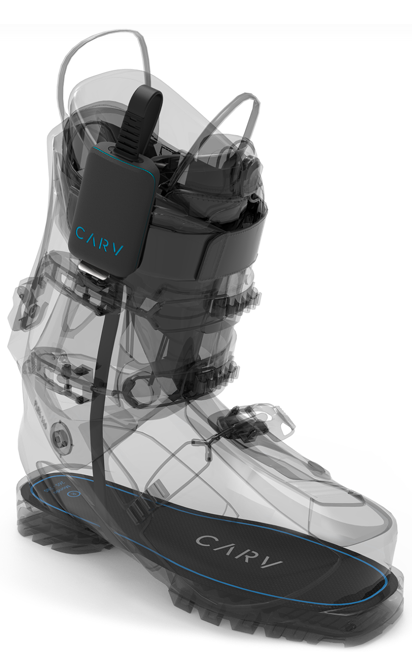
CARV has three components: a boot insert, battery/Bluetooth ‘trackers’ and an iPhone/Android app. I bought mine online and received it three days later. The boot insert, which has 72 embedded sensors, fits between boot liner and shell; the tracker attaches to the boot strap.
Setup process is straight-forward. Once you download the app and create a user account you’re ready to go. YouTube videos explain how to do everything needed to get CARV set up and calibrated. When you arrive at the hill, open the CARV app, connect the trackers to boots and calibrate each tracker. This involves lifting each ski off the snow, then standing on it. Plug in your earbuds, and you’re ready to go.
One of CARV’s best attributes is the sophistication of the software which has 40 million turns in its database. If you’re an intermediate skiing in the “back seat,” it let you know. If you’re making more advanced carved turns, it recognizes the subtle pressure change from ball of foot to heel, keeping ski tracking through the end of the turn. I expect that as CARV gathers more data it will continue to update software, making it even smarter.
CARV has four modes, each of which uses input from the insole sensors to evaluate edge angles, balance, early edging, ski similarity, turn smoothness, left/right turn symmetry, body rotation, outside ski pressure and foot roll.
The FreeSki mode creates a SkiIQ while you go about skiing. After a run you will be told your SkiIQ—along with a tip on what you can focus on to improve during the next run. You also can look at the result on your phone while riding the lift and see, in detail, aspects of your skiing evaluated quantitatively.
In Monitor mode you get to select a single aspect of your skiing for evaluation. As you make each turn you hear a number that helps you evaluate how you did and whether you’re improving. A great aspect of this mode is it helps your brain connect with how it feels when you do it well.
Challenge and Training modes provide exercises to help you improve. Training mode provides spoken feedback while executing the exercises.
After eight days of skiing with CARV, I’ve experienced a noticeable improvement; wish I had it when I was an intermediate.
Even if you’re an expert I expect that CARV will help. Ski racers have coaches and Level 3 PSIA instructors have ongoing training to improve their form.
Does CARV replace an instructor? I don’t think so. But no instructor can give you that level of precise feedback. At $349, it’s a great addition to any skier’s toolbox.
Make More Tracks: Cross Country Skiing is Booming Despite COVID
XC Is Hot And Getting Hotter.
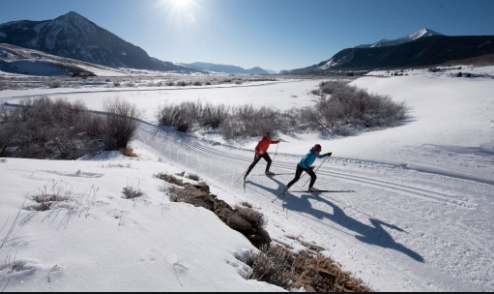
Crested Butte Nordic Center attracting alpine skiers who can’t get downhill reservations.
The Cross Country Ski Areas Association (CCSAA) has been conducting online sessions with its cross country (XC) ski area members since last spring, focused on sharing information about how XC operations should respond to the COVID-19 pandemic. Discussions resulted in widespread adoption of plans aimed at minimizing risk of virus transmission for staff and guests.
For example, many XC ski areas have adopted e-commerce and are requiring on-line purchase of trail passes, rental equipment, and lesson reservations. Plans to alter the flow of ski area traffic on the premises and in buildings for safe distancing, as well as limiting or eliminating indoor capacity, have also been put in place.
With plans ready, the onset of winter has come—and business is booming.
High Demand
As per usual for the XC ski business, there is snow in some places and a lack of snow in others. But one thing is consistent and fresh—at least since August, XC ski gear has been flying off the shelves.
There are shortages for popular sizes of skis and boots. Bindings and ski poles are also hard to find. Manufacturers have been unable to supply enough products to fill the dealers’ needs. Adding to the shortage, an October fire at a huge Ukrainian factory that reportedly produces a majority of the industry’s skis has hampered the ability to meet demand.
Great Start
XC ski area operators attending the meeting were upbeat about the demand and the level of business this winter, so far.
Christie Hicks of Crested Butte Nordic Center, referring to the two weeks before Thanksgiving when the center in Colorado first opened, “We were slammed from the beginning, and the holidays have been through the roof with five of the seven days during the period being the biggest ever.” Crested Butte Nordic’s season pass sales were up 40 percent, and rental revenue was up more than 100 percent.
First timers at Crested Butte Nordic over the holiday enjoyed good snow conditions and great weather. The center also welcomed alpine skiers who failed to reserve tickets in advance at the alpine ski resort and were turned away due to capacity restrictions.
Richard Hodges of White Pine Touring in Park City, UT, described “business being relentless, as everyday is as busy as a great Saturday. The on-line retail sales are up 300-400 percent, with all the beginner gear sold out and significant gaps in the inventory, but we are hopeful that we can get more products from suppliers by the late winter.”

“With regard to our retail equipment, we are now almost all sold out,” explained Dustin Hite of Osceola Ski & Sport Resort in northern New York. “Indoor capacity is limited to 50 percent per the state, but all the rentals are out on most days and season pass sales have been very strong,” said Hite.

Woodstock Nordic Center is tuning up old XC gear people are using to come back to the sport.
In Vermont, the Woodstock Nordic Center, which traditionally relies on guests at the Woodstock Inn & Resort, has doubled sales of season passes with locals compared to other years despite a 50 percent decline in occupancy at the Inn. Woodstock manager Nick Mahood said, “We had our biggest day ever for revenue leading up to the holidays, and then there was a rain out. Then we got enough snow to open and increased business has occurred despite Vermont’s restrictive travel policy.” Mahood said that many local people who left the sport for years were coming back with their old gear that they want to get tuned-up.
In Truckee, CA, Tahoe Donner Cross Country is experiencing a low snow winter so far but has had strong season pass sales. According to area operator Sally Jones, “the state has set capacity limits, which is impacting the rentals and food operations. The health authority opposes eating at the premises—even outdoors—because it wants to minimize congregation on the area’s patio.”
On a recent visit I made to Green Woodlands in western New Hampshire (recently named a top place to XC ski in the US by an on-line outdoor website), there was enough snow to ski. And out of 50 XC skiers I saw in the parking lot and on the trails, there were only a couple not wearing masks. XC skiers appear to be respectful without being told to wear masks and there seems to be a minimal chance to get infected with the virus when passing other skiers along a trail if you’re wearing a mask. So join in, get outdoors, and hit the XC ski trails!

Green Woodlands in NH has groomed trails, parking, warming huts and no fee!
[authors_page role=contributor]