


Tips To Better Smartphone Photos
Don’t Lug Your DSLR. Smartphones Can Do It.
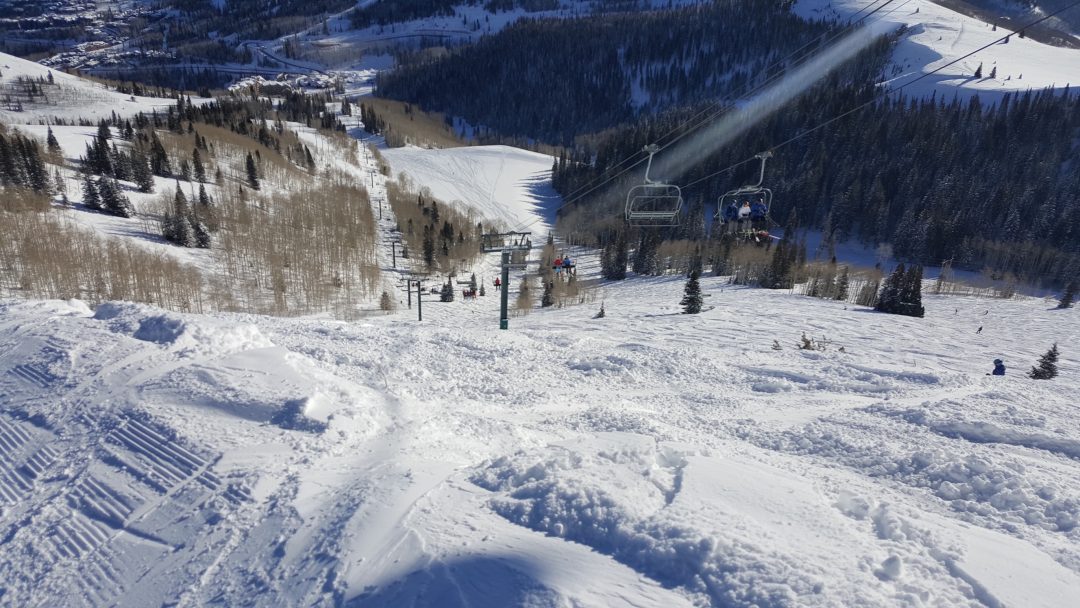
It’s steeper than it looks. Credit: Tamsin Venn
Do you want to take better photos with your Smartphone? Transform your friends into Alpine or Nordic heroes?

Mark Phillips is a professional photographer.
Mark D. Phillips, a former AP photographer, is used to lugging around SLRs and long telephoto lenses for photographing ski racing. Increasingly, for sheer convenience, he uses an Smartphone to get good high quality shots. Here are some pros and cons of using the Smartphone and tips for how to take better photos, according to Phillips.
- The Smartphone quality level is about half of your standard SLR so you sacrifice quality. But if you are doing photos mostly on the internet and sharing with friends and family, the clarity will be fine.
- The phone works best as a wide angle lens. You can take that a step further and turn on the fun panorama feature. Use anchor points on either end to bring the image together.
- One drawback is not having the use of a telephoto lens (true on the earlier models). Stay tuned for new phones which will have new zippy telephoto features.
- To compensate for the Smartphone’s lack of depth of field, try to connect the elements of the photo: the skier with a line of trees or throw in a pop of color to give a sense of depth.
- Use the rule of thirds. Put your subject in a third of the camera, and use the rest as a complement.
- Mix up the camera angle. Hold the Smartphone down at your knees and get an interesting low shot. No need to bend way down or get on our knees.
- Fill as much of the screen as you can.
- The Smartphone has good light values for night photos, but again you are going to lose the depth of field. Use lines for composition to give more of a sense of depth.
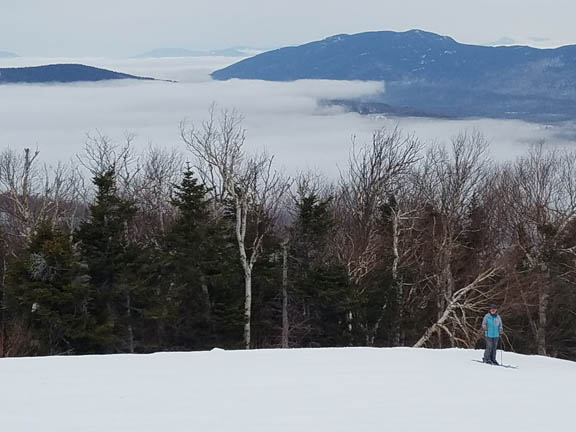
Sugarloaf inversion taken by Smartphone. Credit: Tamsin Venn
- Photoshop tools in the Smartphone rival any of the other tools available for playing with photos. Change the exposure, the highlights, lighten up the shadows and bring some details back into the blacks, or add warmth to take the blue out of the snow. Or, turn the photo into a moody black and white.
- Most people email their photos to their computer, but if you have a lot you may want to use a cable. (If you turn on the “send to cloud” feature, they will show up on your computer.) Work with the largest file size you have, the more data you have when you resize the better the image.
- Shoot video with the slow motion feature, then scroll through the images one shot at a time to find the best single action photo.
- Finally, if you want to shoot your ski tips hanging over the top of Corbet’s Couloir at Jackson Hole, just accept that the Smartphone is going to erase the steepness factor. Then drop in.
Got any tips for taking better Smartphone photos? Share them in the Leave A Reply section below.

Moody day at Deer Valley has been edited with built-in editing tools. Credit: Tamsin Venn

Ski Art II
Don Burch Does It Again
Here’s a new Ski Art video from Don. Some of these images are dramatic, colorful, peaceful, engaging, aesthetically pleasing, and just plain fun to see.

My One Morning Career As A Ski Instructor
A Ski Patrolman Rises To The Challenge.
Dave had to teach a group of local women, and he never even had a lesson himself.
Before I ever had a ski lesson, I had become a ski patrol director, certified (the highest level) by both the National Ski Patrol and the Professional Ski Patrol Association. One morning while working at a small ski area (240 feet of vertical), I was called into the base lodge by the woman who scheduled the ski school programs. This tiny area actually within the city limits ran a number of programs mid week, mostly for housewives, and this morning they had a couple of no shows among their instructor corps.
After numerous phone calls to no avail, it was decided that I would have to teach one of the classes. I asked what level they were as skiers and was told level B, or it might have been C. Neither told me anything. I didn’t know an A from an E. I later learned that A were true beginners, never-evers. Fortunately, these ladies could ski enough to get down the hill. On this second week of their once-a-week program, they got the pro patrolman.
In front of the lodge the ski school director introduced me to the four ladies before he headed off to also teach a class. Having no idea what to say, I simply stated, “I hope you ladies have a good sense of humor. We’re all going to learn together today. Not only have I never taught a lesson, I have never even had one!” One of the ladies laughed while the other three gave me strange looks.
I took them up the lift and watched as they skied down to the top of a broad low intermediate slope. I explained that I needed to see what they had worked on the previous week so I skied part way down and asked them to demonstrate as best they could the turns they had worked on last week.
As each one stopped by me, I complimented them on what they had just done. As they were just breaking into parallel, I decided we would work on a combination of up unweighting and pole plant. I demonstrated the way I thought a real ski instructor might, planting the pole and rising up to ski around it. It seemed to make sense to them so we worked our way back to the lift. We spent the rest of the time skiing around the area, and I made it a point to ride the lift with each one so we could talk about their progress. I also took them on a longer flatter run which circumscribed the area so they could let the skis run and feel how much easier it was to turn with a little speed. Mostly I listened and passed out tips and compliments.
When the lesson ended, I thanked the ladies for their patience and told them I hoped they had as much fun as I had. Later I talked with Shirley who had recruited me for the lesson, and she told me that two of the ladies asked if they could have me the next week. Unfortunately, that was the end of my career as a ski instructor. The following week, they got Bruce Fenn, one of the PSIA gurus who had been in on the beginning of that organization, and knew everything there was to know about teaching skiing. Thanks to Bruce, and his clinics, that small ski area had close to a 100 percent pass rate on PSIA certification exams. And skiing with him and the instructors at those final form clinics were the closest I came to ski instruction at that time.
[authors_page role=contributor]