


Short Swings!

A segment of the population is getting out of hand. We saw it at the Capitol, and we’re reading about it on airlplanes, in restaurants, and, now, of all places, ski areas. Pent up anger and resentment, stoked by misinformation and lies, is erupting in public places. It’s ugly, and it’s upsetting. Unfortunately, it’s not going away.

Most ski areas now require masks and social distancing. But not all skiers and boarders want to comply. Their resistance has led to verbal abuse of employees tasked with enforcing policy. Maybe those opposed to the rules think their freedom is being challenged. But, as history tells us, there really is no freedom without responsibility and that responsibility is to the rule of law and the public’s well-being. Without it, you could selfishly do whatever you choose…the rest of society be damned.

It’s good that some areas are enforcing their policies. The fact that Schweitzer Mountain closed night skiing for MLK weekend and this weekend suggests direct punishment for night skiers/boarders resisting mask and distance policies. Other resorts are issuing notices re-empathizing Covid requirements.
Ultimately, Covid concerns will be short term, whereas on hill collisions from reckless and/or out-of-control skiers/boarders will continue to be an issue. I can only hope for myself, other senior skiers, our children and grandchildren, that the areas will pay more than lip service to this more permanent and potentially lethal situation.
Alyeska Tops 45′

This is what 24′ of snow looks like. Think about 45′!
A few weeks ago we reported that Alaska’s Alyeska Resort was the first in North America to get more than 400’. As of this writing, Alyeska has a season total of 541”.
Park City Patrol Demonstrates for Pay Increase
The Park City Professional Ski Patrol Association, representing 200 patrollers and mountain safety personnel, demonstrated this week for a salary increase and better sick leave. The group, which has been operating without a contract since January 1, claims Vail Resorts (VR) is refusing federal mediation. The head of the group explained it wants VR to recognize ski patrolling as a full-time career, deserving salaries and benefits comparable to other Vail Resorts staff. They have a point, don’t they? And how would VR or any ski resort function without patrol? They also have a sense of humor with their picket signs: “Not on Strike. Just practicing.”
Snow in the Sahara

For the first time in 37 years, snow fell in North Africa’s Sahara Desert. With average winter temps of 57F (summer, 100F), desert snow is rare. But in the Atlas Mountain range looming above the desert, there’s a ski resort and vast backcountry terrain accessible by climbing (there are three tour operators) and Africa’s only heli-ski operation.
Canadian Teen Survives in Snow Cave

Snow cave built by Canadian teen
Last Saturday, 17-year old Robert Waldner got separated from his family while snowmobiling in a mountainous area of British Columbia where this time of year temperatures can drop to -58F. Realizing he was lost, the high schooler shoveled out a snow cave and hunkered down for the night. His breath caused the interior of the cave to ice over, stabilizing the interior temperature. Fortunately, search and rescue spotted his snowmobile and found the lad, unharmed, before midnight.
Outstanding New Skiing History

Just-published, Ski Jumping in Washington State: A Nordic Tradition is exceptionally well-researched and a first-rate read. While the 224-page paperback focuses on the development and evolution of ski jumping in the Northwest, it’s scope covers the golden age of ski jumping throughout the nation. The volume is filled with wonderful illustrations and photographs from early to mid-Twentieth Century. It tells the story of Norwegian immigration to the US and how many of those immigrants — Alf Engen, Torger Tokle, Art Tokle, Olav Ulland, Birger and Sigmund Ruud and others — contributed to ski jumping competition. John W. Lundin, a ski historian and attorney, authored this gem. The book has a Foreward by Eric Nelson, CEO of the National Nordic Museum. Ski Jumping in Washington State: A Nordic Tradition (Arcadia Publishing) accompanies an exhibit on the same topic organized by the National Nordic Museum and the Washington State Ski and Snowboard Museum.
Drive the Streets of 50 Cities
Click here to take a virtual drive through more than 50 cities worldwide. You’re able to set vehicle speed, street noise, etc. Return to the city after one drive and you’ll be on a different route. I took the drive up Park Avenue in Manhattan and passed the building where I used to work.

Make More Tracks: Corrugation For Groomed Trails
The Technical Reason Why Ski Trails Are Corrugated.
Freshly groomed XC trails last longer. Credit: North Shore Nordic Association
[Editor Note: This article was written in collaboration with Auguste Lockwood, Yellowstone Track Systems.]
Interest in winter recreation promises to grow phenomenally in winter 2020-’21, despite—or because of —COVID-19, and a lot of us are looking forward to more friends and families on more and better groomed trails.
One of the subtle, unsung, but vital elements of high-quality (read “fun”) cross-country ski, snowshoe, fatbike, and snowmobiling grooming is corrugation. You’re probably familiar with metal or plastic corrugated panels that increase strength and rigidity for roofs and siding. Those same qualities apply to trails, where consistent, durable, beautiful surfaces are essential for skiers, snowshoers, and riders as well as groomers.
If you’re interested in either producing or using high-quality trails, first thing to know about corrugation is something about the physics of snow. Corduroy —that’s the grooming version of corrugation —has peaks and troughs that create minute pressure differentials. These differences promote the movement of free moisture up through the snowpack to the tips of the peaks, where evaporation is accelerated by increased exposure to cold air.
The phenomenon of “hot moves to cold” describes the movement of moisture from a warm material to a cold one, like condensation on a cold drink on a hot day. Corduroy increases the surface area of the trail, exposing more snow to the air where moisture transfer can happen.
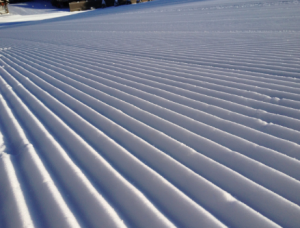 Corduroy creates a strong, stable surface if it’s in place long enough before being used. In addition to faster set-up time (“mechanical age hardening”) and increased snow metamorphism, the triangular shape of the individual ridges adds strength and stiffness. Ideally, corduroy peaks form a thin glaze that extends about 1/3rd of the way down the trough, in effect building a little ice cap. With a well-distributed load, these caps are the first defense against trail flattening, friction, and melt.
En masse, these caps are extremely strong, easily holding the weight of a skier, fatbiker, etc., leaving virtually no damage or even marks. Once the caps or tips fail, the upper half of the ridge is fairly soft, but the layer just above the trail base (about 1/4 inch high) remains extremely strong.
This slightly ridged trail can last for days or weeks under the right conditions. A ridged trail sets up faster, bonds harder, and lasts longer than a flat trail.

Fat Biking On Corduroy
Fat biking promises to become a major winter sport that complements cross-country skiing and snowshoeing, and it’s new enough that grooming for it is a little mysterious. Groomers’ knowledge about any of these sports can help create a premium product for the others.
With the widely-spaced lugs of a fat bike tire, there are two types of interaction with the trail: the lugs, and the smooth rubber of the tire. A corduroy surface makes for a better riding experience by providing consistent traction. With corduroy, tire lugs fall between the peaks of the ridges, allowing the smooth rubber to evenly distribute pressure between the tips of three to five ridges at a time.
Lugs that contact the ridges will crush the snow, digging in and providing lateral traction, while the lugs between ridges grab the edge of a ridge and provide lateral traction, without damaging the trail. This creates a superior surface, as an increased number of ridges per foot of the grooming comb has several advantages.
One advantage is increased surface area, decreasing setup (consolidation) time. Another is more surface contact with a tire, since with widely spaced ridges, the tire will only be contacting a couple of ridge tips, increasing the pressure on the tips and breaking them. In contrast, on a smooth trail, tire lugs either don’t penetrate enough if the trail is too firm, thus reducing traction; or they’ll penetrate the top surface of the trail, until the weight is transferred to the smooth rubber of the tire.
The ideal density can be hard to achieve—too hard and there’s not much traction, too soft and the weight of the rider will crush the top layer of trail, creating a weak spot.
Finally, from an aesthetic point of view for fat biking, really good corduroy leaves a small line of snow on the tire. So while riding, there are three or four (depending on tire width) thin white lines that circle the tire. This produces a mesmerizing pattern on the wheels to watch on your front tire or on the back tire of someone you’re following. The lines run longitudinally around the tire if you’re going straight, but you can zigzag and make cool patterns as they interact with the regularly spaced lugs while turning.

Skiing Weatherman: Something For Everone
Snow For All.
Often when I write this piece, I have good news for one region of the country and not-so good news for other areas of ski country. Such is the nature of winter weather across a country that stretches 3,000 miles from coast to coast and with so many and varied climate zones. However, just as there are times in the middle of the summer when much of the country is warmer than normal, occasionally we see a pattern in winter where most or all of the skiing regions get lined up for significant snowfall at roughly the same time. We are entering just such a period.
In order for a favorable pattern to set up for such a large area of the country we obviously need an ample supply of cold air. From mid-December until just recently, most of the air flowing across the country was of Pacific origin, not the prime source region for winter weather. The jet stream configuration now in place is tapping cold air from the northwestern corner of the continent. There is still a risk that we could see an intrusion of severely cold arctic air by the end of the month, but at a minimum, enough cold has showed up to make even southern regions cold enough to be on the lookout for fresh snow. It certainly helps that this is the time of year when normal temps in most areas are right at their climatological minimums for the year. To illustrate the extent of the cold air, here is a look at the forecasted 5,000 foot level for Friday, Jan. 29th
The area shaded in hues of blue indicate where temps will be below freezing. Sub-freezing temps at that level are a proxy for where the column of air overhead is cold enough to support snow, even the southern Appalachians look sufficiently cold.
The other ingredient for widespread snow is a favorable jet stream configuration. Here is a forecast for the jet stream for late next week that I agree with, showing three key components to a snowy pattern from coast to coast.
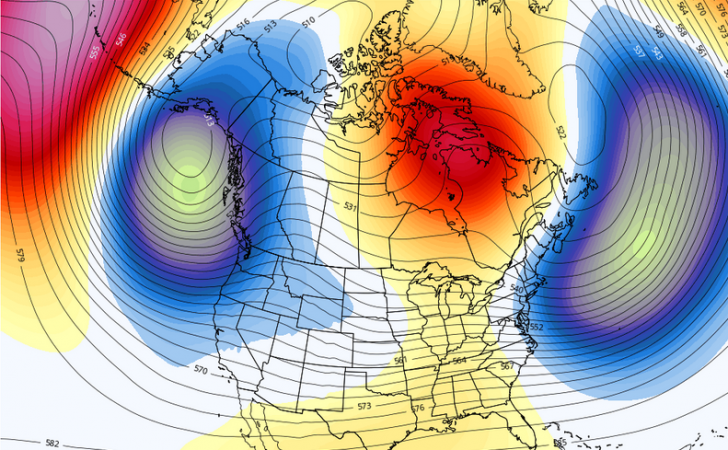
The trough along the west coast will produce fresh snow from Alaska down to the southern Sierra, and inland to AZ and NM as well. Storms from the southern end of that trough will traverse the country and bring the opportunity for snow to the central and southern Appalachians. The red ridge over northeastern Canada will remain in place and help keep storms from cutting through the Great Lakes, which would produce rain to the east of the track. Northern disturbances will come out of the Gulf of Alaska, move along the U.S./Canadian border, and produce snow in the Great Lakes and Northeast from time to time. Those systems are often called Alberta Clippers because they typically move through that province. If the impulses in the northern and southern branches of the jet combine forces, the trough off the east coast will be pulled westward and potentially lead to a blockbuster coastal storm for the mid-Atlantic and Northeast. The potential is high nationwide. Let’s hope the pattern delivers the goods!!!
Regional Details
Northwest U.S./Western Canada: The trough along the coast produces multiple rounds of meaningful snow over the next couple of weeks. No issues with snow levels due to input of arctic air.
Sierra: Trough extends far enough south to produce a much more active storm pattern to this region.
Rockies: Full length of the mountain range will have frequent snow events into early February.
Midwest: Clipper systems keep coming every two-three days into next month. Each one will produce light snow with backside lake effect, as well.
Mid Atlantic/Southeast: Cold enough for snowmaking; southern storm track could generate natural snow at times.
Northeast/QB: Clipper systems help northern resorts with light snow at times. Ridge over Canada likely to suppress major storm track too much UNLESS two jet branches combine for coastal storm.
[authors_page role=contributor]