


Question For You: How Did You Learn?
Did How You Learn Help Or Hinder Your Current Technique?

Hannes Schneider brought Austrian “technique” to the US in early 30s.
I remember taking couple of lessons when I started skiing in the mid-60s. Lessons were based on the snow-plow, stem christie, christie school. Very Austrian. It served me well over the years I skied up to the time my Alpine career went on hiatus.
When I came back to skiing about 15 years ago with new short skis, new boots, I was trapped in the world of my early technique: still stem christies from time to time, narrow stance a la Stein Ericksen, actually trying to “wedlen” under the lifts. Boy, that didn’t seem to work. And actually still gets in the way.
So I took a lesson and tried to adapt. Better but not easy; old habits die hard.
Which leads us to our question for you this week:
What ski school method was used when you learned to ski? Or did you even take a lesson? How has your “Ur-technique”—the fundamentals from decades ago—impact how you ski today? Help? Hinder? What did you have to unlearn? How did you do that?
Please let us know what your experience has been. Make a comment in Leave A Reply in the box below.

Ski School, Austria, 1930s.
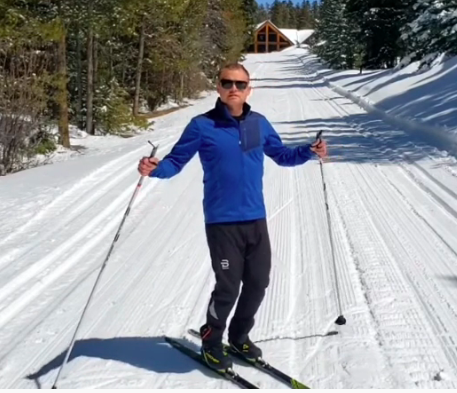
Make More Tracks: Beginning Cross-Country
Looking For Alternatives? Here’s A Starter Kit For XC.
SeniorsSkiing.com has published several articles on getting started in cross-country skiing. Here’s another view from Breckenridge Nordic Center. We watched all nine minutes and picked up lots of new tips, despite our many years of xc skiing. Get going!

Instructional Advice: Don’t Do Turns
Words Matter. Why “Arcs” Works Better Than “Turns”.
Arc thinking makes a difference. Perhaps.
Recently I wrote a small piece on how to handle tough skiing situations and used the word “arcs” where most folk would use the word “turn”. My insistence on using the word “arc’”raised an eyebrow or two on the grounds that it was perhaps mere semantics or even nit-picking. Believe me, it isn’t.
Every single ski instructor I have ever met only uses the word “turn(s)”. You are admonished to “do turns”. Even worse, you are recommended by some to “turn your skis”. It tells you nothing at all about what movements you need to make with your legs/feet/body while in motion.
What on earth is it supposed to mean? Is that how skis work, by “turning” them? Is that a route to understanding, and to excellent skiing? No. Most of the movements you make should be in response to the skis, very little to do with making them do things.
What Is Really Happening When A Ski Changes Direction ?
The objection I have to using the lazy word “turn” is that it does not describe what happens. It tells you nothing about how a ski changes direction and carries you with it. It suggests that you do the “turn”. You can “turn” a lot of things—a quick buck; you can turn to the person on your left; you can turn a screwdriver; you can turn a triumph into a disaster. There is no end to the things you can turn.

An arc is a segment of a circle.
But let’s talk about skiing. When you or an instructor refer to a “turn” in skiing, that is becomes something you think you do. But it is not what happens.
A change of direction may occur, (it may not) but that is an outcome of things you do, and of things that happen at the interface of the snow and the ski; it is not what you do. If you haven’t already, then buy my top selling, incredibly inexpensive and value-for-money book “Ski In Control”.
If you think you do turns, you are highly likely to also think that in order to do it, you will need to “turn your skis” (or worse, your body!) Let’s substitute the word “pivot” for “turn” in this instance; it’s more descriptive. There are times when pivoting your skis may be appropriate to achieving some outcome you desire. Somewhat regrettably it may, though not necessarily, induce a change of direction.
I say regrettably because if and when that happens it is likely to reinforce the idea in your head that you did it. You didn’t. Only very indirectly did the rotation of your ski (your foot) induce a deflection of your ski. An outside force deflected your skis, and because you are attached, you went with them. In a sense, they “turned” you, not the other way about.
Sometimes I allude to Tiger Woods and his golf. If you think you have seen Woods “do” a 300 yard drive, you are mistaken. What you have seen is Woods doing a complex of minute behaviors (many too difficult to observe) the outcome of which is a 300 yard drive.
Does My Insistence Matter?
Yes, it does, because as long as you retain the word “turn” and as long as that affects your understanding, then it will in equal part inhibit your learning and hence your skiing skill development. My dislike of the word “turn” (in a skiing context) is not pedantry, nor semantic nit-picking—it has had singular importance in helping them my pupils to become significantly better skiers.
What Happens Between Skiing “Turns”?
Another issue of faulty perceptions about ski “turns” is the issue of what happens in between them. Probably when you were in the early stages of ski school, you will have been told that there is this type of turn (say a “snowplow”); later, if you are old enough, you may have been admonished to do a “stem turn”; and then if you are good student on the fourth day of your week you might be allowed to try a “parallel” “turn”.
All of this is rubbish. It’ll get you down the hill maybe, but not much more. I accept that there has been a small (far too small) change in some ski schools, but nothing like enough, and I am personally more concerned about folk who learned their skiing quite a long while back. Once learned, poor habits are extremely hard to change/eliminate. I’m advocating good habits and understanding from the start.
A problem that the out-dated, and regrettably still extant, process creates is the idea that you “do a turn”, then a little later on as you ski, you “do another turn”. This process is repeated.
What is not clarified is what happens between “turn” one, and “turn” two. Presumably something, but what? Unfortunately it is commonly a straight line. This is a pity in many circumstances because skis pick up speed when they are describing a straight line if they’re pointing to any extent downhill; and you may not particularly want that. Fine, if you do.
Let’s say that a time of just two seconds passes between “turns” one and two. (Try counting them now, in your head – “ thousand one, thousand two …” ). If you are skiing at 15 mph, hardly excessive—about the speed you’d ride your bike—then in that two seconds you will traverse 44 feet, just under 15 yards. Fifteen yards of potential added speed. Fifteen yards perhaps past the spot you intended to change direction. Downhill racers love it; they attempt to draw the straightest line down the mountain that they can.
A Conclusion: Linked Arcs
Finally this leads us to a conclusion: Since outside forces induce skis to deflect, and perhaps describe arcs, and you don’t “do turns” and arcs are segments (would have been better to say “sections”) of circles or parabolas, then the objective for your skiing skill development is to make movements while in motion (our equivalent of Tiger Woods’ minute behaviors) that lead to continuously linked (and rounded) arcs. Not “turns”.
Leave a comment below or email me (bobski@bobski.com) if you want to continue this investigation.
[Editor Note: Ski Coach Bob Trueman has a series of 19 YouTube videos on different aspects of skiing in control. Enter “BobSki” into the YouTube search.]
[authors_page role=contributor]