


Growing Up Norwegian-American on Skis
A classic ski poster shows a blonde baby in a quaint wooden cradle, one outstretched hand holding ski poles, with a pair of skis protruding from the other side. The caption is “Norway. The Cradle of Ski-ing.” This poster reminds me of my roots.
Jan Brunvand, age 3
I was on skis from before I can remember. An undated snapshot in the family album proves this. I appear to be about three years old.
I suspect that my parents posed me on adult skis, as those boards are super long, even for the late ‘30s. ( I was born in 1933.) My mother surely knit that hat, while those fancy mittens were from Norway. I’m holding one long ski pole, but I don’t seem to be going anywhere.
In a second childhood photo I’m posing with my brother Tor in what could be about my seventh year. Tor was born in 1935, and we had matching ski jackets. The snow sticking to my pants hints that I must have fallen on the run before the shutter clicked.

Jan and brother, Tor
My parents came from Kristiansand, Norway. They were married in 1929 in Windsor, Canada, then moved to Northern Michigan. I was born in Cadillac. By the time Tor arrived we had moved to Lansing.
I have one slightly damaged photo of my dad on a ski trip in the old country, captioned “Easter 1925.” He’s on the right with his hand on the railing. Check out those vintage skis!

Jan’s father
As Tor and I grew up Dad would take us to parks or golf courses to climb up and slide down on skis. Before we gained some proficiency with “snow plow” and “stem” turns he would hold his poles out horizontally for us to cling to for balance as we schussed the gentle slopes.
We climbed either by traversing and kick-turning, or using the herringbone method. When our skis got sticky, we rubbed on a mix of graphite and paraffin.
In 1948 realtor Rollie Stebbins convened a group of skiers to form the Lansing Ski Club with my dad as a charter member. A portable rope tow in Stebbins’ backyard was my first experience with motorized uphill ski travel. After the club bought rural property and installed a real rope tow we enjoyed many days there working on our turns. We also made occasional trips north to ski Caberfae near Cadillac.
In photos of me in those days I am usually wearing a dark blue or red V-neck ski-jumper’s sweater sent to me by my maternal grandfather in Norway.
My Dad carved a graceful Telemark turn, and Tor soon got the hang of it. I never mastered Telemarking, but instead worked on my stem-Christies and eventually achieved a more-or-less full Christiania turn. It was gratifying to learn that both these turns were named from places in Norway. Never mind that the Christie was part of the Austrian-inspired Arlberg system.
Starting college at in 1951 I joined the Michigan State Ski Club and entered a new world of skiing with friends who had actually taken lessons and learned from pros. This led to further trips to Caberfae, and eventually to skiing in the Rockies..
At college I met my non-Norwegian non-skiing future wife and converted her to the sport after a disastrous first experience.
To be continued . . .

Finally! A Ski Boot For Older Feet
I recently had an online boot-fitting session with Dahu, the remarkable Swiss ski boot that advertises with SeniorsSkiing.com.
Before sending a pair of loaners, the company asked for my street shoe size. I could have used their App to determine foot volume but didn’t go through that short step. As it turned out, the boots they sent were the correct size.
Why is this Swiss-designed ski boot remarkable? This is not the same-old prettified with a new buckle or a different color. Dahu was conceived and developed to be fitted more easily, minimize ski boot discomfort, and maximize skier performance.
Although I have not yet skied Dahu, I am convinced it is the ideal boot for older skiers.
Here’s why: The boot has a comfortable, insulated leather inner boot with a patented grooved rubber sole that interfaces strategically with grooves in the shell. This interlocking interface enhances the boot’s torsional stiffness, thus maximizing energy transfer from skier to ski.
Worn separately from the shell, the inner boot delivers traction in all conditions. Good looking, too.
Dahu’s shell is made of Grilamid polyamide composite, a Swiss product combining lightness and durability and consistent flex at all temperatures.
The shell features a hinged tongue with two micro-adjustable buckles and a hinged, releasable rear, incorporating the patented aluminum Powerbeam spine. Similar to the inner boot that interfaces with the shell, the Powerbeam helps transfer body energy to the ski. It also contributes to each skier’s ideal stance.
Like another Swiss product – Swiss cheese – the shell is filled with holes. This feature eliminates the vexing hotspots on most skiers’ feet. Those of you who’ve engaged skilled boot fitters to reshape conventional boots using hair dryers and other tools will know what I’m talking about. By analyzing the common hot spots on most skiers’ feet and removing those sections of shell, Dahu has overcome that issue – extremely important for skiers whose feet have changed with age.
I haven’t skied them yet, but my 40-minute Zoom fitting session assured me it will be a good on-hill experience.
Words don’t do this boot justice. I strongly recommend visiting Dahu’s website to get a more visual picture of the way this unique product works.
One additional thing: Dahu named its shell, Corsair, after the aircraft carrier fighter planes. I’m sure it’s a lot easier to slip foot into liner and liner into shell than it is to land on an aircrat carrier.
Students of Naval history will recall that corsairs also were pirate ships operating hundreds of years ago. Based on ease of fit, comfort and performance, I think Dahu’s Corsair shell and that super comfortable liner will be plundering attention and sales from the rest of the industry.

This Week In SeniorsSkiing.com (Jan. 8)
Happy New Year, It’s January. The Year Has Flipped.

There’s a groomed trail, but lots of folks just went their own way across the pasture at Appleton Farms. Credit: A. Maginn
We launch into 2021 with the notion that positive change is just over the horizon, on the other side of the hill, beyond that copse of trees, around the next turn, and down the road. The vaccine is coming, and, eventually, we will get out from the shadow of this miserable virus. That’s the good news.
The other side of the coin is that there is no timetable for lifting the restrictions and precautions put in place. Chances are, the entire North American ski season will be under COVID rules, perhaps loosening up in late spring when and if the cases go down. Who knows? We don’t even have a schedule for when shots are coming our way. It’s early days, and we are hung up between the optimism of the vaccine and the uncertainty of how implementation will work.
Because of the uncertainty and changes in ski area operations due to virus restrictions, many readers have said they are putting their Alpine ambitions away for a while, taking up skinny skis and making the most of winter that way.
In any case, if you are an outdoor winter lover of snow and cold, you’ve probably already thought of making some snow shoe or cross-country tracks whenever the snow flies. We’ve been promoting the benefits of these other ways of enjoying the snow in our season long series Make More Tracks, highlighting cross-country and snow shoe stories from our correspondents.
Just the other day after a 15 inch snow fall–the first major one of the year—, a contractor came over to look at a leak in our roof. Wrapping up his visit, he looked across the road to Appleton Farms where he could see people XC skiing through the trees. Lots of people. “That looks like fun,” he said. “Easy to do and inexpensive to get into,” says I. “And it’s good for you. Aerobic, full body workout. Kids can do it. Try it.” “Maybe I will,” he said getting into his truck.
Never tried it, probably will. That’s the theme this year when it comes to snow sports. Yes, there are those devotees who will ski at their local resort, others who will venture to destination resorts, some will head to back country (be careful) and a whole bunch of people who will be trying cross-country, snow shoeing and fat biking for the first time. In fact, last week’s big snowfall here in the Boston area brought the biggest crowd we’ve even seen skiing in Appleton Farms, the 900-acre Trustees of Reservations land we are lucky to live across the road from. Cars were overflowing the regular parking lots and parked on side roads. Our local volunteer non-profit North Shore Nordic Association prepared the trails the night before, grooming with their snowmobile, creating a corduroy skating tracks as well as tracks for classic striders. It was encouraging to see so many people coming out.
Have you Made More Tracks this season? Tell us.
This Week
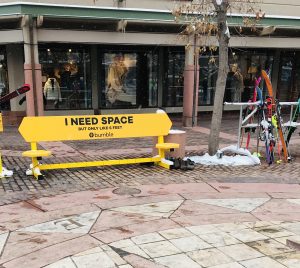
Reminders are everywhere. Credit: Evelyn Kanter
Correspondent Evelyn Kanter made a pre-holiday visit to Aspen and she reports on how a big destination resort is implementing its COVID plans. Check out her “report card” here.
One of our frequent correspondents Marc Liebman has been contemplating how he will get to those big destination resorts in lieu of flying. He can’t wait to get back to skiing after a long convalescence, and he has his doubts about getting on an airplane. Here’s his story.
Back country skiing is one of the alternatives to resort based skiing that is seeing a huge surge of interest. Correspondent Tamsin Venn overviews some resources for educating yourself about keeping out of trouble in remote areas. This is an important article to read if you have any interest in going “under the ropes” or farther afield. Read this important article here.
We have a poem for January that fits the mood. Here’s Wallace Steven’s The Snow Man. Let us know what you think.

Ski the TOA. Race? Fun? Both? Up to you. Credit: Anchorage Daily News
Correspondent Don Burch has been producing some great videos this season. Here’s one that proves a you-are-there experience of skiing the classic New England trails at Killington, Okemo, Mt. Snow. Western skiers, this is Eastern Skiing at it’s best. Thanks Don.
Our Question For You this week pings off Evelyn Kantor’s report card on how well COVID precautions are being implement in a big destination resort. How say you? Are resorts delivering on the plans they made to keep visitors and staff safe? Tell us your experience.
The next article in our Make More Tracks series tells correspondent Jonathan Wiesel’s story of his Tour of Anchorage XC race. Ill-prepared, slightly out of shape, jet-lagged, he signed up for the 50km because it seemed like a good idea at the time. Find out what happened when his favorite candy bar saved the day.
Thanks for reading SeniorsSkiing.com. Tell your friends and remember, there are more of us every day, and we aren’t going away.
[authors_page role=contributor]