

Short Swings!
My deadline for wishing people Happy New Year is getting shorter.
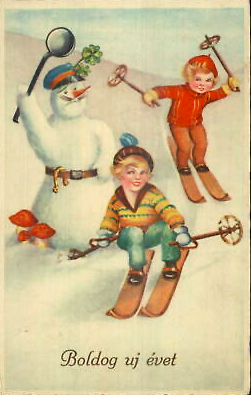
Boldog új évet is Happy New Year in Hungarian. Numerous postcard artists in the 1920s/30s incorporated kids on skis.
Centuries ago, when I worked in an office (remember when people worked in offices?), it seemed like New Year’s greetings extended through at least the first week of the year. You’d bump into a colleague and offer the obligatory phrase. Once, many weeks after the New Year, I said “Happy New Year” to a co-worker. That prompted a discussion about time-limited greetings. We decided that, unlike birthdays, anniversaries, weddings and deaths, New Year’s greetings should be limited to a few days. That said, and the fact that this is reaching you about a week after this year’s not-so-sparkling event, let me bend that rule and wish you Many Happy and Healthy Turns in 2021!
“When” by John O’Donnell

Award-winning Irish poet John O’Donnell lives in Dublin. His work is widely published. His poem, When, was published last week in The Irish Times. It’s a good read for this New Year.
And when this ends we will emerge, shyly
and then all at once, dazed, longhaired as we embrace
loved ones the shadow spared, and weep for those
it gathered in its shroud. A kind of rapture, this longed-for
laying on of hands, high cries as we nuzzle, leaning in
to kiss, and whisper that now things will be different,
although a time will come when we’ll forget
the curve’s approaching wave, the hiss and sigh
of ventilators, the crowded, makeshift morgues;
a time when we may even miss the old-world
arm’s-length courtesy, small kindnesses left on doorsteps,
the drifting, idle days, and nights when we flung open
all the windows to arias in the darkness, our voices
reaching out, holding each other till this passes.
Six Word Challenge Winners

Over the past month several readers submitted six words summarizing the current situation in their ski lives. Two winners were selected. Their entries are below. They’ll each receive The Bootster ski boot shoe horn.
Boots in car. Pee In Woods
Norm Reynolds, Golden, Colorado
Mask, balaclava, gaiter, helmet, goggles. Breathe?
Susan Zangrilli, Sandy, Utah
Thanks to all who sent in their creations!
Western Snow Magnets

Alyeska Resort (AK): 336”. Stevens Pass (WA): 221”. Jackson Hole (WY): 212”. Whistler Blackcomb (BC): 201″.
Austria Closes Schools and Stores; Not Ski Areas
Covid closures have affected virtually every aspect of public life for Austrians, except ski areas, which continue to function. News reports describe intense crowding in lift lines and elsewhere. Last season, Ischgl, near St. Anton, which attracts big numbers for it’s apres ski scene, was linked to the spread of the virus throughout Europe. Ski area operators lobbied hard for their facilities to remain open during lockdown. Swiss areas also remain open. However both countries have imposed quarantines for those crossing their borders, effectively making the hills off-limits to those living elsewhere.
Superyacht Heli-Skiing

La Datcha, the first ice-breaker superyacht, is available for heli-skiing adventures this season in Russia’s remote Kuril Islands and Kamchatka Peninsula. The cruise will focus on first descents. The 252’ superyacht carries a staff of 25, two helicopters in a below deck hangar, and a 3-person submersible. Cost for 7-days start about $1,225,000 for up to 12 guests and include heli-skiing, guides, equipment, meals, beer/wine, and use of the submersible. Website: https://www.eaheliskiing.com.
First Wood RFID Pass

Source: Skidata
SKIDATA, which produces tech associated with paperless lift tickets, has a new pass made of wood. It’s being used by Austria’s Kitzbühel Bergbahn.
14 Year Old Skiing Wunderkind
At 14, Jackson Hole‘s Kai Jones may be the youngest ski pro. When he was 11, his amazingly graceful form and derring-do helped him win the International Freeskiers Association’s North American championship for skiers younger than 12. The New York Times recently featured his skiing career: click here to read. Click on the video to see Kai in action. Wowee!!!!

Skiing Weatherman: Ch-Ch-Ch-Changes
For the title of this piece I chose a line from David Bowie’s classic song. The jet stream pattern that ultimately determines the snowfall haves and the have-nots is undergoing change and, ultimately, it will be dramatic.
As a lifelong skier and weather nerd, my step gets a little lighter and I tend to have a song in my mind when the weather pattern is soon to become more favorable for cold and snow. I’m an Easterner and guilty of a provincial bias. So far, the East is at the short end of the weather stick. Other regions (i.e. Southwest, Wasatch, and Tahoe) also are struggling to attract snow. But much of the East remains significantly below typical trail counts for early January, largely due to the massive Christmas rainstorm.
In my last report, filed a week before Christmas, it looked like the holiday storm could be a major snow producer. Alas, there wasn’t enough cold air available to make that happen, and that has been the case much of the time since. Pacific air has been flowing across the country, leading to heavy snow in the Pacific Northwest, with lighter, but still significant amounts across the northern Rockies. Further downstream, plenty of disturbances have tracked through the Midwest and East, but without cold air from Canada, those disturbances have produced mixed precip events.
So, what is going to change? It’s the jet stream, the hand that moves the pieces on the weather chess board. Here is picture of the current set up…
The red blob over northeastern Canada is a blocking ridge slowly migrating west. It will end up over far northwestern Canada by mid-month, where it will tap a growing supply of cold air. The blue area over the Southeast is a trough that is delivering a late week snowfall to the southern Appalachians. That storm is suppressed by the ridge to the north and until it the ridge moves northwestward, it will be tough for any storm to turn the corner into the Northeast. But I do think that will happen within the next week, and likely several times in the following weeks. Also of note, if you look over the eastern Pacific and follow the lines from west to east, you can see that the prime source of air masses is the Pacific, not the Arctic.
Now take a look at a jet stream forecast for the 18th, one that I agree with.

The changes are substantial. The ridge is stretched out across the far northern latitudes, with an extension over the northeast Pacific. The clockwise circulation around the ridge will help access cold in the Yukon. A deep trough over eastern North America is poised to receive the cold and spawn surface storms.
Better times are ahead for skiers and boarders east of the Mississippi. At the same time, rather quiet weather will develop out West. This pattern, once established, will persist into February.
Regional details…
Northwest U.S./Western Canada: Occasional Pacific systems will bring snow next week…slowing down after, as western ridge builds.
Sierra: Storm track to the north for the foreseeable future.
Rockies: Moderate snow events across the north in the next week…weaker systems fight through the ridge after that. Central and southern Rockies pick up occasional light snowfalls.
Midwest: Cold starts pushing late next week, Alberta Clippers and lake effect snows will become frequent events for the second half of the month…and beyond.
Mid Atlantic/Southeast: Fresh snow in NC mountains late this week. Entire region in line for mountain snows and great snowmaking as the cold air deepens after mid-month.
Northeast/QB: Cold, but with suppressed storm track through next week. Extended cold, snowy pattern develops thereafter.

The How-Do-I-Get-There Conundrum
What If Driving Is An Undesirable Or A Non-Option?
Some planes are full; others are half empty. Credit: Picture Alliance
The world’s COVID hangover is going to continue well into 2021 so obviously ongoing precautions are needed to keep from contracting the disease. For those who live within three to four hours by car of a ski area, you’ve got options. Your car becomes your transportation bubble and then while skiing, just stay away from people and wear a mask under your scarf.
However, for those of us who live a long way from a ski area, getting to a ski area is, at best, a one day trek each way. So three days of skiing turn into five, five days of skiing, needs seven, etc.
Ski Apache is the closest to my place in Texas, 560 miles straight west and an eight or nine-hour drive.
Taos is 650 miles from my front door. Plan on 10 hours. I’ve made the drive in eight, but….
Ski Durango, a.k.a. Purgatory and one of my all-time favorite places to ski, is 860 miles away. Plan on 13 hours in a car unless you want a ticket or two.
Conditions are already very good in the Rockies and Sierra Nevada. I can feel the slopes beckoning. So, how do you get to a ski area if you don’t like driving long distance?
If you own a plane or can afford to charter one you can fly in your own bubble. For the rest of us, unless you can take a train or bus, the only other practical way is sitting in an airline seat with 150 or more of ‘your closest friends.’ The airlines have done a yeoman’s job of sanitizing the planes, updating the cabin filtration systems as well as trying to convince the traveling public that sitting in one of their aluminum tubes won’t lead to becoming infected. I’m not convinced.
The risk doesn’t come from just the plane ride. There are the people in the terminals and who knows if they’ve been exposed. Throughout the trip, you touch all kinds of things so latex gloves become the order to the day. Net net, the CDC says the risk of catching COVID is increased if you travel by plane.
When you actually receive the COVID vaccine should be factored into the decision to go skiing. For example, I’m in category 1B (over 75, compromised immune system) which means early this year, I should have the first dose injected. Second dose comes, depending on which flavor you receive, about a month later. Full efficacy of the vaccine occurs about a month after the second injection.
The vaccine gives me choices. There are non-stop flights from DFW Airport to airports a short drive from almost any ski area in the country. In a COIVD-vaccinated world, flying on airlines again becomes the best option for those of us who don’t live near a ski area.
So here’s the timeline that’s rattling around in my head. Mid-January, first dose. Mid-February, second does. Mid-March, full efficacy. That’s when I am going skiing!
[authors_page role=contributor]