

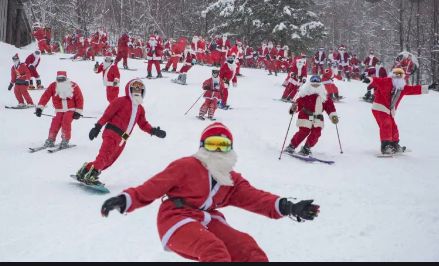
Question For You: What’s Santa Bringing?
What Snow Sports Stuff Do You Have On Your List?

He’s coming to town. What’s in his bag for you?
It’s not too late to write to Santa to request that single, elusive item you crave for your ski kit. What would make a nice present for you? A new knit hat? Expensively warm gloves? New boots?
Our own research into reader wants reveals that underwear and layers are at the top of the list. Gloves and goggles aren’t far behind. As are skis and boots.
Perhaps this year you want a cool handheld satellite phone or a rescue beacon. Or cell phone holders, buffalo fur socks, battery-powered foot warmers, a hot, new Go Pro, multi-tools for outback survivalists, boot dryers, beef jerky, the list goes on.
If you’ve been a good senior skier all year, Santa might bring you what you wish for. Tell us: What’s on your list?
Click here for gift ideas from REI.
Click here for gift ideas from Gear Patrol

Carve Turns On Opening Day
Master Making Those Modern Arcs.
Ski instructor Paul Lorenz has a great instructional series on You Tube showing how to carve on skis. To properly execute this type of turn, it is important to consider the basics of balance.
Those of us who have skied for a while know that it is most important to stand on the new downhill ski during a turn and make sure that most of your weight powers that ski through the radius of the turn. For some of us coming from a traditional background with longer skis, that also meant lifting the inside ski a little to aid in the execution of the turn and to make sure that most of the weight was on that downhill ski.
With the advent of the modern ski with shorter lengths and more dramatic side cut, the up-unweighting that we all utilized is not that necessary any more. Sure there are times when you need to up- unweight ( powder, crud, etc). But for the most part, the modern turn is executed by moving the center of mass across the skis and towards the next turn. Think of it as moving your belly button towards the next turn. This way, the turn is more lateral than vertical.
Look at the video and you will see a balanced, wider track stance, with lateral movement and flexion to execute the modern turn on groomed conditions. If you watch the World Cup on the Olympic Channel or NBC Peacock, watch the racers and their stance. GS turns today are very much like Paul’s. Lateral movement with very little vertical movement. Downhill and Super G are similar with the exception being slalom, where sometimes vertical movement is crucial to get the skis in position for a tight turn.
At the beginning of each season, I try to make my first turns rounded and executed with both feet on the ground throughout the turn. I make a conscious effort to be flexed, in a lower position (I cut my pole length this season to accommodate), and move across the skis instead of utilizing vertical movement. We are not skiing on longer skis anymore and to really appreciate the value of the modern ski, we need to study and practice the modern turn. Try it on your first outing. Nice rounded turns.

Make More Tracks: Milestones In XC Skiing
From Wooden Skis, Wax, And Pine Tar Bases To High Tech Equipment in 50 years.
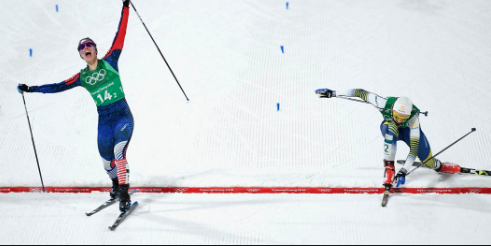
Jessica Diggins with Kikkan Randall win first Gold Medal for US XC in 2018, making Americans serious competitors on the international racing scene.
Since the time that wooden skis were found in a peat bog in Sweden dating to 2,000 BC, there have been many milestones that brought XC skiing to where it is today. In the USA, the forefathers of cross-country skiing include people like Snowshoe Thompson, who delivered the mail in the Sierra Mountains of California and Jack Rabbit Johannsen, who XC skied in northern New York.

Before around 1970 or so, XC skis were wooden, required the right wax combination to work on the snow, and bases had to be prepared with pine tar “melted” in. Since then, the XC world has experienced enormous growth and change. The editors of XCSkiResorts.com, using various sources, considered this recent history and development of the sport and created this list of the Milestones of Modern XC Skiing in the USA in rank order of significance:

Waxless skis with fish
scale bottoms made skiing simpler. (Credit: Tahoe Trail Guide)
1. Development of synthetic XC skis in 1974.
2. Development of the waxless based ski in the early 1970’s, most notably the Trak ski with synthetic fish scales on the ski base to eliminate the need for ski waxes. The waxless base gave the recreational skier grip on uphill travel while also allowing gliding downhill.
3. Integrated XC ski binding systems, which provided substantial improvements in simplicity of boot/binding interface and control in the mid 70’s.

Bill Koch started skating on XC skis in the Olympics and changed the sport. Credit: ISHA
4. Olympic and World Cup successes, like Bill Koch who won the Olympic silver medal in 1976 and World Cup in 1982, the first American to ever win at that level. The Nordic Trak exerciser used the Koch image as a fitness icon in advertisements for years. In 2010, there was US Olympic medalists in Nordic Combined, and in 2012 there was a World Cup winner in women’s sprint.
5. The onset of the commercial XC ski area concept began in 1968-69 at Trapp Family Lodge. This brought designed, groomed, and maintained trails making XC skiing easier and safer for the average person.
6. The skating technique proliferated, creating a faster paced and higher performance form of recreation.
7. Revolution Skis developed by Fischer led the way to shorter skis which were easier to use and consolidated ski sizing and simplified ski selection.

Vintage Mother Karen XC jacket made of synthetics came out in the 80s.
8. New lighter clothing with synthetic and breathable materials was more conducive to XC skiing comfortably; company brands such as Mother Karen led the way in the late 1970’s.
9. Other technological advances such as the 2 Wax System that offered one wax for cold temperatures and one for warm temperatures simplified ski waxing, while the BackCountry binding systems provided a beefed up boot/binding system that provided substantially more support and control for backcountry recreation.
10. The Nordic Integrated System (NIS) developed in 2005 has changed the ski/binding interface. This system combines the ski and binding at manufacture rather than at the retail store. NIS plates were affixed to the ski by the manufacturer and the binding was slid onto the plate rather than screwed directly into the ski.
The changes in XC skiing in the last 50 years has been explosive and exponential, compared to the 4000 prior years. What’s next? Better binding-ski-boot systems, warmer-adaptable clothing, improved grooming, and more resorts catering to the sport.
[authors_page role=contributor]