

My 80 Plus Patch and Its Potential
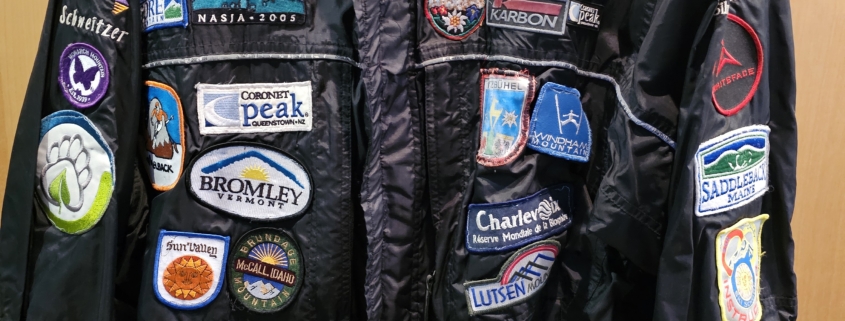
Two years ago, when I signed up as a member of the 70 plus ski club, I received my 80 plus patches. I had collected patches from ski areas for years and have a coat that adorns all or most of my patches. I have tried to buy one at every new ski area I visit.
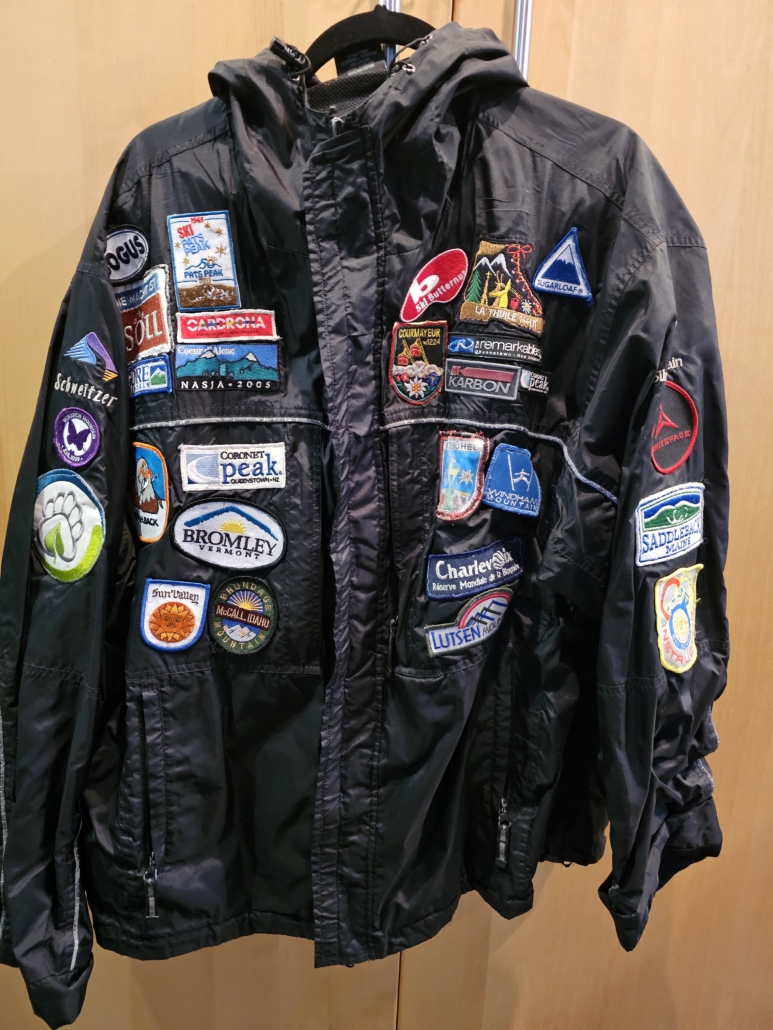
So, I placed this patch on my current ski coat with a big Velcro backing so I can switch the patch to the ski coat I am going to wear that day. Ever since I put that patch on my shoulder, I would get comments, “Great to see you can still be out here”, “Really! Your 80?”, “Keep on going!” and always resulting in a great conversation on a lift or in the lodge.
I am so thankful that my body still allows me to participate in numerous sports, racquetball, pickleball, kayaking, riding my bike, motorcycling and golf (my least favorite but there to fill up the down time between ski seasons).
Now as you know, I am always concerned about our skiing safety, so I am working on an idea (more on that below). I first saw a poster for the Snow Angels foundation at Palisades Ski Area a few years back. Snow Angels has devoted its efforts to educating skiers about the after effect of skiing too fast, being out of control, and not being courteous. When I saw that first poster it had a big impact on me and continues to this day. Co-founders Chauncy and Kelli Johnson have snowboarded and skied most of their lives. They brought this passion into their marriage and subsequently with their children. On Christmas Eve, 2010 a snowboarder riding at approximately 50 mph collided with Kelli and daughter Elise (5 years old). The collision resulted in the death of Elise and the snowboarder. Kelli sustained life altering injuries including a severe Traumatic Brain Injury and other injuries that she lives with to this day.
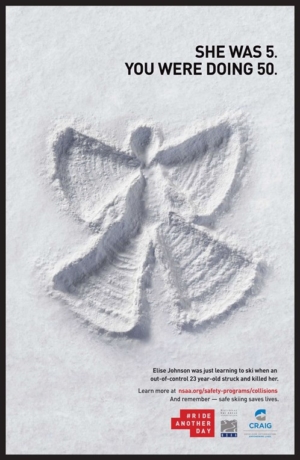 This now relates to the patch. I have spoken with the organization’s staff and discussed having a Snow Angels patch which I could wear. Snow Angels will be making a patch to wear, and I think everyone should wear on their shoulder. I hope the patch resembles their poster with the snow angel. I am not sure yet as to how they will be distributed, but I imagine they will be available shortly and maybe for a small donation to the not-for-profit to help promote skiing safety.
This along with my ski guardian flag warning systems, which appear to have worked well last year while getting some great response on the slopes. I think fewer people have passed close by me. It certainly seems to me there have been fewer close calls than before using them. Ski Guardian has teamed up with Snow Angels and have a flag that will go on their poles extensions which will also help the cause.
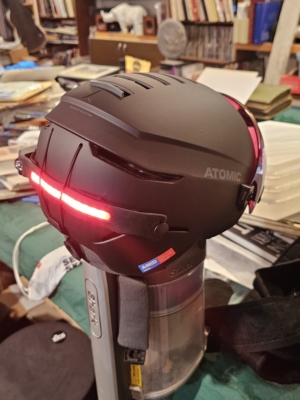
Now about that idea. Going along with my safety schtick, I am working on a red-light system to go onto the back of my helmet. This might be over the top but as in my earlier drawings for skier safety I included lights on my jacket. Let’s see how this works this year!!!
Hope everyone has a safe and fun ski season this year.
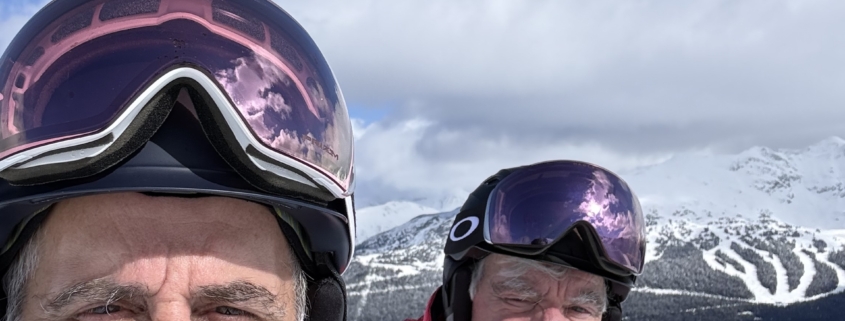
Musings from Whistler
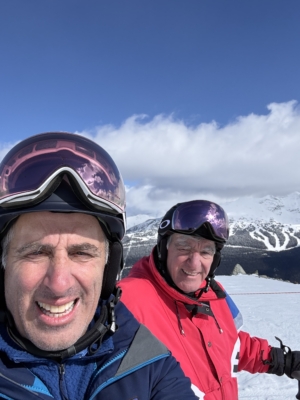
Scott and Marc at the top of the T-Bar on Whistler. Seventh Heaven in the background.
Whistler is really a combination of two large areas – Blackcomb, Whistler, and a small village called Creekside. Each has a gondola that will take skiers up the mountain. Getting off any of the gondolas, it is an easy ski down to
Blackcomb has a vertical drop of 5,280 feet, and Whistler Mountain has only 5,020! In practical terms, if, at so2me time in the day, you are at the top of the Blackcomb Gondola at 5,784 feet and decide to ski to the bottom, be aware that Whistler Village is only 3,660 vertical feet away!!!
Blackcomb Peak tops out at 8,000 feet, but as a practical matter, unless the Showcase T-Bar is open, the top of Blackcomb’s skiable terrain is 7,449 feet. Over on the Whistler side, the quad Peak Express will take you to the top of Whistler Mountain, 7,160 feet above sea level and the intermediate Peak to Creek will take you down to the Creekside Gondola, 5,020 vertical feet below.
Skiing the mountains. Whenever my brother and I ski at Whistler, we joke about the trail markings. At most ski areas in the world, what Whistler marks as an intermediate would have diamond or double diamond ratings.
For example, the intermediate runs Ridge Runner and Rock ‘n Roll off the quad Chrystal Ridge Express are narrow for a Western area. They are full of twists and turns, changes in camber, and steep pitches that lead you to a waterfall!
The good news is that most, but not all, of the beginner and intermediate runs are well-groomed. The expert runs like the Dave Murray Downhill may be groomed, but you can expect lots of moguls on those that are not.
How and where to ski the two mountains is an article unto itself. Suffice it to say, Whistler has enough terrain and long, thigh burning trails to keep skiers of all levels entertained for months. And, BTW, all the chairs except the triple Magic Chair have footrests.
Paper trail maps are available. At Whistler, they are appropriately called Mountain Atlas!
Food and bathrooms. There are restaurants and bathrooms all over the mountain. Glacier Creek has the most variety of food, but the food court is upstairs. The bathrooms are on the floor you enter.
Rendezvous and Roundhouse are often crowded from 11:30ish to 1 p.m. Bathrooms on the entry floor. One of my favorites is Chic Pea, which makes cinnamon buns to die for and has no stairs to climb.
The huts – Raven’s Nest, Crystal, and Horstman – all have limited menus, but again, no stairs. For those of you who like to be served lunch on the mountain, there’s Steeps and Cristine’s.
Food prices are comparable to most U.S. resorts, and show your Epic Pass and you get a 20% discount. The Canadian dollar was worth about US$.73, which makes it even cheaper.
Bottom line is that the best recommendation for a destination resort is how often a skier returns. I ski at Whistler every year. ‘Nuff said.
How Wheaties Affected The 1936 Olympics
Publishers Note: It is with great sadness that we learned of the recent passing of one of our most popular contributors, Harriet Wallis. This is one of her many articles we are republishing this season.
The Breakfast of Champions Kept Champion Ski Jumper Alf Engen From Competing.

Wheaties Ad 1936, Courtesy of Alan Engen
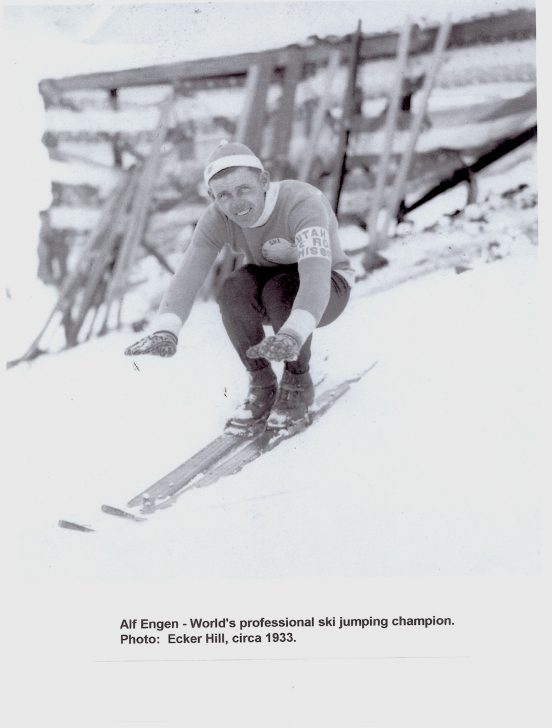
Legendary extreme athlete Alf Engen, known as the greatest all-around skier ever, was a champion soccer player, skier and ski jumper. During the 1930s, he set ski jumping world records. He helped design and establish more than 30 ski areas in the western United States. And he’s fondly remembered for pioneering deep powder skiing techniques and for his ski school at Alta.
But world champion Alf Engen was banned from competing in the 1936 Olympics because of a Wheaties breakfast cereal box.
It was just the fourth time that countries faced off against each other in wintertime Olympics. Competition included just four sports: bobsleigh, ice hockey, skating, and skiing. Twenty eight countries sent their best athletes to the IV Olympic Winter Games.
As background, Engen came from Norway to the United States in the 1920s, and he played professional soccer. By the 1930s, he was acclaimed for his ski jumping feats, he joined a ski jumping team, and he soon won 16 national ski jumping titles. And his jumps set world records. He also won national titles in all four ski disciplines: ski jumping, cross country, downhill, and slalom skiing.

Alf circa 1933, Courtesy of Alan Engen
Also in the 1930s, radio was the mass media communication method of the era. There was no television. People used their imaginations to create pictures from the words they heard.
But another form of mass media was taking hold: cereal boxes. Until then, breakfast cereal had to be cooked, but when food manufacturers invented cereal that could be eaten right from the box, they faced a marketing dilemma. How could they convince families to switch from cooked cereal to this newfangled ready-to-eat cereal? A cereal box sitting on the breakfast table with pictures of all-star athletes would be the marketing device. And unlike radio, the images were right there on the box.
Four athletes appeared on the Wheaties box—Bob Kessler, basketball star; Mike Karakas, champion hockey player with the Chicago Blackhawks; women’s speed skating champion Kit Klein; and famed skier Alf Engen.
Meanwhile, Engen became an American citizen. In 1935, at the U. S. Olympic Ski Jumping Finals held at classic Ecker Hill, he out-jumped everyone. He was immediately named as a member of the U.S. Winter Olympic Ski Jumping Team which would compete in the 1936 Winter Games in Garmisch-Partenkirchen, Germany.
But just before he was scheduled to leave, Avery Brundage, president of the International Olympic Committee and a zealous supporter of amateurism, ousted Engen from the team because his picture had appeared on the Wheaties box. He declared that Engen’s image on the cereal box made him a professional, not an amateur athlete.
“Engen said he didn’t remember getting any money from the cereal company, ‘Just a lot of Wheaties. I think I gave everyone in Salt Lake City free Wheaties.'”

Alf with trophies, courtesy of Alan Engen
Ironically, shortly after the Olympics, Engen jumped against—and he beat—both the gold and silver medalists from the Olympic Games, Norwegian gold medalist Birger Ruud and Swedish silver medalist Sven Eriksson.
The remarkable skiing Engen family is the only family to have four family member in the U.S. Ski and Snowboard Hall of Fame: Alf, his two brothers Sverre and Corey, and his son Alan.
Alan lives on in his father’s tradition. He’s a champion skier and athlete as well as an accomplished scholar, author, and historian. He carries on the Engen tradition of serving the skiing community.
Alan dreamed of displaying hundreds of Alf’s ski trophies and memorabilia for the public. The dream grew into the $10.5 million Alf Engen Ski Museum at the Olympic Park in Park City, Utah. Visitors can also learn about avalanches, sit in a real bobsled, try their knack at interactive ski jumping, and more. The museum was funded entirely by private donations, including donations from Utah’s famed and philanthropic Quinney and Eccles families. Visit and enjoy the museum when you’re in Utah.

Alf in flight, circa 1936, courtesy Alan Engen
[authors_page role=contributor]