


Short Swings!
This week I participated in a media briefing about the coming season. It was organized by Ski Utah and featured presenters from most of the state’s areas.
They confirmed what most of us already know. This will not be a normal season. Resort skiing will require more advance planning than we’re used to. Some of the details, as presented in the aforementioned media briefing, are outlined a few paragraphs down.
 Those of you who live close to where you ski won’t feel the pain. Not so for those of us who must travel.
That’s one of the reasons I plan to try cross country this season. I won’t be alone.
Cross country skiing is about to boom. Since its impact was first felt, Covid has prompted many more people to pursue solo outdoor sports.
According to Reese Brown, executive director of the non-profit Cross Country Ski Areas Association (CCSAA), early sales of entry-level gear packages were up over 200% in August and September. This bodes well for that branch of the sport.
This issue of SeniorsSkiing.com is dedicated to cross country and other Nordic activities. When Covid entered the scene, we anticipated that many of you, turned off by new obstacles, might look to Nordic activities as an alternative. That’s why we introduced the Make More Tracks: Nordic Resource Guide and are featuring a Nordic article in each issue. You’ll note that Alpina, which makes top-of-the-line Nordic ski boots and other gear is supporting the initiative.
Cross country, skate skiing, snowshoeing, and snow biking don’t always require traveling great distances to enjoy. If you live where there’s snow, many parks and local golf courses have groomed trails. If you’re fortunate enough to be near a cross country resort, you can enjoy extensive trail networks with many amenities.
Clearly, Covid has turned skiing on its head.
What did I learn in that media briefing mentioned earlier? Among other things, advance ticket reservations will be required. It’s one of several ways areas will limit access.
Places like Snowbird will regulate the number of skiers by requiring parking reservations. And at least for the first part of the season, parking spots will be for morning arrivals only.
 For several seasons, Utah has encouraged people skiing the Cottonwood Canyons (Alta, Snowbird, Brighton, Solitude) to take public transportation. Depending on time of day or day of week, ski buses were at their 60 passenger capacity. This season, each bus will be limited to 20.
Many senior skiers enjoy the amenities of a locker room. Now, in an effort to improve social distancing, Deer Valley will limit access locker room access. The resort already has removed all seating.
Snowbasin is introducing portable “executive” restrooms.
Restaurants will require reservations or ordering by app. Powder Mountain will do both as well as increase take-out locations around the resort.
These changes are representative of what to expect at resorts throughout the U.S.
In closing the media briefing, Nathan Rafferty, who heads Ski Utah, shared his metric for success for the coming season. As I recall, in the past it has been increasing the number of skiers and the number of skier days. This year, it’s simply “Get open and stay open.”
Vail, Killington, Park City Mountain Resort, Alta Opening

source: Alta
Vail, Park City Mountain Resort and Killington each announced season openings on Friday, November 20. Alta will open Monday, November 23. Check your email and favorite mountain website for more opening dates.
The Nordic Approach
That’s the name of the new online magazine for cross country skiers. Click here to visit the free site and find resorts, retailers, lots of good articles and tips for everyone interested in or already enjoying the cross country skiing lifestyle.
Parlor Skis Backcountry Emails
Parlor Skis is the Boston-based custom ski manufacturer known for high quality skis designed for the purchaser’s individual skiing style and needs. I know several skiers who’ve invested in Parlor skis, and they absolutely love them! The company takes an intelligent and analytical approach to the customization process. Its New England heritage is reflected in a new email series exploring back country skiing in the Northeast. If you’d like to receive Parlor’s emails, send your request to mark@parlorskis.com.
ISHA Needs Your Support

International Ski History Association
ISHA (International Skiing History Association) is the non-profit that, among other things, publishes Skiing History magazine. If you’re not already a member, I urge you to join. You’ll receive Skiing History every other month. Click on ISHA’s ad at the bottom of the stack of ads on the right and you’ll receive the free digital version. But at this time, it’s important to send ISHA money. Like so many other non-profits, the group is feeling the effects of Covid, especially from corporate sponsors cutting back because of reduced revenues. Please help ISHA weather this particularly tough storm. A one-year membership is only $49.
U.S. Ski-Snowboard Hall of Fame, Too
This is another worthy non-profit whose revenues this year were interrupted by Covid. The Hall of Fame‘s mission is to honor and celebrate the athletes, pioneers and visionaries of the United States who have significantly enriched the global sports of skiing and snowboarding and to showcase their stories and historic memorabilia…” To learn more and/or make a donations, click here.
A Skier’s Thanks
Next Thursday the U.S. celebrates Thanksgiving, a time when we give thanks for our good fortune by stuffing our faces and tolerating people we’re obligated to have at our tables. I apologize for the cynicism. This year will be different. Like others we know, Pam and I will be alone for our traditional feast. We’ll eat well, knowing that many will not and that many will be alone. As we do on every Thanksgiving and throughout the year, we’ll remember those no longer with us and those less fortunate. As skiers, we should be expressing thanks to the people who work hard so we can enjoy our good times on the hill. There are the groomers who work throughout the night, often in dangerous conditions, to prepare slopes and trals for our enjoyment. There are the lifties, standing in bitter cold to assist us onto the chair. And patrol, up early to control avalanches and working throughout the day to make trails safer. The people preparing and serving food. Those clearing the lots. There are many we never see and whom we never have the opportunity to thank. Maybe it’s not the purpose of Thanksgiving to thank them, but this year, let’s do it anyway. And while we’re at it, let’s thank the medical researchers, especially those at Pfizer/BioNTech and Moderna. It sounds like their commitment to developing Covid vaccines will soon get us back to some form of normal, including a more normal ski season. Thank you!
Frustration #1. Frustration #2.
Frustration #1: Readers are reporting that SeniorsSkiing.com requires re-entering name and email address each time you try to open the site. We believe the issue may be the need to enable cookies on each device used to access SeniorsSkiing.com. If you’ve done that on your laptop and want to open the site on your phone, you must enable cookies on each device. On my iPhone, I went to Settings, scrolled to Safari, turned off (grey bubble) “Block All Cookies” and turned on (green bubble) “Prevent Cross-Site Tracking.” Other phones may require other steps.
Frustration #2: We’d like more classified advertisers. It’s a great deal. Advertise for four weeks for $1. Once the classified section takes hold, we plan to increase the cost of advertising. For the immediate future, however, you can advertise something for sale, something for rent, a club trip, look for someone to ski with, etc. for a buck.
Back December 4
SeniorsSkiing.com is taking next week off. See you December 4!

Editorial: Why Cross-Country Skiing?
[Editor Note: Roger Lohr is SeniorsSkiing.com’s Nordic Editor and publisher of XCSkiResorts.com]
The Older I Get, The More I Love Cross Country Skiing.
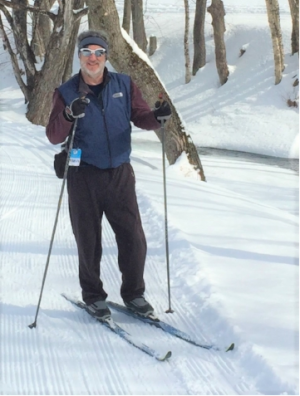
Roger Lohr in the grooves. Credit: XCSkiResorts.com
I love the sensation of gliding on the snow through the forest, being outdoors in nature. I can smell the fragrance of the trees. I can hear the bubbling brook and the sound of a bird in the distance, or the screech of my ski bases on the snow.
Groomed trails make it so easy to pass through the woods without worrying about the snow condition or getting tripped up by a hidden branch. But there is also something ethereal about skiing between the trees backcountry down the hill avoiding obstacles and picking my way to the destination. Even on a local trail network, being out in the forest seems like in the words of author Anders Morley (This Land of Snow), where wilderness and civilization meet to negotiate their differences. Even if you can hear cars on a nearby road, that negotiation allows a meditative state in the here and now.
Most skiers are encouraged to go skiing by their family or friends, or they personally always wanted to do it. Getting outdoors is among the list of reasons for people getting into XC skiing, and exercise is most likely an important reason for people to try it. The well-being factor goes beyond exercise as psychological and emotional benefits may very well be the cross beams of XC skiing that buttress the soul.
I love XC skiing in my light jacket and pants over a lightweight base layer, taking my small backpack with all my necessities. Barriers to XC skiing are low. For example, you can XC ski where ever there is snow so it is very accessible in parks and on local trails. While the sport admittedly takes time and practice to master, XC skiing is easy to do at beginner levels. It is also rather inexpensive compared to many other recreational activities. Additionally, people can ski at their own pace and go to a local park to get some outdoor exercise or enjoy the winter scenery.
On the other hand, there are issues that make XC skiing a challenge to people who’ve not tried it. Beginning XC is easy, but if you want to get proficient you have to work at it. Proficiency to higher levels only comes with time, experience, and practice. Specific equipment is important for the different types of XC skiing such as on track, off track, beginner, backcountry with heavy or light weight gear, skating, etc. Struggling on skating skis up a hill exemplifies the need for learning the right technique, skiing on proper equipment, and practice. The different segments of XC skiing may be perplexing to some people. Another factor is that experienced skiers are a tight-knit group, and it maybe a little while before the uninitiated feel accepted.

Why people quit cross country skiing is similar to why people quit any activity. People get tired of traveling or take the time to get to the trails or ski area. Time commitment can be an issue to some. Responsibilities such as work or family are also a significant reason for people deciding to reduce or eliminate time for skiing.
There are few injuries suffered by XC skiers, well, beyond being sore on the next morning because of muscles that are unaccustomed to being used. For XC skiing, proficiency is a factor when learning to glide, go uphill without backsliding, or control the skis on steep downhills.
The reasons why people start or quit skiing have been understood for decades and developing programs and incentives to address concerns is a great challenge for the snow sports industry. But personally I begin longing for the snow as spring time flourishes and am exultant the next time the ground is covered come November or December. Valhalla.

Mystery Glimpse: XC Dominator
Perhaps The Greatest XC Competitor Of All Time?
This week’s challenge might be very difficult for some, easy for others. Why? Because not as many people follow the fortunes of cross-country competitors compared to their Alpine counterparts. Everyone knows Karli Schranz, Jean-Claude Killy, Bode Miller, and the rest. But how about Sverre Stenersen, who consistently won medals in the Olympics and World Championships through the 50s? Remember what Jessica Diggins and Kikkan Randall did just a few years ago in the team sprint at the PyeongChang Olympics? Curious? Check it out here.
This week we are presenting a photo of an xc racer who some have called the very best. If you know who he is, comment in Leave A Reply below.
Okay, that’s a nice pic, but hard to identify the person. How about this one?

Last Week
 This is ski jumper Anders Haugen wearing his 1924 Chamonix Olympics coat. Norwegian-born Haugen came to the States in 1909 and started ski jumping with his brothers in the Milwaukee area. Between 1910 and 1920, Anders and his brothers won the US Championship 11 times. As captain of the US team at the inaugural Winter Games, Haugen wound up placing fourth behind three Norwegians.
However, in 1974, a sports statistician noticed that Haugen’s score was incorrectly calculated. After verification by the International Olympic Committee, Anders Haugen, at 85 years old, was awarded a bronze medal. Thus, he became the first American Winter Olympics medalist and the only US athlete to win an Olympic medal in ski jumping.
As for this fantastic coat, it was created for the US team by the Hudson Bay Co. of Canada and is called a Capote.
The 1924 Olympic capote is made of felted, twill-weave wool. It is white or natural color with printed bold stripes in black, yellow, red and green-blue. There is fringe along the top of the shoulders and sleeves and along the top front opening of the coat made of the same wool fabric, along with a tall, pointed hood.

Anders Haugen’s “Capote” from 1924 Olympics. Credit: Colorado Snowsports Museum
[authors_page role=contributor]