

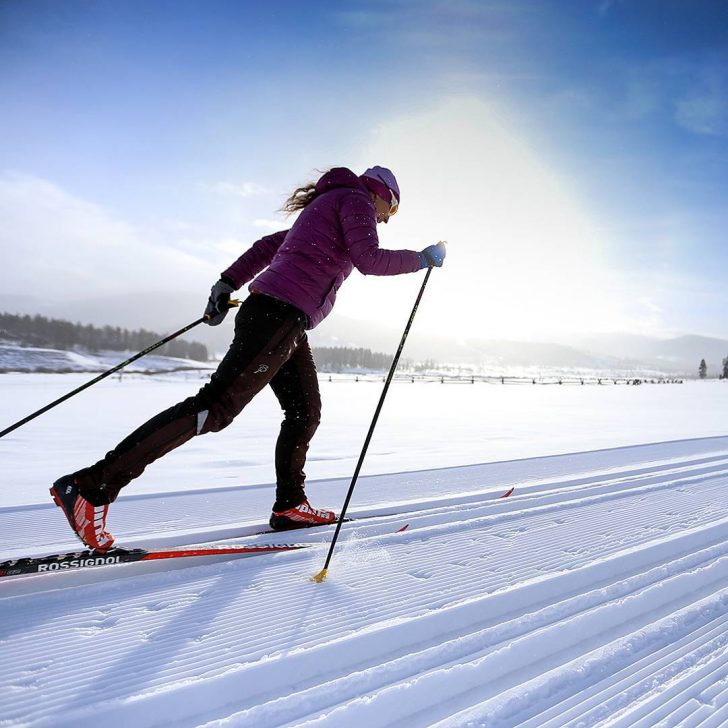
How To Choose An XC Ski Vacation Destination
So Many Choices, How To Decide?
In general, xc skiers select their winter xc ski destination resorts using some rating system of how xc ski areas perform in eight categories of criteria including trail quality and grooming, scenery, food quality, staff friendliness and service, the ski lodge facility and family issues. There is a great range of xc ski areas in North America and in the eyes of xc skiers these characteristics delineate areas without concern to whether the area is an inn, a ranch, a day area, a destination resort, or a recreation park area. I’ve purposely avoided the issue of cost – whether you like to travel to distant resorts or only travel within your region, you will still compare the other criteria to select your destination resort.
The information below describes what a quality xc ski resort is all about in terms of services and amenities at some of the leading xc ski resorts in North America.
XC Ski Trails
Trail Quality relates to the skiers’ comfort on the trails, even though those skiers might be at different skiing or experience levels. The trail signage should help skiers understand where they are on the area’s trail network. And signs should help skiers know the direction that will help them return to their starting place. The trails should provide a skiing flow so there aren’t too many long uphills or sharp turns at the bottom of steep downhills. One idea that is done at Lapland Lake in Northville, New York that makes trails seem less crowded is to have skiers go in the same direction (one-way). The result is that the trails never seem crowded. Jay Richards of Maplelag in Calloway, Minnesota said, “Feedback from the majority of our skiers let us know that they prefer double-tracked trails more than single tracks. And we had overwhelmingly negative opinions about allowing dogs on the trails, too.”
Some of the best xc ski areas are just blessed with great terrain for xc skiing. The location of an area such as Royal Gorge in Soda Springs, California is perfect for xc skiing as the area’s land diversity offers flat, rolling and more challenging variety. And Royal Gorge claims Sierra maritime snow consolidates well and is great for the base on the trails, which means that skiers can count on excellent conditions when they ski there.
Trail grooming can make or break the ski conditions. Olavi Hirvonen former owner of Lapland Lake explained, “We groom every morning unless we have to wait for the snow to dry out or cool off – and I groom the way I like to ski the trails myself.” Hirvonen had the Lapland Lake staff out on the trails after windy periods to rake and pick up the debris from trees like fallen limbs and pine cones so skiers don’t have to ski over the debris as it appears on the trails from the Springtime melt.”
One thing that most of the best xc ski areas share in common is that they acquire and use the latest trail grooming technology to give them a mechanical advantage. They do not skimp when it comes to using snowcats with their grooming attachments to break up ice or powderize the snow into the finest trail surfaces.
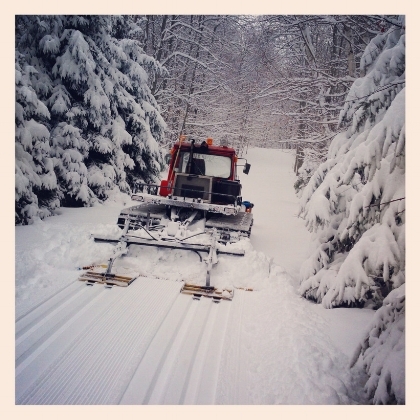
Without getting into the details of grooming machinery and techniques, the personal pride of the area operators is paramount to the trail quality issue. There is pride and commitment to the quality of the trails at many of xc ski areas.
Staff Service And Friendliness
You know it when an area’s staff is a great one – they seem happy to see you. In most instances, areas that have veteran employees have them because it is a great place to work. Most of these great employees do not need “customer service” training. They already have the personal touch. Most of the people that work at the best xc ski areas want to work there as a lifestyle choice. This is apparent with their attitudes with the guests and about working at one of the best xc ski areas.
The Richards family, who own and run the Maplelag Resort in Callaway, Minnesota, treat their guests as part of their family. It may sound trite but their guests sincerely feel welcome and they state it unequivocally in testimonials. The staff often greets the guests by name. The Richards constantly ask their guests if there is anything that can be done and they drop everything to help their guests, be it in the lodge, on the trails, in the rental shop or at the dinner table. Richards feels, “One of us (the Richards family) is always around to help with our guests. It’s fun to chat with and be pampered by the actual owners of the resort.” Many testimonials from different areas claim the same thing with regard to their feelings about the service at the best resorts – they feel welcome, comfortable and “at home.” And Maplelag avoids posting rules or signs saying “Don’t do this or that.”
Resort Lodges
XC ski lodges can be designed to provide space, convenience and efficient utilization, but there are also other factors that make a difference to skiers. The best places are clean, cozy, and convenient, but facilities such as restrooms can get pretty yucky, that have to be kept in good condition throughout the day. Lapland also takes into account brown baggers (bring their own lunch rather than purchase food at the area) by offering them a picnic area. And they have a public shower and changing area for skiers, who want to clean up before their drive home.
At Devil’s Thumb Ranch in Tabernash, CO, part of their ambiance is the scenic location and rustic looking facilities. They’ve added new updated facilities such as a dining room, lodge and cabins, but many guests go there to enjoy the rustic feel. It looks like what people expect Colorado to look like and they incorporate features such as a yoga studio and spa to provide guests with amenities that they appreciate while on vacation. And Devil’s Thumb has invested in many sustainable aspects, which guests support.
The main lodge at Maplelag is the area’s group meeting place, and it is a living folk art museum. Jay Richards has collected unusual items from around the world. He stated, “We work very hard cultivating this look to be a feast for the eyes.” There are nooks and crannies where people can sit and relax, read a book, play games with the family, etc. The lodge also houses the main dining room, hot tub, sauna, massage rooms, rental shop, gift store and it is where the Saturday night talent show and dance takes place.
Food And Beverage
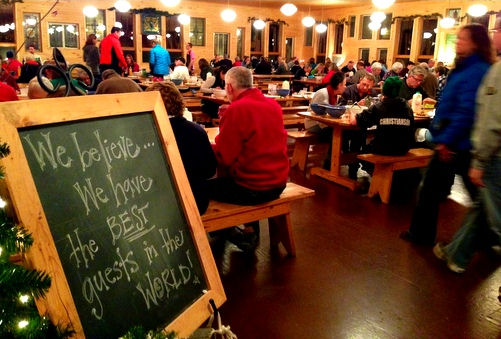
Whether Nordic skiers bring a picnic lunch, stop at a trailside snack shack or relax with a first class dining experience, the best areas usually are known for their outstanding cuisine. Good food service is a result of the area’s commitment, quality chefs with pedigree culinary backgrounds, wine selection, and so on. The Maplelag kitchen is run by Debbie, the chef who has been on the job on and off for 25 years. There is a window opening to the kitchen where guests can speak with Debbie and see the staff cooking the meals. They make everything from scratch using only natural and fresh ingredients. They call it homestyle, hearty, and wholesome and it is a unique menu that is endorsed by the guests. Richards’ summarized, “Food is a real joy at Maplelag.
Quality Family Time
Some xc ski areas are highly touted for their commitment to families. They cater to family needs by dealing with the kids AND grandparents. So the trails have plenty of flat terrain for kids and they offer pulks (sleds that skiers use to carry small children), children’s sized snowshoes, skis, boots, and ice skates. XC skiing offers families an activity that they can all do together. And that can include a four-year old on Snoopy skis skiing right alongside of grandpa skiing on his pine tarred woody originals.

Child-oriented instructors are a key element for families and so are instructors that can cater to older skiers’ needs. For the kids to have a positive attitude about Nordic skiing they must have positive first experiences and older skiers relate to older instructors because they are on the same wavelength. Kids get comfortable with child-friendly instructors as individuals and on subsequent visits the kids commonly request to take additional lessons so they can spend more time with those friendly instructors.
Another important way to cater to families is to offer a variety of other skiing and non-skiing activities. At Lapland Lake a game played in Finland called Napa Kiikku is organized on weekends and holidays. The game involves a pole on ice with a sled that goes around in a circle. Adult lessons are conducted to correlate to the time that the kids play the game.
The entire family loves a campfire by the lake, sleigh rides, or just playing on a big pile of snow. Trapp Family Lodge in Stowe, Vermont conducts many kids “classes” from swimming to puppet classes or making stuffed animals. The kids’ classes provide parents and grandparents with some child-free time for going on harder ski trails or getting a massage while the kids are being entertained. And older guests love the tour offered at the lodge with property managers who are often the children of Johannes von Trapp.
Jay Richards (Jim and Mary Richards’ son) of Maplelag commented, “Seeing our large family with our own kids running around, being involved makes families feel welcome here. We try to make parents feel at ease about having their kids run around.” Maplelag cabins and cabooses are great accommodations that can fit large families and the Richards try to help families focus on being together doing family activities. Serving meals “family style” is a key element to the atmosphere. But so are the other family activities such as the dance and the talent show. Baby sitting services are available on site, too. Jay feels that one of the biggest reasons families visit is that there are many families already at Maplelag every time people visit and that makes families feel welcome.
Summing Up
Of course, there are other criteria for selecting winter destinations – for example, couples that are looking for a romantic weekend will have different needs (and desires). There is something more memorable about traveling to a destination compared to going to the local trail network for a couple of hours to xc ski or snowshoe. Whatever your interests, there is a perfect xc ski resort for you.
Editor Note: This article was originally published in XCSkiResorts.com.

Nordic Skiing Terminology
XC, Nordic, Touring, Cross-Country. What’s What?
Touring is Nordic is XC. Credit: Dynafit
If you’re new to the sport, you’re going to find people using terms that may be a little confusing at first. Here’s an explanation of most of the jargon you’re likely to meet.
- Nordic skiing is the catch-all term that includes classic technique, skating, ski touring, telemarking, even jumping and biathlon… In all these cases, your boot’s toe is fixed to the binding and your heel is free to lift up, as opposed to the fixed heel in downhill (or alpine) skiing. Nordic skiing is about a jillion years old; downhill is a relative newcomer.
- Grooming lets you glide on top of a solid, consistent base that’s been prepared by snowcats or snowmobiles pulling special attachments. Groomed trails are used by both classic skiers and skaters.
- Cross-country refers to skiing on machine-groomed surfaces – track for classic skiers and compacted snow for skaters
- Classic technique (also called diagonal stride). You’re moving straight ahead instead of skating.
- Skating is a relatively new technique (was introduced to racing in the early 1980s) involving an ice-skating like motion of arms and legs, thrusting out to the side. It’s dynamic and relatively exhausting.
- Ski touring means skiing on ungroomed snow, whether it’s playing in your backyard or day-long treks in the mountains.
- Track skiing (for classic skiers) means skiing in precise machine-compressed grooves, with snow compacted on both sides of the track for planting your poles.
- Telemarking is an elegant and practical descent and turning technique.
- Ski joring means being pulled, usually by a dog, though I’ve also been pulled by a horse, reindeer, and VW bug.
- Biathlon refers to skiing and target shooting, usually with a rifle.
- Kilometers are how cross-country ski trail lengths are measured. A km is a little over 1/6th of a mile. Skiers get more of a kick out of saying, “Hey, I skied 10 km today!” than “Well, I skied about 6 miles.”
- Nordic Combined naturally enough refers to the blending of ski jumping and cross-country skiing.

Track Vs Tour
Groomed Vs Bushwhack? Both Have Positives.

Classic diagonal style goes down easy on groomed trails, also essential for breaking trail. Credit: WebCyclery.com
For the past 50 years or so, there’s been a generally amicable debate whether cross-country skiing on machine-groomed trails is preferable to making your own way o’er the fields and through the woods. The argument has a lot of angles, including “Free vs. Fee” and “Pristine, Silent, and Serene vs. Speedy, Social, Service-based, and Secure”.
Clearly, you don’t have to choose one over the other – they’re both delights (and the world’s best exercise), in somewhat different ways. The thing is, as my increasingly complaining bones and joints frequently announce, groomed trails for classic and skate techniques have more and more going for them.
One huge differentiator is that if you want to take up the sport, you’ll be smart to start with one or two lessons from a professional instructor at a cross-country ski area, learning and practicing efficient movement. Undesirable options are learning by yourself off-track (I know someone who tried to do that while consulting a printed manual – results were not pretty, and the manual got soaked) or getting often-incoherent suggestions from a friend while floundering in unpacked snow (‘nuff said).
Whether you’re a long-time practitioner or a newcomer, groomed trails make things easier, faster. For classic style/diagonal stride, you’re riding on a consistent, packed surface, with your skis guided forward in compressed, parallel tracks. (It takes some effort to get lost that way too; whereas I’ve been known to ski in circles in fresh snow, totally convinced I was moving in linear fashion.) Gotta love it, especially if you have balance or vision issues, as I do.
Almost as important but often not noted, your pole tips are digging into packed snow and no further; while breaking your own trail, the entire basket may sink, throwing off your balance and helping you to get up close and personal to the snowpack. And as many of us have discovered, getting up in deep snow is challenging (though your instructor can show you best techniques there too).
Skate skiing has its own techniques and gear. Credit: HuffPost Canada
Skate skiers (for downhill skiers, skating can be easier to absorb than classic style) need a packed surface even more than diagonal striders. Two or three inches of fresh snow even on a machine-packed trail are enough to catch an edge and tip you over. It’s nearly impossible to skate in ungroomed snow except for glorious spring crust-cruising (not the same as skiing on ice – you can set your edges), which gives you a solid, consistent surface – crust lets you go almost anywhere, speedily zipping along. Euphoria!
One of the delights of cross-country is that you can evolve from a groomed trail skier to an off-track tourer (fields, forests, hill country, parks, golf courses…). You’ve developed good classic technique in the tracks; you know how to make your legs do the work and your arms help out – now you can apply those skills in a quieter setting, with shorter strides but still good balance.
Cross-country areas have services – anything from plowed parking to lodges with food and drink, heated bathrooms (also heaven on a brisk day!), rental, retail, even overnight accommodations. Groomed trails may have signs, maps, possibly ski patrol, probably snowshoeing – and if you’re wild for something different, increasingly there’s fat biking available.
If you’re taken by the charms of overnight tours, there may be Forest Service cabins in your area (bring your own food, clothing, sleeping bag…). And finally, for true adventure, there’s snow camping (bring your own stove too). Touring with a pack in fresh snow can be truly character-building (been there, done that, I happily leave it to today’s kids – but there was a time before groomed trails…).
[authors_page role=contributor]