


Out-think Your Feet With XC Lessons
It’s Not Like Walking. But Not Complicated To Learn.
Lessons make a difference. Credit: White Pine Touring
In the early 1970s, in a visionary but totally wrong-headed move, the fledgling Nordic ski industry declared that, “If you can walk, you can cross-country ski.”
Retrospectively, it would have been a lot more helpful and realistic to say, “If you can walk, you can learn to cross-country ski. And it takes only a single lesson from a professional to learn how to glide.”
Those were times when an alpine resort manager pigeonholed skinny skiers as, “Guys who head into the woods Friday night, and come out Sunday without having changed either their underwear or their $5 bill.” We were on the defensive – and dang, it’s tough to fight clever stereotypes!
Those were also the days that New Englander John Frado, who designed a lot of the best trails in North America, coined the hilarious phrase that’s the title of this article. And boy, was he right, because you’re going to become a better skier, use less energy, go further faster, and have more fun sooner if you start the sport with instruction. (And by that I mean ideally not just one lesson, but one, followed by practice, then another. And so on. Believe me, this approach works!)
Cross-country can be filled with grace – not just the dynamism, incredible self-discipline, and athleticism you see at the Olympics, but true beauty. Or it can be an awkward downer.
So here are half-a-dozen tips to make skiing euphoric, quickly.
First, please do something the Nordic business has never been able to, and come up with more endearing descriptions than “lesson,” “instruction,” “teaching,” and “ski school.” Who wants to go back to studies when you’re out to have winter fun?
Next, don’t even think of learning from a loved one – instead, learn from a ski professional. There’s always an uncomfortable level of stress and self-consciousness if your instructor is also a relative, or your sweetie. Too distracting; and incidentally, your kids or grandkids are likely to absorb everything depressingly faster than us oldies. But once you can glide, that’s the moment you discover that cross-country becomes incredibly social, skiing side by side with friends and family.
Third, learn to ski at a cross-country area or club with machine-groomed trails, where the compressed tracks will guide your skis. (More on this in a future article—promise!) Two outstanding resources on places to go are https://www.xcski.org and https://www.xcskiresorts.com/, which introduce you to marvelous places in both the U.S. and Canada.
Fourth, your ski pro needs to explain, early-on, how and why to hold your poles properly (my very own cliché: reach for the sky up along the shaft, then shake hands through the grip). Grabbing the poles tightly and ignoring the straps means you’ll be upright, stiff, walking rather than gliding, and a lot more fall-prone. Oh yeah, and wear gloves to avoid cold and abrasion.
Fifth, if you’re renting equipment, check to see if your instructor uses the same skis you do. It kinda levels the playing field.
And finally, think about a second lesson – or a private lesson – that concentrates on the whole range of descent techniques on these narrow skis that don’t have metal edges or heels held down, while you’re using footwear akin to sneakers. Wedge turns, step and skate turns, parallels, telemarking, traversing with kick turns, side stepping… – they’ll all get you down that hill.
And as I found even in my prideful youth, sometimes you just have to take your skis off and walk down. It’s all legit!

As we said, fun lessons. Credit: Mazamas

Snowshoes: From Wood To Metal To…Foam?
There’s Always A Better Way. Foam Is Light, Strong, And Long-Lasting.

Crescent Moon Eva snowshoe.
As a long-time, single-minded Nordic fanatic, snowshoeing used to seem pretty tame – kind of a melding of on-snow recreation and utility, with not much maneuverability and no glide.
Aging knees and mature perspective (or an approximation!) have changed this some, along with vast improvements in snowshoe materials and design, from wood-and-animal hides to aluminum-and-synthetics. Newer products aren’t as pretty as the natural materials, but they’re tougher, lighter, longer-lasting, have easily adjustable bindings, and come with metal crampons that can grip in crust and up (as well as down) hills. Also, rodents don’t chow down on them in summertime.
It’s always interesting to see how technology evolves. In the Nordic world, we’ve seen the introduction of groomed trails, synthetics in skis, skate skis, manmade clothing, waxless bases, boot/binding systems… All that’s led to more fun, faster skiing, better support, easier turns, warmer toes and tushies – virtually a different world.
And in snowshoeing, we may be seeing an equivalent revolution with the introduction of foam snowshoes: the Evas. (Thus far, the only foam manufacturer seems to be Crescent Moon Snowshoes in Colorado: www.crescentmoonsnowshoes.com.)
Got to be kidding, right? Foam? It’s gonna fall apart in the cold, crumble into small pieces under your weight.
Nope.
I’m a 195 pound guy who’s waded around wearing Evas in a foot of fresh Montana powder as well as heavier crud; managed a 180 degree jump (no good reason, I was just curiousJ); even backed up for a couple of yards without damaging self, ego, or equipment.
Among the things I like about these ‘shoes is the weight (3.5 pounds per pair); ease of movement (you can walk, you can run… and they feel like an elongated extension of your foot, due partly to a “rocker” design, plus they’re only 24 inches long); self-explanatory bindings; flotation (the entire base is in snow contact); good insulation from the snow below; and a lot more. Even sidestepping is easy; and the price is right at $159.
I’m also delighted by the Crescent Moon sense of humor, which describes the Evas as looking like “the love child of a running shoe and a burly snow tire.”
The Evas became available in 2018, so there’s been a chance to test their longevity – has to depend on amount of use and abuse, I suppose; but figure for most of us, several years. The one weakness I found initially was that the multiple plastic cleats and lugs didn’t grab as well as metal on crust, especially on sidehill. (On the other hand, I’ve slid sideways downhill on the old wood ‘shoes, and slipped on crust with modern metal/synthetic snowshoes too.) Happily, the company now gives you the option of inserting metal cleats, which takes just a couple of minutes.
I haven’t used the Evas in more than about 14 inches of fresh snow, but Crescent Moon suggests using them on trails rather than in deep snow. My guess is that it’s not good for the foam ‘shoes to step around on abrasive surfaces like sidewalks or road crossings (yep, done that with my aluminum snowshoes – not smart then either).
And if you have any questions or concerns, call owner Tanner Dunn at 303-494-550 and ask about… yes, plans for biodegradable snowshoes! I’ve suggested to Crescent Moon making them edible as well, so if you’re stuck in the woods you’d at least have a ready food source; but so far that hasn’t been incorporated into design. But ya never know!
Lightness and improbable strength are features of the Eva.

Fat Biking At Nordic Ski Areas
Fat Biking Is A Combo Of XC and Cycling: What A Workout!
Fat biking at Kingdom Trails, VT
Fat bikes, dubbed the “Hummers of the two-wheelers’ world” in the Wall Street Journal are proliferating where there are more than 150 cross country (XC) ski areas that have fat bikes available to use on snow covered trails. These specially-made bicycles that accommodate ultra-wide tires that can be run at very low pressure 4-8 pounds of pressure allow fat bikes to roll over soft, slippery surfaces like snow. XC ski areas and regional pockets across the nation in Vermont, Michigan, Wisconsin, Minnesota, Alaska and Washington now have fat bike trails with groomed single track and signed trails, rental bikes, and special events.
An industry source (at QBP, the manufacturers of fat bike brands Surleybikes, Salsacycles, tires, boots, gloves, and apparel) recently reported that 150,000-200,000 fat bikes have been sold since 2010 while there are about 7 million mountain bikes sold. Fat bikes provide a great way for avid cyclists to stay in shape during the winter season and they provide different recreational fun for people who are active or love the outdoors. Fat bikers are mostly male and are aged 35-65, with 80% at high education levels Bachelors degree or higher) and professional/managerial vocations.
Kingdom Trails
A small group of North American Snowsports Journalist Association members were recently introduced to fat biking by the welcoming folks at Kingdom Trails in Lyndonville, VT. The group found the bikes easy to balance and maneuver. Similar to XC skiing, the fat bikes provide exercise when going on flat terrain with more effort required up hills earning thrills on the downhills.
The Kingdom Trails in northeastern Vermont is the foremost mountain bike destination in the east with more than 40,000 day passes sold in 2017 (20% increase from the previous year) and they’ve quickly parlayed this notoriety into becoming a mecca for fat bikers in the winter. Kingdom Trails has 100 miles of bike trails (30 of which are used in winter for XC skiing, snowshoeing and fat biking) and works with 80 different land owners. They also host Winterbike, which is the biggest fat bike festival in the east.
At Darling Hill Road in Lyndonville, the Village Sport Shop has a trailside facility adjacent to the Kingdom Trails Nordic Adventure Center renting fat bikes for $55 a day and sells the bikes ranging from $1,800 to $2,800. Fat bike products include softgoods, accessories and bikes available from companies such as Liv Bikes and Pivot among others.
Another option for those who would like an introduction to fat biking is to have a guide at Kingdom Experiences take care of all the details. They’ve got certified instructors and want to help cyclists have an experience catered specifically to rider skill and ability levels offering kids camps, women’s clinics and getaways and more.
Kingdom Trails has three paid groomers who maintain about 30 miles of trails. Day membership prices (day pass for trail access) are $15 a day for those aged 16-69 and $7 for youth aged 8-15. There are also year-round memberships available with an annual family membership priced at $150. The Kingdom Trails Welcome Center is in East Burke and the Kingdom Trails Nordic Adventure Center is on Darling Hill Road in Lyndonville.
Other Fat Bike Locations
At the Nordic Village outside of Flagstaff, AZ there are 25 km of snowshoe trails that accommodate fat bikes. The bikes ride much better on packed trails compared to riding on soft snow. Fat bikes can be rented at Flagstaff Nordic for $35 on weekends plus a $10 trail fee, and they offer a 40% discount on weekdays ($20) while charging a lower trail fee on weekdays ($7), too.
In eastern Washington’s Methow Trails the winter season can be longer than all other seasons combined and it was one of the first trail networks to embrace fat biking. They saw it as a new, exciting way to get outside and recreate and for the passionate XC skier interested in fitness, it provides another way to cross-train. Some guys from Methow Cycle & Sport groom some of the local trails and the shop rents 16 fat bikes.
One avid snow biker describes the thrill of riding his fat bike in the winter as, “Riding on snow has been a great alternative to my other winter love…Nordic skiing. Hopping on the snow bike has been a great way to mix up the winter activities. There’s an amazing sensation when you climb aboard a snow bike and find that you “can” ride where only skiers or snowmobilers had once been able to go!” Surveys show that 71% of fat bikes were introduced to the sport at a demo, borrow, or rent the bike that they are riding and 64% of the fat bikers said they would pay to ride on groomed trails.
Fat bike trail offerings are assessed on a day-by-day, snow conditions, user compatibility basis. Information on the trails that are open to fat bikes is available daily on the Methow Trails grooming report. Just like a skier, a valid Methow Trails day pass will be required for snow bikes.
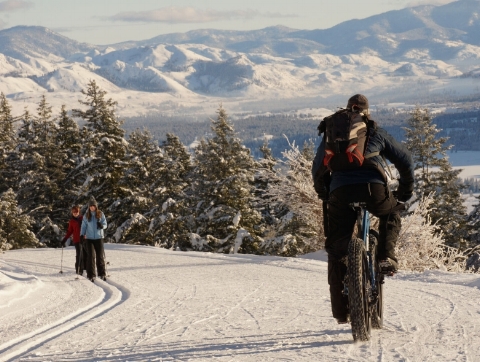
Views in Methow Valley, Washington
Fat bikes are available for rent ranging from $15 per hour at Rikert Nordic Center in Ripton, VT to $55 for a full day reaching $75 a day at New World Sport, a Fort Collins, CO, shop that sends riders to local packed snowshoe and XC ski trails. Methow Cycle and Sport in Winthrop, WA has a $35 half day rate or $55 for a full day. Reservations are recommended for weekends and holidays. Methow Cycle and Sport will also provide rack adapters for customers who wish to transport rental fat bikes to the riding area of their choice. Other XC ski areas that have fat bikes on location to rent include Woodstock Inn & Resort in VT, Great Glen Trails in Gorham, NH, Cross Country Ski Headquarters in Roscommon, MI, Crosscut Mountain Sports Center in Bozeman, MT, in California at Bear Valley Cross Country & Adventure and Mont-Sainte-Anne, QE.
As one might imagine the price for purchasing a fat bike ranges greatly from a low-end of $200 (at Walmart) to $1,800-6,000. Like any other equipment the low end is probably less reliable and the high-end includes bells and whistles or are built with carbon fiber construction.
Currently, the issues for fat bikers include skier/biker relations and conflicts, variable and changing snow conditions, impact on trails, and building fat bike-specific trails. Fat bike riders are looking for packed snow trails, moderate climbs no more than 8% grade, and narrow single tracks to ride. They are asked to follow a code of etiquette because they can damage trails groomed for classic and skate XC skiers. A typical list of XC ski area “conditions of use” include:
- Riders need to purchase a trail pass to use the area’s trails and tell the ticket vendor that they are planning on fat biking.
- Trail access is dependent on conditions and they should check the daily grooming report for detailed trail access information.
- Bikes should yield to all other users. Stay to right side of trail at all times, stay out of the classic ski tracks, and give skate skiers a wide berth. * Stay off trails with more than 3″ of new snow.
- If you are leaving a rut deeper than an inch, having a hard time riding in a straight line, or pushing your bike, the snow is too soft and you absolutely should not be biking on the trails.
- Be an ambassador for the sport – stay polite, educate other bikers, discourage bad behavior, follow the rules, and we’ll all have a good time this winter.
- Stay on trails designated for Fat Biking.
Editor Note: This article was originally published in XCSkiResorts.com
[authors_page role=contributor]