

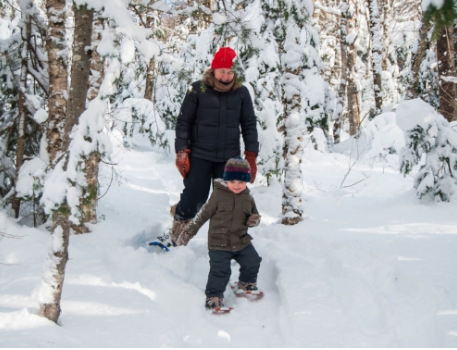
Taking The Grandkids Snowshoeing
A Little Planning Goes A Long Way To Ensure A Positive Experience.
Fun on snowshoes. Credit: Laura Rose/SnowshoeMag.com
On a winter trail outing near my home, I ran into a neighbor and her granddaughter on snowshoes – and it was not going well for them. The kid was whining and uncomfortable and she headed back home (nearby) by herself. Grandma kept going and since she is a neighbor, I went along with her for a while and chatted. She was not aware of how to help her granddaughter have a good time snowshoeing on a cold winter day. Here’s a primer about going snowshoeing with the grandkids.
Snowshoes
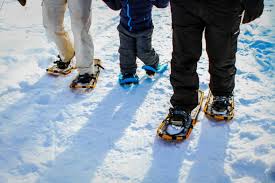
You can get the kids snowshoes that are used or new but it’s best to get equipment that is appropriate for their size. For the youngest kids 4-8 years old get colorful snowshoes but most importantly ones that are secure and easy to put on. The Tubbs SnoGlow has LED lights, and also from Tubbs is a model called the “Snowflake.” Ideal has the SnoStompers for under $20, but expect to pay more than that for name brand snowshoes. Most of the companies have a snowshoe for kids.
Keep in mind that the older the kid the more important they’ll want “cool” looking snowshoes rather than a pair intended for babies. As kids get older, they’ll need a snowshoe that is intended for lighter people and has regular snowshoe and binding characteristics (looks and performs like an adult snowshoe).
Again, the key issue is that the snowshoes are easy to put on and easy to walk in. I’ve also found that it is easy to sell used kids snowshoes after your kid gets too big for them.
Clothing
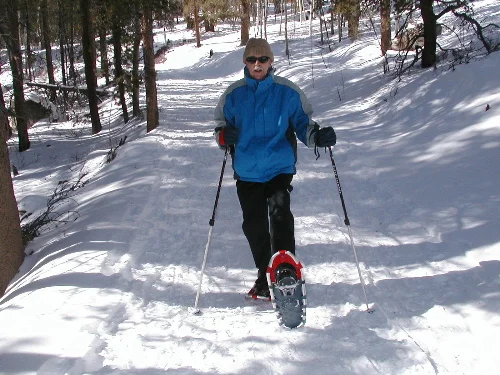
Light layers of clothing are comfortable and you can add or remove clothing as needed (i.e., if it gets too hot). A lightweight synthetic base layer of long underwear helps to keep you dry and transport perspiration away. A middle layer provides insulation such as a shirt or sweater and then a jacket shell on the outer layer works great. Don’t forget a headband or light hat and a pair of appropriate gloves. Alpine ski gloves may be too warm for snowshoeing unless it is very cold outside (or you have poor circulation issues).
The goal is for the kids to recognize when it is too cold or too hot and to encourage them to change to feel comfortable with the temperature. Wearing a backpack will allow kids to stash or pull out the extra clothes, and feel self sufficient.
Fun on Snowshoes
If you want it to be a good time for them (and you) you have to make the snowshoeing outing less “boring” and more exciting. Additionally, the first few outings should be short and easy so that the kids don’t feel that snowshoeing is “too much work.” Maybe they can use a camera or cell phone. Plan ahead and discuss what to look for – perhaps there are different kinds of scenic views, trees, animals, tracks, and silly poses that you can do. You can not stop too many times to take photos. Pose for them, take selfies, get some photos of them without you, send them out on social media, etc. You’re making and saving memories!
Perhaps you can print the pictures and create photo books of the adventures. Maybe the kids will discover that they love photography. It will give you an indoor activity to arrange the photos that you can do together with the kids.
Set up a scavenger hunt on the way out on the trail (hang or hide treats or something) and use the destination as a goal to be eligible to play the game. On the way back, the kids can look for and accumulate the hidden treasures.
Kids love candy and perhaps they’ll love to go snowshoeing to look for candy that is cached (hidden in specific locations in bags). Take them on a “Quest for the Candy” by following hints that you write in advance as a poetic treasure map to follow. This is a new type of orienteering for children.
“Orienteering” can be fun for older kids, whereby they snowshoe to find markers by using a compass. Set up five numbered markers in advance and figure out different ways to go to them by taking a compass reading. Give each snowshoer (or team of snowshoers) a compass and show them how to use it. Then see if they can go to the markers in a different but specific order. The first one to record all of the marker numbers wins.
“Snowshoe Biathlon” incorporates other backyard games such as ring toss or ball toss into a container. Set up a course and stations along the trails. If you want to have a competition, keep time as snowshoers race through all the stations to a finish line. Add time for each toss that is missed. If you do not have backyard games or are unable to easily create them, snowshoers can walk backwards or hop through a natural obstacle course at the stations. If you prefer not to have a competition, do the biathlon just for fun.
Choose the Trail
Make sure to take the kids on interesting trails and accept that “interesting” may be very different than it is for you. They may not like historic bridges or flat trails that lead to nothing. Have a destination such as waterfalls or a hilltop, or a site for wildlife spotting. Discuss this issue prior to planning the trek so you are aware of what they might enjoy. It may be like pulling teeth to get them to decide but it will give you a goal as to where to go. Make snow angels and slide down the hills and they’ll keep going. Be aware about whether the child is over his or her head – the trail may be too steep, too long, or you are not getting to the destination soon enough.
If you want to avoid all of this decision-making, go to a cross country ski area that can accommodate kids on snowshoes like Great Glen Trails Outdoor Center in Gorham, NH. They have a scavenger hunt called “Trail Tracker” which is a big hit for kids to track down signs of cartoon animals out on the trails. When they find the animated creature signs, they stamp a card and upon return to the lodge, they get a treat.
Hydrate and Snacks
Plenty of snacks and drinks are a must for a successful outing. If you are going out more than a half hour pack enough water or drinks. The kids get thirsty fast and they may like to play the “I’m thirsty” card when they want a break. Granola bars, sandwiches, energy drinks, fresh fruit and crackers can provide ample energy boosts but also consider some snacks that you know they enjoy like chocolate or candy bars.
A Great Time with the Grandkids
Try to teach them to have fun with snowshoeing. Take snack breaks or play I-spy in the middle of the woods to keep them interested in continuing to walk. Go for a snowshoe adventure rather than just a snowshoe hike.
Take the opportunity to get outside and enjoy nature and exercise, while at the same time get some bonding time with your family; you’ll be glad you did.
Editor Note: This article was originally published in XCSkiResorts.com

Resort Review: Crested Butte, CO
Skis, Dogs, Bikes. It Must Be Crested Butte.

Crested Butte Nordic has rentals for $20 a day. Credit: CB Nordic
It sometimes feels like not much of the American West remains unspoiled, but the town of Crested Butte, CO, comes mighty close. It’s a ski town that used to be a mining community (gold and silver, then coal). Somehow it’s kept the serenity (population is pretty steady at around 1,700) and retained its Victorian architectural integrity.
Meanwhile, the mountains around town haven’t changed at all. They’re beautiful; inspiring; stunning! So is the Nordic skiing, from groomed trails all around town to famous telemarking at nearby Crested Butte Mountain Resort. (Now there you’ll see a lot of change—it’s morphed from a mid-sized area to a significant alpine ski destination. Still, it’s a great complement to XC for folks who like to split their time downhilling or snowboarding.)
Where?
Crested Butte is located in southwestern Colorado, about 30 miles north of the jet airport at Gunnison. It’s a genuine contender for the “Best Kept XC Secret and Remote from Everywhere” award. (Denver is about a four-hour drive, including a sometimes character-building trip over 11,312’ Monarch Pass, especially interesting in snow and wind.)
It’s a place you visit because you want to be there, not because you’re wandering the neighborhood. And you should want to visit, because it’s gorgeous (the Elk Mountains are spectacular), friendly, and kinda charmingly quirky.
The Skiing
The Crested Butte Nordic Council (https://cbnordic.org/) grooms 50 km of trail, usually starting in mid-November and running into early April. Winters can see up to 25 feet of genuine powder.
Trails are rated about 40% Easier, 40% More Difficult, and the rest Most Difficult. That beginner-intermediate emphasis is especially welcome to visitors, since elevation (up to 9,500’) is literally breathtaking. Give yourself a couple of days to get used to the altitude, and then stay a week (or two).
The skiing is very convenient, since you can hop on the trails at several points on the edge of town, plus there’s a free shuttle. Along with skiing, there’s snowshoeing and 10 km of groomed fat bike trails.
First place to visit is the Nordic Center. It’s your primary source for rentals, instruction, and information, with a pleasant lounge upstairs and ice skating next door. You can ski from the Center to The Bench (there’s some uphill) and tootle around on mostly intermediate trails, with good forest protection.
My favorite trails are around Magic Meadows, combining wonderful terrain and mind-boggling views. There’s also a ski-in yurt where you can book dinner or Sunday brunch.
For variety, the Nordic Center also offers guided trips. Another intriguing option is touring up to the old mining town of Gothic and overnighting (heat, electricity, and running water – BYOB, food, and bedding).
XC Idiosyncrasies
CB’s Alley Loop marathon starts in the middle of time. Credit: Xavier Fane/CB Nordic
Did I mention quirky? There’s the 42 km Alley Loop marathon (“best costume party of the year”) each February, which winds its way through town (a bunch of streets are closed to traffic during the event) – lots of fun, but serious enough to be an American Birkebeiner qualifying race.
A Taste of Town
One of the things I like best about Crested Butte is that everything is walking distance from everywhere else, and virtually any place you go is architecturally and historically captivating. Along the way, you’re going to see dogs and fat-tire bikes, whatever the weather.
There are a lot of dining options, but a local favorite is Sherpa’s Café (https://www.sherpascafe.com/), with Nepalese, Indian, and Tibetan cuisine, also serving beer and wine. Prices are surprisingly low for a resort town.
I’d recommend staying at Elk Mountain Lodge (www.elkmountainlodge.net). An easy walk from the Nordic Center, it’s run by skiers for skiers and has pleasant rooms, fine breakfasts, and great staff. Rooms for two run from around $170/night.

Elk Mountain Lodge in Winter.

Dressing For Nordic
What To Wear: Ditch The Parka.
Often on the cross country (XC) ski trails the clothes that many of the uninitiated wear are malfunctioning…that is, they are dressed for downhill skiing wearing insulated ski jackets and pants, alpine ski gloves or mittens, and ski goggles. XC skiing is a form of recreation that involves moving and thus lighter clothing is appropriate. Recreational XC ski garb is versatile, functional, and fashionable, which is different than either the outfits for downhill skiing or the suction suits worn by the XC ski racers seen at the Olympics.

New parkas from Daehlie. More athletic, breathable.
Currently, the most popular cross country ski apparel is from companies such as Craft, Daehlie, Sporthill, Swix, and others, but what is important is that the products fill a function that includes comfortably allowing movement, protection from the outdoor elements, and transporting perspiration out to keep skiers dry. Of course, skiers need to heed the weather by wearing layers (base layer underwear, pants and tops, and outerwear) and when its colder, more layers or thicker layers are necessary.
XC Ski Jacket and Pants
A jacket for XC skiing provides a layer to keep warm and also a way to cool off and transport perspiration away. These jackets have a mesh liner and material that is comfortable when you have to zip up the collar on a very cold day. The hood on the jacket is useful if it suddenly gets cold out on the trail. The high-hip fit keeps you warm and the zippered side pockets can be closed to avoid losing pocketed items. In some jackets the pockets have a mesh liner that allows for the skier’s heat to escape when working hard. The jacket arms might have extended cuffs, which are a nice touch to keep snow out of your gloves. The inside chest pocket has a zipper and a hole for a phone and earbuds for the times that you may want musical accompaniment on solo trail outings.The pants for XC skiing may be light overpants with zippers along the entire length of the legs and at the ankle there is an elastic area that may be closed with a zipper. This pant ankle set-up is a most significant aspect of the pants because it tightly fits around the boot and keeps snow out of the shoe top to avoid getting wet socks while skiing. To prevent losing a set of keys, zippered side pockets (on pants or jackets) allow a way to lock away your valuables. The base layer also known as long underwear is intended to provide a dry layer next to the skin, but if there is lined material in the pants it may be enough to stay warm with or without a base layer underneath.Other Aspects of the XC Ski Outfit
Base layers in various thicknesses can correlate to warm and cold days. Moving perspiration away from the body is very important and lightweight underwear on those nice winter or spring days are the way to stay dry, but on the coldest days use a heavier or thicker base layer pants and a top that may have a turtleneck. For your head, a light hat or headband is the way to go. Light Lycra neckies are good for your face but when it is very cold (below 15 degrees Fahrenheit) try a heavier neck gaiter like you’d wear when alpine skiing.Socks and gloves are an entirely other matter that could be covered in a separate article. In short, parameters for selecting socks include the sock material for perspiration, thickness, spacious comfort for your toes, and height of the sock on your leg. Socks for downhill skiers are intended to accommodate the higher alpine ski boots and this may be too high on the leg. Expect to pay as much as $25 for a pair of quality socks these days.Different pairs of gloves will allow adjusting to the temperature ranging from heavier insulated mittens or two-fingered gloves for the really cold days to lightweight gloves needed for the springtime. One of the glove features to consider is the patch of soft material found on the outside part of the thumb, which is useful for nose wiping.For eyewear opt for sunglasses rather than goggles. Sunglasses allow the air to flow while goggles tend to fog up when you get hot. Oversized glasses that have interchangeable lenses for sun or flat light are great for XC skiing.Editor Note: This article was originally published in XCSkiResorts.com.
[authors_page role=contributor]