


Keeping Your Ski (And Other) Pants On
OK, That Sounds Salacious But It’s Not.
Who knew a belt could be so important? Credit: Jeltbelt.com
I kind of collect belts, from the 50-year-old hand-stitched inches-wide leather style with ornate Mexican silver buckle; to a contemporary pseudo-leather critter with multiple off-set holes; to a futuristic version (my favorite!) that grips, flatters, goes through airport security without setting off alarms, comes in colors – and keeps my pants up in all circumstances thus-far encountered. Now, that’s versatile!
Back in July, 2017, after moving to Montana (still gotta get the dog, battered pickup, and rifle rack to feel like a native), I started exercising and leafing through local magazines, simultaneously. The exercise dropped my shorts a size; the editorial introduced me to the Jelt Belt (https://jeltbelt.com/), an ingenious product that’s fun, socially and environmentally responsible, yet totally practical – so many positive qualities that it gives renewed faith in the entrepreneurial mindset. And it fits my new almost-size-34s as well as the previous 36s.
I’ve always liked leather belts. They’re handsome, can slide reasonably easily through loops, even smell rich when they’re new – and you can commission designer buckles. But it can be tough to punch extra holes as time goes by and waistlines expand or contract; and if you don’t have belt loops, they’re slick enough to slide up and down, with consequent droopy pants.
With fabric belts, you can often pierce the material with the buckle prong, but again they’re often on the thick and wide side. Like leather, they generally have metal buckles, so you may need to remove the belt (and put it on again) while going through airport security – not fun if you’re literally running to make a flight.
Enter the all-synthetic Jelt Belt: tough, adjustable, stretchy, with a grippy inner-surface gel. Endearing from an environmental perspective, they’re made of yarn from recycled plastic water bottles; while part of sales goes to organizations supporting veterans wounded in combat, environmental causes, and kids. New belt lines are being manufactured in Montana rather than China.
Jelt Belts are slender rather than thick or wide (4 sizes plus an adjustable version), but they hold very snugly. You can order for adult jean sizes 22-40. They come in different colors (I’m partial to the River Turquoise and Denim Navy Blue; kids get fun shades too).
Maybe more importantly than aesthetics, buckles in four sizes are quick-release. I’ve even learned to release and re-buckle one-handed (let your imagination run wild, but so far they’ve been very mundane uses). Buckles are low profile – flat, actually – so there’s no bulge under your shirt or sweater. Skiing, golf, running, walking, climbing, socializing, they seem right for every occasion.
Okay, you want to know about the name. The belt was founded by Jennifer Perry, thus it’s Jen’s Belt, which evolved into “Jelt Belt.”
Why a belt for skiing? Whether you take a fall or are skiing in a storm, the Jelt keeps snow out of your pants. (I once entirely lost my pants sliding downhill after a fall, face first, on my belly – wouldn’t have happened with a Jelt Belt.)
I plan to become a collector of the Jelt Belt subset of belts, perhaps display them in chronological order of acquisition. And the price? Figure from $32 for adult belts, less for kids’.

The Meccas Of Cross-Country Skiing
What Are The Vails and Aspens of XC?
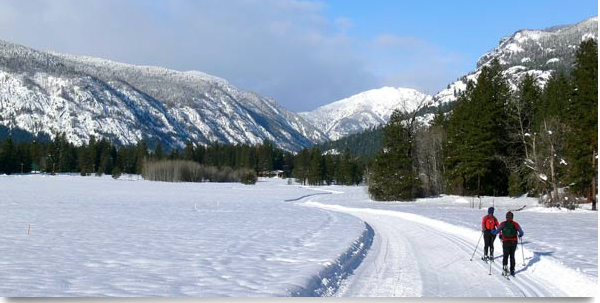
Ask the general public to name an alpine skiing “Mecca” — described as a location where people, who share a common interest, yearn to go — even those who don’t ski can come up with at least Aspen or Vail, if not Killington and Sun Valley. But mention the Gunflint Trail or the Methow Valley to cross country (xc) skiers and more often than not, you’ll elicit a blank stare. Yet these are just two of several xc skiing destination resorts that devout xc skiers revere. In fact, each of the following five regions is definitely an “xc skiing Mecca” — each one, a destination that all traveling xc skiers have put on their “must visit” list.
 Comprising the small, picturesque towns of Conway, Sugar Hill, Bartlett and Jackson in the heart of New Hampshire’s White Mountains, the Mount Washington Valley has a half-dozen xc ski areas, all at the base of the most majestic mountain in the eastern U.S., the 6,288-foot Mt. Washington. Here, the spectacular scenery is enhanced by hundreds of inns, lodges and restaurants, plus unsurpassed outlet shopping. Ski past mountain streams, a white steepled church, or over a wooden covered bridge on the network of 150 kilometers (km) of trails that glide past numerous inns and stores and through the woods in Jackson Village.
Up in Pinkham Notch, Great Glen Trails Outdoor Center features 40 km of trails for cross country or snowshoeing and the more adventurous can take a snowcoach up the Mt. Washington Toll Road to unparalleled views and then make the choice to ski, snowshoe or ride the coach down. On the other side of Mt. Washington, Bretton Woods Nordic Center has its Mountain Road Trail, a 7-km downhill thrill that might be the most fun to be had on xc skis in all of New England. Franconia Inn is tucked away but is known for great cuisine in the evening and more than 50 km of trails. The region also has dog sledding, snowmobiling, zip lines, and 7 alpine ski areas to round out the snow sports offerings.
The Hills are Alive
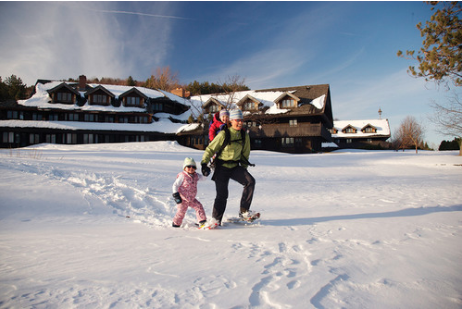
Trapp Family Lodge. Looking for Edelweiss.
The “Sound of Music” is more than 50 years old and another production by the Von Trapp family, America’s first xc ski center at the Trapp Family Lodge in Stowe, Vermont is just two years younger. Nestled beside Mt. Mansfield, Vermont’s highest peak, the lodge is among the most famous and diverse xc ski trail networks in the country. Three Stowe xc ski areas interconnect to provide roughly 150 kilometers of groomed trails, and there’s a link to backcountry ski 14 km to Bolton Valley Nordic Center via the Catamount Trail. Plus, with the variety of trails for snowshoeing around Stowe, it’s no surprise that the quintessential New England village is the original home of Tubbs Snowshoes, the largest snowshoe manufacturer in the world. Stowe’s Recreation Path, which runs 5.3 miles along the river (and over 11 wooden bridges) and Route 108 is perfect for an easy snowshoe jaunt. Don’t miss the Vermont Ski Museum in downtown Stowe or the Ben & Jerry’s Ice Cream headquarters (most popular attraction in the state) in nearby Waterbury, Vt.
Scandinavians settled by the thousands in Minnesota so it stands to reason that their national sport, cross country skiing, would abound in the state. The trails in northeastern Minnesota near Grand Marais offers more than 200 kilometers of groomed trails in the Laurentian Highlands adjacent to the Boundary Waters Canoe Area Wilderness. Here, xc skiers enjoy moose yards, overlook ridges, old trapper trails and railroad beds. The Gunflint attractions include extensive stands of white birch, spruce, and aspen and spectacular cliffs.
Of course, in the land of 10,000 lakes there’s a multitude of frozen lakes and there is also a great chance that visitors in northern Minnesota will see the oscillating luminary curtains in the evening sky known as the Northern Lights. Perfect for those wanting to get away from it all, this area is less populated than other xc Meccas and the region is sprinkled with many isolated lodges, bed and breakfast inns, lakefront cabins, and yurts (large circular heated tents with hard floors, bunk beds and room for 6-8 people). And count on hearing the distant howls of timber wolves.
Northwest Delights
More than 70 years as a winter sports destination, the Sun Valley/Ketchum, Idaho, area was developed by railroad mogul, W. Averell Harriman to attract train travelers. Known for its alpine skiing, the area features more than 160 kilometers of trails and now it touts itself as “Nordic Town USA.” The Sun Valley Resort includes the Sun Valley alpine ski area, a Nordic ski area on the golf course, and a selection of accommodations. The North Valley Trails run from the Galena Lodge back to town along the river. Expect to see colorful performance striders and skaters alongside snowshoers out walking the dog on this popular avenue.
For superb backcountry skiing amidst forests of pine and aspen, head to the Sawtooth Mountains and its high mountain reaches laced with granite spires and inviting cirques. Here xc skiers can enjoy trekking and guide services, even overnight accommodations in backcountry huts and Mongolian-style yurts.
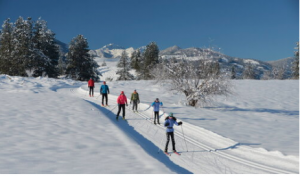
Methow Trails on a bluebird day.
The Methow Valley in northwest Washington on the eastern slope of the North Cascade Mountains is one of the best kept secrets among xc skiers. A network of 200 kilometers of groomed trails for classic and skate skiing combines at Methow Trails with lodges like Sun Mountain Lodge and warming huts along the trails, which are surrounded by more than a million acres of national wilderness and forest lands.
Snowfall here is not only plentiful, it is also dry thanks to the moisture traveling across 100 miles of mountains from the Pacific Ocean to get to Methow. And after the snow arrives, a crystal blue sky almost always follows revealing the incredible scenic mountain panoramas. Located only 2,000 feet above sea level, this 40-mile-long xc skiing valley requires no altitude acclimation.
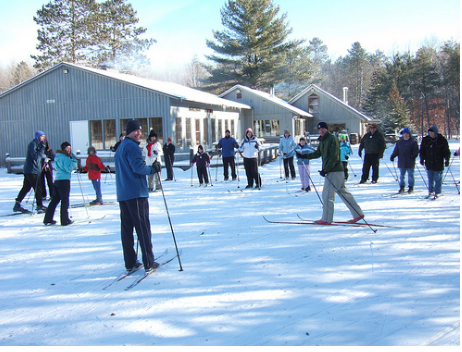
Cross-Country Ski HQ in Michigan
Many other North American regions could make the list of xc skiing Meccas, including Michigan’s Grayling region and the statewide GoMichigan, California’s Lake Tahoe, Colorado, Lake Placid in New York, and Canada’s Quebec and British Columbia areas. Start your own list of “must visit” xc ski destinations, and use XCSkiResorts.com to explore the many choices and then make some reservations to explore different regions in your next winter adventure.
The Skinny On Recreational Nordic Ski Gear
Move Up To New High Tech Equipment.
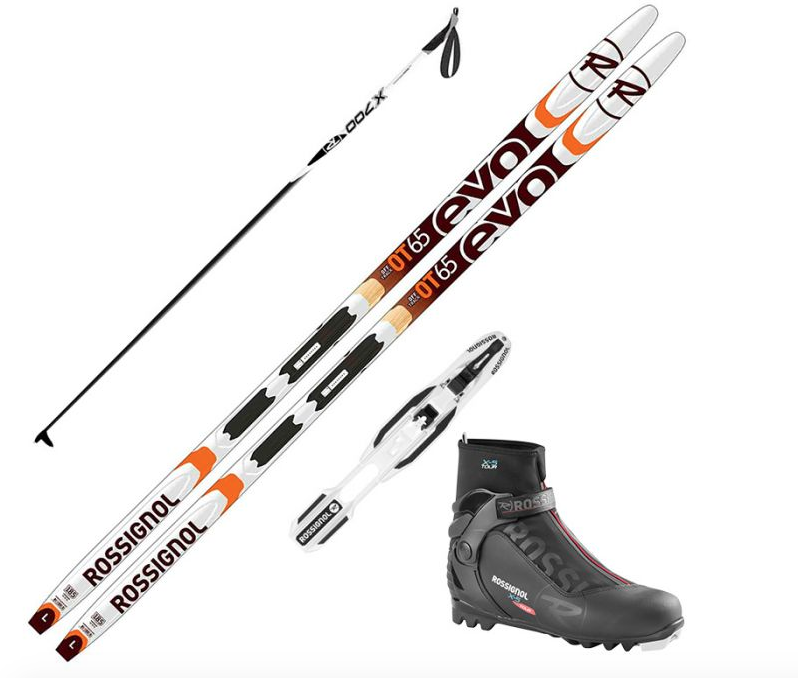
 As a part of the cross country ski industry for more than three decades, I had to qualify my response when SeniorsSkiing asked me about new cross country (XC) ski equipment. There was an unknown research source in the 1990’s that proclaimed, in general, owners of XC ski equipment had their gear for about 17 years. With a view of the meager statistics of annual XC ski sales, the age of the average XC skier’s equipment is now probably a couple of decades older than 17 years.
The key element is to know how you intend to use your equipment – classic or skate skiing on groomed trails; skiing on ungroomed park trails; backcountry in deep snow; serious mountain excursions; or if you are hoping to find equipment to deliver some type of hybrid performance in a variety of uses. XC skis provide varied width, flex, waxless base designs, and edges, all designed to perform optimally in different XC skiing situations and conditions. The recreational skier may be one that wants to get out in nature a few times per winter or a serious fitness-oriented person who is into skate skiing after work three times per week.
Ski magazines and websites deliver gear reviews with a focus on what’s new for the XC ski expert or racer. It is thought that the technology used in these products geared to advanced skiers will “trickle down” to be incorporated and become beneficial to recreational skiers in the future…well, the challenge is to provide a view specifically for recreational interests and to look at select products that offer a great experience XC skiing.
At the outset, it is uncertain why a recreational skier would want to wax their skis these days. If you possess an encyclopedia of knowledge on the matter of snow texture, humidity and temperature, there could still be changing conditions that will make your decision on the proper wax a big mistake. They’ve simplified waxing and at the same time have also have increased the options – but, recreational skiers are mostly on waxless skis. Of course there are many different types of bases that provide the grip when needed to go up the hill but also allow the best glide on the flats and down hills. Enough said to acknowledge that the most significant aspect of ski fitting has to do with the weight of the skier, and the length and stiffness of the ski and the different waxless bases are subservient to these qualifications. The other issue is the width of the ski where a narrower ski is faster and usually does not control as well as a wider ski, but again the stiffness of the ski is relevant. If you are skiing in groomed tracks, the narrow lightweight waxless ski can provide excellent glides and it can still grip when needed, if the match is done well for skier weight, and ski stiffness and length. On another matter, many people glide and may provide better stopping capability, but depending on the skier, even edges may be of no consequence when in an emergency situation.
XC Skin Skis

Author Roger Lohr on Fischer Twin Skin Skis
The cross country ski waxless “skin” bases, use inserted mohair strips on the ski bottom, which are extremely effective for all temperatures and snow conditions. It is high performance waxless base technology for the classic skier, who prefers to use a waxless ski. The ski strips are like small climbing skins which are embedded in the base and they are resistant to icing because they have a Teflon-like coating. I’ve found that there are certain conditions where the performance of the skin skis are less than desirable such as when there are dirt and leaves on the trail.
XC Ski Bindings
Today people want the convenience of stepping down and snapping into the ski binding. One new concept is the adjustable binding. Technique, temperature and snow composition all have an influence on ski performance but the TURNAMIC® binding models provide tool-free adjustment for skiers to match their individual needs. Sliding the system forward provides more grip, while sliding it back will noticeably improve glide. With the optimized setup of the boot-binding-plate-ski components, TURNAMIC® gives you dynamic skiing performance like never before.
A suggestion is to find a cross country ski area or ski retailer that has a demo fleet of skin type skis from any product company and give them a try. Play with the binding settings on the ski binding to see the effect from adjustments on grip and glide. Expect the ski to perform better than you have ever experienced.
Of course you want some brand information and that is mostly beyond the scope of this content but with the Rossignol EVO skis, it’s easy for skiers to choose their model from the line of skis determined by the level of use or performance to suit the skier’s needs. The ski width would be based on where they’ll be skied and how much floatation is desired
The Spider 62 Crown is Fischer Nordic’s popular versatile ski for a variety of uses including machine-groomed tracks at the ski area, in man-made tracks, or on unmaintained terrain. This ski will not glide well compared to the lighter, narrower, stiffer line of XC skis. The Spider is available in three sizes, has a steel edge for control, and a base pattern that holds going uphill.
XC Ski Boots

Modern XC boots from the big brands.
The biggest change in XC skiing is that the ski boots are built for support, comfort, and warmth. XC boots should be easy to get on, well insulated, lightweight, stiff soled, keep you dry and most of all, feel like bedroom slippers. The plastic cuffs and straps around the shin will provide more support, but some higher-cut boots just keep the snow out and do not provide support. Molded footbeds are recommended (acquire them separately) and make sure that the fitting occurs with the socks that will be worn when skiing. Be aware of whether the XC ski boot is specifically for skating, backcountry, or general use. Make sure that the boot matches the binding. Salomon and Rottefella bindings need boots that go complement them; BC models have wider connections to a wider boot, etc.
It is recommended that XC ski equipment is tried prior to purchase and you can do that at an XC ski area or a demo held at an XC ski area. Again, it is likely that most of the demo gear is set up for advanced skiers rather than recreational. The XC ski area rental operations may very well have different recreational rental products for you to try. When in the retail store be mindful that retail salespeople should be cognizant of your needs (where you’ll mostly ski, how much performance you desire from glide or control, etc.) and that the products that you purchase fit your specific needs.
The issue of price is basic – you get what you pay for. If you save substantial money, you’ll likely be foregoing quality, performance, or fit. Expect a discount if you purchase a package of XC skis, bindings, boots and poles.
Happy hunting for the right gear.
This article first appeared in XCSkiResorts.com
[authors_page role=contributor]