


Take Advantage Of An XC Demo Day
Try Before You Buy.
Many XC ski areas conduct demo days to give skiers an opportunity to test drive the newest XC ski equipment. It’s a day when product suppliers’ branded tents and flags are flapping in the wind and company reps stand guard armed with knowledge of their wares.
You might participate in a demo because you have outdated gear (national statistics say that XC skis are 17 years old on average) and want to test new and different equipment to replace your old clunkers. Or you might just want to experience the advantages of the new gear. There are many reasonably priced skis but a pair of XC skis can be as high as $500 for premium models, so it makes great sense to try some different skis, ski categories, and brands to find something that best fits you.
Depending on how organized the demo is, you might need a credit card and/or identification for security but remember to also bring an open mind. The rep will ask you about your skiing ability and interests. If you’re an intermediate skier who gets out on the trails four times a winter it is very different from a skier who hits the trails every weekend and can fly on skate skis. Give the rep an accurate description of your skiing prowess and interests so he or she can make a recommendation for you.
If you need a new set up and want to use a product demo to help make the decision about what to buy, do some homework before going to the demo. Talk with a knowledgeable ski shop employee who XC skis. Be wary of the alpine ski shop that limits its XC ski products to a dark or dusty back corner of the store. Find a reputable XC ski shop that sells multiple models among a few different brands of XC skis. Check out some company brand websites or other general XC ski-oriented websites.
When at the demo, get the right size skis for your weight and ski on them for about 15 minutes. Find some uphill and downhill trails to see how the skis perform. Do the skis hold going uphill or do you have to fight to prevent backsliding? Are some skis easier to turn than others? Does the glide seem to extend or do the skis slow down quickly? If you don’t know what to look for while testing, ask the rep for some tips.
It is recommended to stay in the same category of skis when testing, so if you’re trying a recreational waxless ski from one brand, test a similar ski and price point from a different brand before switching to a different kind of skis. Skis perform differently depending on flex, width, and construction – some skis glide better and some are more stable, turn easier, and are slower.
Of course, there are two different XC ski boot/bindings available and if you don’t use the same system on the different skis that you’re testing, you’ll have to change boots to ski the other boot/binding system.
Rossignol rep Will Masson commented about the advantage of demoing with the NIS binding, “The NIS system allows you to move the binding on the ski to 7 different positions so you can fine tune your grip and glide position on the skis. The binding starts out at the balance point position and moves forward 1.5 cm and back 1.5 cm to customize your weight distribution on a particular ski. This can only be achieved when using the NIS system.
There is a graph that shows the benefits of moving the binding forward and back on the plate for skating and classic. A customer might be right between a 176 cm and a 186 cm ski on the recommended weight chart. That customer can be put on the longer ski to enhance the glide, and then the binding would be moved forward to maximize their grip on that longer ski. Advantages are like fine tuning a driver in golf, or a handlebar stem height on a bike, or strings in a tennis racquet. With other Nordic binding systems once you mount the binding you are stuck in that position!”
XC ski boots are a very important aspect of XC skiing comfort and it makes great sense to ski on some different brands. Do you want your boots to feel like a comfortable sneaker or do you desire the substantial support of a stiff sole? Is the toe box area of the boot creasing in a comfortable spot when you’re skiing? Do your heels rise when you lift your foot? Is the boot too tight or too loose? Should you get custom insoles for your boots to make your feet feel more comfortable?
Have you tried XC ski poles recently? Ski poles have different grip straps that are easier to use and you may find that they are more comfortable and effective than traditional ski pole straps. Sunglasses are a great item to test. Do they fog up when you get sweaty? Do they feel so tight that you might get a headache? Are interchangeable lenses available for times of low light or bright sun?
Dedicate part of your ski day to the demo and try more than a few skis, poles, and boots. It should be fun and then you can make informed decisions when you purchase your next set of XC ski equipment and you’ll feel great that you bought the perfect gear. To find a demo day contact a XC ski area or Nordic ski retailer near you to see when they will conduct their next demo day. SIA Photo of SIA Nordic Demo at Devil’s Thumb Ranch Resort & Spa.
Editor Note: This article was originally published in XCSkiResorts.com.
Learning To Love Snowshoes
Not XC’s Poor Cousin Anymore.
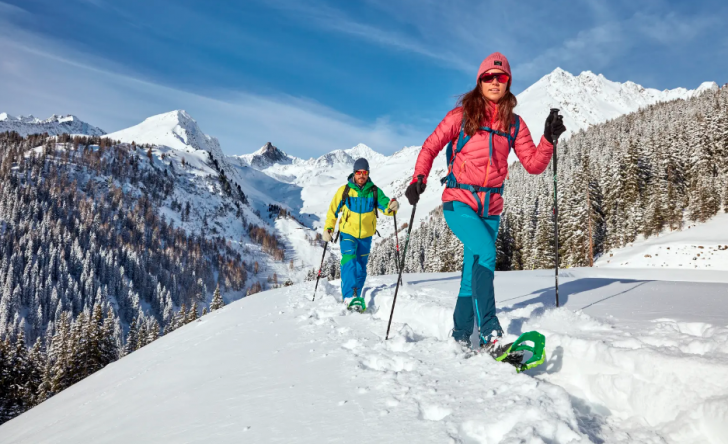
Snowshoe hiking gets you out on the snow and sunshine.
Back in 1971, when I transferred winter affections from downhill to Nordic skiing (due to a spectacular fall in Austria, that racked up one knee and stripped off my nifty French-made Fusalp ski suit– but that’s another story), I tried snowshoeing too. After all, cross-country skis and snowshoes were both made of wood and quite beautiful; they’re both ways to travel over snow rather than wade through it; they’re both very low-impact sports…
But cross-country evolved into my lifelong true love, while snowshoeing became merely the affably boring cousin you contact every few years. Too much work; bindings were crappy (now you’re in, now you’re not – and your fingers are gonna freeze putting the damn things back on); ‘shoes didn’t slide like skis, except sideways downhill on crust; wood frames cracked; rodents enjoyed chewing the rawhide webbing in summer storage…
Modern snowshoes confirm the theory of evolution. They’re clearly descendants of the woodies but fill new niches in design, materials, flotation, fun…

We moved ‘way beyond Sergeant Preston and his gigantic snowshoes.
I found this out one January about a dozen years ago, designing XC trails near Big Sky resort in Montana. (Sadly, I hadn’t visited that cousin in almost 30 years.) The snow was too deep, buried underbrush and deadfall too catchy, to use Nordic skis; so since slogging through waist-deep powder on foot was out of the question, what to do? Happily, intuition had suggested bringing my new aluminum snowshoes along, to test the frozen waters; and they behaved magnificently, though I dumped a couple of times trying to back up, sinking the tails of the ‘shoes. (My style of absorbing knowledge always seems to be “education through error.”)
So what’s new about this next generation – or two – of snowshoes? It may seem minor at first, but bindings have improved incredibly – they’re easy to use, stay on, sturdy, and they don’t stretch so they slide off your boots. The ‘shoes themselves are durable and have no food value, since they’re generally made with aluminum frames and synthetic decking that’s durable and gives great flotation – that combination also allows light weight, so less effort. The addition of bottom metal cleats gives you much better grip on crust and even side-hills (though it’s still smart to avoid those when possible).
Let’s, what else? Modern models definitely aren’t as pretty, but it’s a trade of aesthetics for dependability, longevity, convenience, and ease of movement.
Snowshoes are usually not as pricey as Alpine (or even Nordic) gear, but it’s still smart to rent before you buy to see if you like the sport. You can use hiking or snow boots with today’s adjustable bindings, or even sneakers with neoprene booties. A pair of gaiters will help keep out the snow and make sure your feet stay warm and dry.
There’s a new kind of ‘shoe that came on the market recently from a Colorado company (www.crescentmoonsnowshoes.com). They’re made of foam (foam!), but from my destructive testing are not just light but also sturdy, incredibly maneuverable (I backed up in them, did a 180 degree jump-turn for no good reason – no falls!), have great bindings, and are setting the snowshoe industry on its butt.
There are a thousand more subtleties to fun snowshoeing – using poles, running vs. walking, clothing, etiquette, blah blah. They’re relatively unimportant. Snowshoeing has become easy, and easy on your bones and joints. And even if you don’t glide, just repeat too yourself, “600+ calories per hour!” enjoy the burn, and head for the dessert tray after your outing.

New Gear For XC: Skin Skis
An Old Idea Updated With High Tech.
Author Roger Lohr on Fischer Twin Skin Skis
The cross country ski waxless “skin” bases, use inserted mohair strips on the ski bottom, which are extremely effective for all temperatures and snow conditions. It is high performance waxless base technology for the classic skier, who prefers to use a waxless ski. The ski strips are like small climbing skins and they are resistant to icing because they have a Teflon-like coating. There are conditions where a de-icer should be applied to the skins. There are anti-icing solvents that do not degrade the glue (which holds the skin to the ski) but it is best to get an anti-icer made by a ski manufacturer to avoid damage to the skin and the glue.
Specific cross country ski models that have a flex that are created in conjunction with the skin material, which rides above the snow in the glide phase, are easy to press down for excellent grip during the kick phase.
At Fischer, there are skin skis up and down the product line. The Twin Skin skis have two separate skin strips arranged in offset positions and with variable base-depth integration result in smooth and balanced gliding. These mohair skins ensure you can rely on the kick action, especially in hard or icy conditions and thanks to the unique Teflon coating of the skins, moisture absorption and subsequent icing is completely minimized.
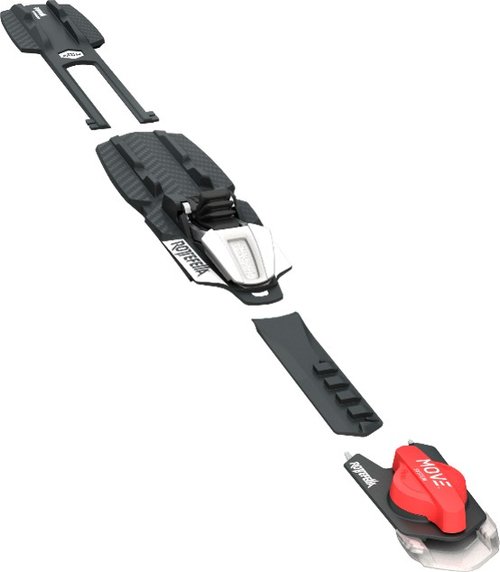
Technique, temperature and snow composition all have an influence on ski performance but with all TURNAMIC® binding models, which provides tool free adjustment skiers can better match their individual needs. Sliding the system forward provides more grip, while sliding it back will noticeably improve glide. With the optimized setup of the boot-binding-plate-ski components, TURNAMIC® gives you dynamic skiing performance like never before. FLOWFLEX® technology enables the ski to flex freely. I own a pair of Twin Skin skis and I’ve found that these skis glide better than other skis that I’ve owned in the past. At the same time, the skis have not lost the ability to climb up hills.
The TURNAMIC® binding has a user-friendly entry mechanism providing individual adjustment possible in seconds and tool-free. The bindings quickly slide onto the plate without the use of tools. When it’s time to ski, the Turn Lock mechanism can be operated even with a gloved hand, making entry and exit easier than ever before. The Rottefella Move binding when it arrives in the USA, will provide even easier dial-oriented adjustments.The Fischer Twin Skin Superlite EF provides a lightweight all-around ski featuring Efficient Forward, which gives the skier an easier, more forgiving kick action and smooth gliding. The lightweight fitness sport skis come in traditional length to glide easily on the trail.

The Rossignol R-Skin Ultra features a replaceable mohair insert, and the waxless R-SKIN base structures offer an easy, consistent kick and maximum glide with no additional prep work necessary. The Rossignol ski is built with a Nomex Honeycomb construction for an accessible mohair skin classic ski for fitness-oriented skiers. The R-Skin Ultra not only offers a bit more width than a traditional race-oriented classic ski giving a more stable platform, but it also has the same high quality base as Rossignol’s top end race skis, and a great new graphic. Compatible with the Turnamic® binding system, the new Integrated Fixation Plate (IFP) allows the most natural ski flex for unparalleled snow feel, precision, and glide. Replaceable mohair inserts reportedly provide 100-150 days on the snow before they might be replaced.
With the Atomic Pro C2 Skintec, prepping and handling couldn’t be easier thanks to its Skintec technology. There’s no need for kick-waxing – instead mohair grip zones produce excellent kick and glide in all snow conditions and temperatures. And you can replace the grip zone after heavy wear. Atomic has added a high-quality base, race grinding, a sportive sidecut and a flexible tip for an easy slide-in and glide. This year they’ve also given the series a facelift with a cool new design for the track.
A suggestion is to find a cross country ski area or ski retailer that has a demo fleet of skin type skis from any product company and give them a try. Play with the binding settings on the ski binding to see the effect from adjustments on grip and glide. Expect the ski to perform better than you have ever experienced.
Editor Note: This article first appeared in XCSkiResorts.com
[authors_page role=contributor]