


Tips On Starting Nordic Skiing
It’s Different, It’s Fun, It’s Accessible.
So you’ve decided to try cross country skiing, You can call it cross country skiing, Nordic skiing, XC skiing, or ski touring – when trying cross country skiing the first few times it may be a totally new experience for you and it may take time for you to become confident. Experienced cross country skiers might call you a first timer, beginner, novice skier, and even a “never-ever” but as with any recreational activity, if you do it a few times, it will become easier and more familiar. Cross country skiing can take a while to master, but it is outdoor fun even on the first time on skis.
Downhill Skiing Is Not The Same As Cross Country Skiing
Most people believe that if you are an alpine skier and have mastered the lift-served form of snowsports, that you can easily master cross country skiing. But alpine ski equipment is much heavier than cross country ski gear – the big plastic ski boots and wide skis provide substantially more support compared to cross country ski equipment. Snowplowing on cross country skis takes more technique to roll your ankles and hold/push the ski edge of the skis against the snow while you are moving. Even though both sports are on skis and on the snow, there are many differences between downhill skiing and cross country skiing.
Wobbly Feeling
Putting on the comfortable cross country ski boots, stepping on the bindings and attaching to the narrow skis, you may feel a bit wobbly at first. You’ll be gliding down the smallest incline and you may feel unsure, but bend your knees and try to relax. Don’t lean backwards – bend your knees and feel your weight on your heels and you’ll have more control.
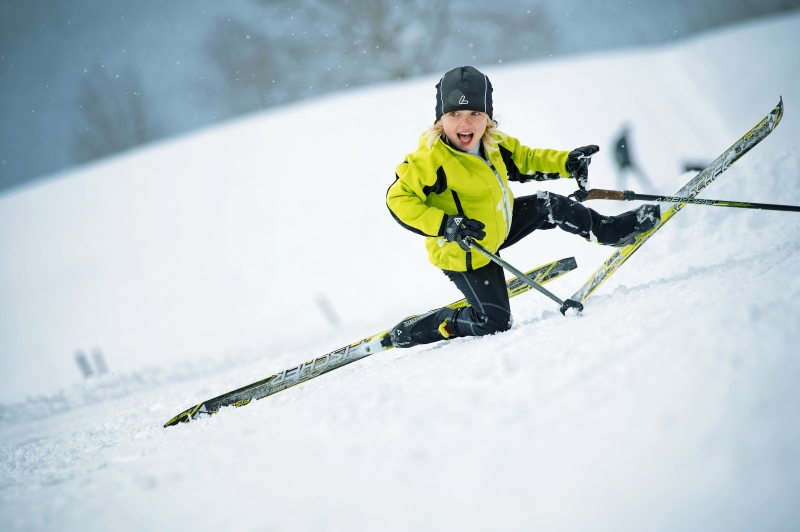
You Will Fall Down
Accept that you will likely fall while cross country skiing. Everyone falls while cross country skiing sooner or later and the snow provides a soft landing. Getting up after a fall is sometimes complicated to orchestrate, but take your time to untangle and get to your knees. Once on your knees it should be easy to stand up.
Groomed Trails
Many people dream about cross country skiing as an adventure in the forest and down hills in the wild. The truth is that this form of recreation is much easier on groomed trails…that is, trails that have been packed and tracked by a machine. On groomed trails, it is easier to glide, easier to go up hills, and easier to control the speed going downhill with a snowplow technique. Cross country ski areas provide trail grooming and charge a fee to use the trails. The trail grooming, signage, maps, lodge facilities, and other services are definitely worth the fee. Most cross country ski areas do not allow dogs to use the trails, but some areas offer dog-friendly trails.
To find a cross country ski area, use the Internet or websites such as www.XCSkiResorts.com or the Cross Country Ski Areas Association (www.xcski.org). These areas often require a reservation to get a lesson, as they do not always have instructors on site, so visit an area’s website in advance to get their information.
Be Prepared
The typical safety concerns are prevalent with cross country skiing. Go out with someone else, take water and food, and have some additional clothing (dry gloves, hat, neck gaiter, etc.) in case it gets colder or snows. These concerns can arise if you take a wrong turn where you end up on a longer trail that you expected.
Hills
If the terrain that you are skiing on is perfectly flat, you should not have much problem on cross country skis but when there are hills, you’ll encounter the sport’s ups and downs. The first time going down a hill could be a bit frightening but as in any sport, with practice you will become more accustomed to the feeling…hopefully. It is best to get tips or a complete lesson. The various cross country ski techniques are taught by experienced or certified instructors at cross country ski areas. Most likely you have friends who try their best to provide insight on ways to master the skis. The former idea (with a certified ski instructor) is the better choice.
Get Out There
Cross country skiing provides one of the greatest full body workouts available as it uses all parts of the body’s muscle groups. You may not feel exhaustion while you are out on the trails, but your body is working hard and using unfamiliar muscles, so take it easy. It’s best to go on a short outing at first and build up the distance or time on the skis over multiple outings.
Getting information about equipment and the different forms of cross country skiing (on track, off track, skating, backcountry, etc.) can be found on the Internet and/or at a cross country ski area. It makes sense to rent your equipment the first couple of times to see if you like cross country skiing. Most ski areas have rental gear for first timers (skis are softer and wider) and for more athletic people (skis are narrower and more lively). The narrower skis will glide better and go faster, while the wider skis will allow more control but feel like they drag a bit on the flat terrain.
When you get ready to purchase equipment, talk with professionals at a cross country ski area or retail shop to make a decision about what to purchase, which will depend on your interests (on track, off track, control, performance, etc.). Once you become a cross country skier, you’ll look forward to when it snows and it will become a magical experience to enjoy every winter. Top photos, Fischer Skis, Bottom photo, Great Glen, NH
Editor Note: This article first appeared in XCSkiResorts.com
This Week In SeniorsSkiing.com (June 26)
Is Fitness On Your Mind These Days?, Harriet’s Hip Advice, Exercise Hacks Book Review, Questions For You.
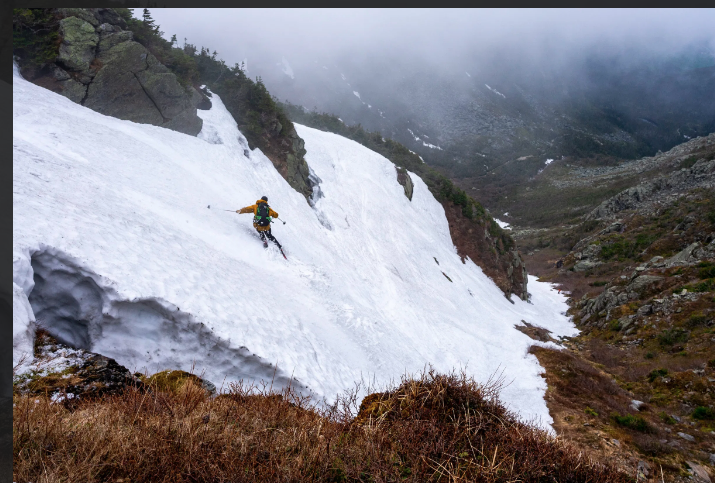
Ski Tuck in June? Sure, say three Vermonters. See below for link to story in Powder Magazine. Credit: Connor Nash from Powder Magazine
The summer solstice has come and gone. On solstice day, a northeastern Siberian town located above the Arctic Circle, recorded 100.4 degrees, the highest temperature ever recorded in the Arctic since records have been kept.
In the East, an early summer heat wave continues, putting a damper on vigorous outdoor activities for seniors.
Or not.
Around our rural neighborhood, we’ve noticed several senior road cyclists riding solo in the heat of the day, temperature in the mid-90s, humidity up there, their gray hairs sticking out of their helmets giving them away. Senior runners are out there, too. Wise to keep pumping? Witless for pushing the limit?
At our age, most readers engage as best they can in vigorous physical activity, snow sports in winter, other activities in non-snow months. The virus, however, is cramping our habits. Gyms are closed or opening under major constrictions; team sports are out, bike clubs are social-distancing and mask-wearing, and pools are off limits.
As a result, we know for a fact that some seniors are exercising with new behaviors perhaps unwisely, too much, in the heat, perhaps with existing injuries. We know because we are one. Too much aggressive yoga led to pulled muscles, shutting down our physical activities for weeks now.
It’s hard to ignore that our lives have changed in these times of the virus. What we need to understand is that new fitness habits have to be thought through so that our enthusiasm for that endorphin rush doesn’t compromise our bodies.
This Week.
 In this week’s edition, we have a series of articles on fitness. SeniorsSkiing.com correspondent Harriet Wallis offers her advice on critical decisions prior to having a hip replacement. Harriet should know; she has two new hips and two new knees.
We have also been sent a cool book on fitness for seniors. K. Aleisha Fetters’ Fitness Hacks For Over 50 offers 300 ways to build easy fitness moves into everyday activities. It’s a very clever idea to get us to think of different ways to keep our bodies in motion.
The results of our Next Season Survey are in. Click here to review the highlights. Thanks so much for your participation. We had a 21% response rate which is very high for a publication like ours and evidence of the engagement of our readers.
We have some additional Questions For You this month, focusing on cross-country skiing and how frequently SeniorsSkiing.com should publish next season. Please offer your thoughts.
And despite the oncoming of summer, three Vermonters found a way to ski left-over snow at Tuckerman Ravine in the White Mountains. Click here for a link to this story from Powder Magazine about three lucky skiers who saw an opportunity ski the Ravine in late June.
Be safe, stay well. Remember there are more of us every day and we aren’t going away.
Short Swings!
Over the past few weeks, we’ve received numerous emails from ski industry and other leaders supporting Black Lives Matter. Mike and I want to add our voices to this and to other expressions of social justice.
Many of you will remember Bob Dylan’s 1964 song, “The Times They Are A Changin.” His anthem to social change and the consequences of ignoring it takes on new relevance during this time of social, environmental and economic uncertainty and disease.
Each of these issues is evident in skiing, boarding and other winter sports. There should be more people of color on the hill, but for many, the effects of historic social injustice have prevented their participation.
We are constantly reminded of the unfair treatment of those whose skin color relegates them to economic and educational disadvantage and the lifelong consequences of those disadvantages.
The ski industry has acknowledged the need for change. For years, National Ski Areas Association has reached out to minorities in an attempt to attract them and add diversity to the sport.
It appears that decades after Dylan released “The Times They Are A Changin’,” things, finally, are changing. It’s about time.
National Brotherhood of Skiers
The National Brotherhood of Skiers the group of African American skiers founded in 1972. Its history is fascinating, and its programs introducing black youth to the sport are encouraging. Learn more about NBS by clicking on the image above an watching a first-rate video produced by REI.
95-Year-Old Heli-Skier Sets Guinness Record
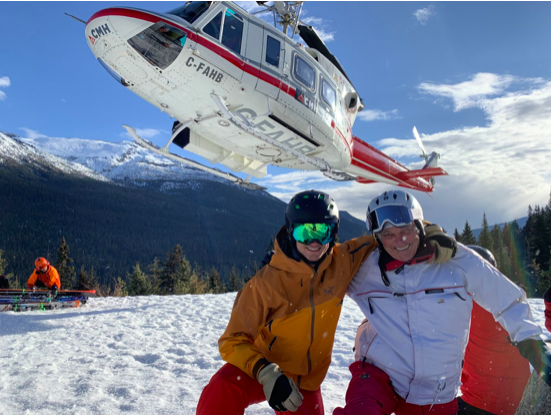
World’s oldest heliskier Gordon Precious and grandson. Credit: CMH Heli-Skiing
Gordon Precious, 95, of Hamilton, Ontario, recently set a new Guinness World Record for oldest heli-skier. A lifelong skier, he achieved the record last year and shortly before his 95th birthday. The previous record was set by a 91-year-old.
Liftopia Stiffs Ski Resorts
Liftopia, the biggest online lift ticket seller, owes more than $3MM in ticket sales to Alterra, Mountain Collective, Aspen and other resorts. Sources report Liftopia will seek bankruptcy protection.
Mountain Collective Lowers Price; Adds Resorts
Good News: Mountain Collective is giving 2019-20 passholders $50 off their 2020-2021 passes. And it has added these resorts: Sun Peaks Resort, BC; Grand Targhee, WY; Panorama, BC; Sugarloaf, ME, and Chamonix, France. There are now 23 top-raking destinations on the pass.
Less Than Good News: “No Questions Asked” refund deadline for purchasers is October 16, 2020; slightly early to know about the health of the ski season when COVID’s second wave may be reaching shore.
Portillo Postpones Opening “Indefinitely”

Portillo
A letter this week from Ski Portillo states that the legendary Chilean resort will remain closed indefinitely because COVID-19 is at peak levels in Chile, quarantines, and travel restrictions.
Reliable Source of Reliable COVID Supplies

KN95 Mask Type II Surgical Mask
I keep on hearing about people ordering face masks online and getting ripped off. An acquaintance thought she was purchasing COVID masks and was sent tiny, mouth-only coverings, unusable for COVID or any other protection. A recent column mentioned that Masterfit, ski boot footbed manufacturer and SeniorsSkiing.com advertiser, now sells high quality KN95 (comparable to the US’s N95) and Type II surgical face masks.
- KN95 masks fit securely around the face and provide maximum fluid resistance and filtration efficiency. They’re good for those interacting closely and frequently with the public.
- FDA Certified Type II surgical masks are what many surgeons wear. They’re lightweight and provide excellent protection through the triple filtration face barrier. Type IIs comfortably wrap around nose, mouth and under the chin. While not designed to make an air-tight seal, it does provide significantly greater virus filtration protection than a simple dust, particle or homemade mask.
Masterfit also sells reusable face shields and an excellent COVID disinfectant spray. SeniorsSkiing.com subscribers enjoy a 10% discount on masks. Pre-discount prices : $35 per package of 10 KN95 masks and $39.50 per package of 50 Type II surgical masks. Click here to access Masterfit’s PPE products. For the discount, enter FOMCOVID1910 at checkout.
[authors_page role=contributor]