


Planning on Skiing Next Season? 92% of You Say YES!
Based on the just completed SeniorsSkiing.com Reader Survey, 92% of you plan to go skiing next season. This, despite growing coronavirus concerns, especially within our age cohort.
You also weighed in on the importance of preventive measures ski areas can take to control the virus:
- 86% of you consider continuous sanitizing in all public areas (e.g. dining, lodge, restrooms) to be extremely or very important
- 74% say social distancing in dining areas, lift lines and other public spaces is extremely or very important.
- 59% report use of face masks on lifts and in public spaces is extremely or very important.
- 50% indicate daily limits on numbers of skiers and boarders are extremely or very important.

Almost 3,500 of 16,500 readers responded. That’s 21% of our growing subscriber base. Past survey response rates rage from 17.5% to 27.5%.
As to where you plan to ski, 40% will stay local; 56% will take one or more long distance ski trips and ski locally, and 25% will take one or more long distance trips.

Of those taking long distance trips, 42% will ski the US Rockies, 26% will ski the US West, 14%, each, will ski the Canadian Rockies and the US East, and 10% will ski in Europe, Australia, New Zealand, Asia, or South America.
We also asked with whom you usually ski. The question listed “solo,” “spouse,” “spouse and friends,” “friends,” “adult children,” “grandchildren,” etc. and gave you the opportunity to check “all the time,” “quite frequently,” or “somewhat frequently,” “rarely,” and “never.” Your responses, while not absolute, present a proportional picture:
- 48% ski with friends all the time or quite frequently
- 44% ski solo
- 43% with spouse
- 34% with spouse and friends
- 25% with adult children
- 16% with adult children and grandchildren
- 10% with grandchildren
We’ll report on other findings in future issues, but one we thought you’d be interested in learning is the amounts you reported spending last season on all aspects of skiing (e.g. equipment, clothing, accessories, travel, lodging, food, lifts, etc.) for yourselves and others.
- 51% less than $2500
- 29% between $2500 and $5000
- 19% more than $5000
The average respondent’s age is 69.8. Seventy-three percent are male; 27% female.

Thank you for taking the time to provide your points of view. We expect that your input, especially on next season’s plans, will help inform resort management decision-making.
The survey was conducted in early June using Survey Monkey.

Is A Hip Replacement In Your Future?
Here Are Some Tips From A Two-Hip Skier.

Here’s Harriet. Two new knees, two new hips. When it comes to joint replacement, she knows what she is talking about. Credit: Courtesy of Alta
Your decision to replace any body part is a serious decision. Unlike a purchase from a retail store, you cannot return an implant!
But when your “original equipment” wears out, it’s time to have it replaced. Overall, we’re living longer, we’re living healthier, and we want to enjoy life—and ski.
As background, I have two artificial hips, two artificial knees, and I skied 78 days during this last winter before resorts closed because of the Covid virus. Artificial hips and knees work really well.
Here are some tips if you’re considering new hips.
Choose your surgeon carefully. Your future depends on it. Pay the cost of visits to several surgeons. Those visits will help you choose the right one for you.
1. Ask hip questions
Here’s the list of questions I asked each surgeon. I printed a sheet for each surgeon and I wrote down their answers so I’d remember what each one said. Unexpectedly, their answers were quite different. Print out these question and bring them with you to each visit.
- Do I need a hip replacement?
- How many hips do you replace a week? A year?
- Do you do the surgery or does someone else do it?
- Do you do anterior or traditional cut? Why?
- GPS guided? Robotic? Manual?
- What kind of anesthesia? Why?
- What brand of implant do you use?
- Metal or ceramic?
- Glue? What kind? Why?
- Bone density. What if my bones aren’t good when you get in there?
- Do you resurface instead of replace? Why?
- How long in hospital?
- Will I need help when discharged?
- What kind of PT do you recommend?
- Can I ski?
- Why should I choose you?
2. Do a visual check
Are the surgeon’s shoes clean and polished? How’s the hair? It’s a quick measure of how well the surgeon values him/herself. Neat and clean is a good sign. Think twice if s/he’s scruffy.
3. Find out if he’s/she’s athletic.
A surgeon who is physically active will understand your need to keep your active lifestyle and ski. If she or he’s a golfer, plays tennis, bikes, water skis or is active in some sport, she or he’ll identify with your need to keep your body in motion.
Personal note, funny story:
I met with a noted—but fat—surgeon, and I asked: “Do you ski?”
He replied, “No, but I own a house at the resort!” And he said I should give up skiing. I eliminated him from my pool of possible surgeons.
Get your X-rays on a disc
Be prepared. Take the disc of X-rays with you each time you visit a surgeon so they don’t have to take new X-rays. Surgeons might be in different networks and therefore not have access to your X-rays. Or, even if they’re in the same network, the computer system might be down that day.
Before surgery, plan ahead for PT
Visit some physical therapy studios, ask about their rehab for hip replacement, and decide where you want to work out. Do that homework before surgery.
Personal note: When I came home, I did the prescribed home exercises exactly as I should. But the exercises got easy and I stopped making progress. I was glad I’d checked out PT studios and switched to one with electronic equipment, gym-type equipment and a heartier workout. Recovery came quickly.
After surgery
Expect to start moving right away. Expect to be walking the day after surgery, and expect to have in-hospital physical therapy.
Personal note: I was in the hospital for a couple days and I progressed quickly. The PT studio stairs became too easy, so the PT therapist took me to the hospital stairwell for greater challenge and practice. On a nice day, we went outside and walked around the entire building.
Shoes and boots
Your new metal hip might like more cushy shoes or a different pitch than you’re used to. Buy your shoes and boots at a store such as REI that lets you wear them, see if you like them, and bring them back if they’re not right.
Personal note: With two metal hips and two metal knees, my body is fussy about what’s on my feet. I now buy all my footwear at REI so I can test drive them for a while in real life, not just in the store.
Look forward to a new hip. Work hard at PT. And I’ll look for you on the slopes.
To read Harriet’s five-part series on knee replacement, click these links.
- https://seniorsskiing.com/life-knee-replacement-part1/
- https://seniorsskiing.com/knee-replacement-isnt-sissies-part-2/
- https://seniorsskiing.com/knee-replacement-interviewing-docs-part-3/
- https://seniorsskiing.com/knee-replacement-chose-surgeon-part-4/
- https://seniorsskiing.com/knee-replacement-now-part-5/
Book Review: Fitness Can Be Everywhere, Every Day
How To Integrate Exercise Into Just About Everything You Do.
 SeniorsSkiing’s readers all know and appreciate the value of fitness and exercise. Our surveys have shown that when the snow season is over, out come the golf clubs, bikes, tennis racquets, kayaks, hiking boots, and the like. Active lifestyles are us and part of who we are.
Enter the Corona Virus which, for reasons still unknown, goes after some people more viciously than others. Several risk factors are correlated with severity, according to Michael Osterholm, PhD, MPH, an internationally known infectious disease epidemiologist at the University of Minnesota. “If you’re over 65, you’re male, if you have underlying heart disease, hypertension, diabetes, certain lung or blood cancers or if you’re moderately to severely obese, then these are all risk factors for developing the disease,” said Dr. Osterholm in a recent interview.
He goes on, “Healthy lifestyles are so important in reducing your risk for severe disease.”
Maybe your gym has been closed, you can’t ride trails in locked up parks, you’re bored beyond belief with walking your usual three mile loop, or, after four months of lock down, you’ve retreated to the couch and binge 0n Netflix. These are strange times, requiring new ways to do old things. Fitness is one habit to figure out how to maintain.
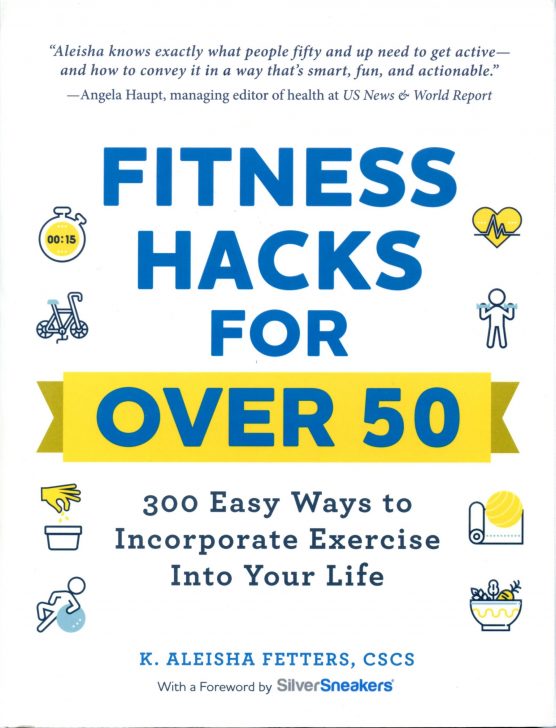
We recently received a brand new book that gives us 300 ways to keep that healthy lifestyle going. Exercise specialist K. Aleisha Fetters’ Fitness Hacks For Over 50 is strike-zone for senior athletes and actives like us.
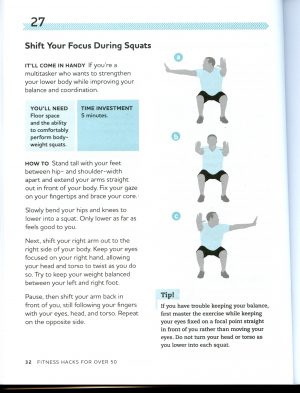 Fetters has created a number of simple things you can do—she calls them “hacks”—that build fitness activities into your day. The book is divided into four major sections: Balance and Coordination, Flexibility and Mobility, Muscular Strength, and Aerobic Capacity and Endurance. Note that while you are probably already engaged with a couple of these—we are overloaded on muscular strength—there are others that need attention.
For example, how many readers focus on Balance and Coordination activities, a skill critical to aging? Here’s an interesting one. Close your eyes when you’re exercising in place, brushing your teeth, making the bed, or washing dishes. Use your senses like hearing and touch to compensate. Simple? Try it. This is a mental game—brain-body coordination—that’s really important to master as we age.
Fetters defines flexibility as being able to touch your toes—the ability for muscles to lengthen and stretch. She calls mobility the ability to get up off the floor—how your joints actually move. Different things. Some hacks here include Lifting A Knee while standing against a wall, Reaching Behind your back, one hand over the shoulder, the other coming up the back. In this category, there are a number of yoga asanas (poses) including a full Salute The Sun sequence.
 In Muscular Strength you’ll find a number of class gym-type exercises as well as novel ideas like Hover Over A Toilet Seat, handy in public rest rooms, or Squeezing Your Cheeks. Yes, those cheeks.
Fetters has 75 ideas for upping your heart rate from Hitting Intervals to Tickling Someone to adding steps in the mall, the parking lot, the airport.
This is an excellent reminder to us that it is important to move the body in a variety of ways every day. Fitness Hacks For Over 50 makes exercise accessible to us all, so we can continue our healthy lifestyle even though the gym is closed, and the couch is calling us.
[authors_page role=contributor]