


John Fry (1930-2020)
Journalist, Historian, Innovator, Hall of Fame Member Passes On.
[This article first appeared in Ski History Magazine. We thank the International Ski History Association for permission to reprint this memory of a ski industry legend.)
John Fry. Credit: SKI Magazine
John Fry, the dean of North American ski journalists, died suddenly but peacefully on January 24, two days after celebrating his 90th birthday
Fry was in apparent good health. According to his wife, Marlies Fry, he suffered a probable stroke while floating quietly in shallow water off a beach on Vieques Island, Puerto Rico.
Over a 60-year career devoted to ski journalism, Fry served on the staffs of the magazines SKI LIFE, SKI, Snow Country and Skiing Heritage (now Skiing History). He was editor-in-chief of SKI, founding editor of Snow Country, and served as president and then chairman of the International Skiing History Association.
“John’s love of skiing, combined with his talent for in-depth reporting and crystal writing style, set the standard for ski journalism not only in English but world-wide,” said Seth Masia, who went to work for Fry in 1974 and is today president of the International Skiing History Association. “Those of us who had the good fortune to work for him loved his wit, warmth and mentorship. He was the heart and soul of each magazine he edited and was more productive and inspiring than ever during his final years with us.”
Kathleen James, editor of Skiing History, had this to say: “In 1994, John Fry gave me my first big-time magazine job as an associate editor at Snow Country. Over the years, working for him there and later at Skiing History, he taught me how to hold every issue of every magazine to the very highest standards: to examine story ideas with a critical eye, ask authors the right questions, and artfully present the finished article on the page. At the age of 90, his comments on stories, his suggestions, and his headlines — succinct, funny, compelling — were always the very best. He was my mentor, my friend and a second father who always pushed me to be better. To my occasional frustration and eternal gratitude, he was (almost) always right.”
Fry edited America’s Ski Book, revised edition (1973), co-authored with Phil and Steve Mahre their autobiography No Hill Too Fast (1985), and authored the award-winning book The Story of Modern Skiing (2006) and a work of Canadian history, A Mind at Sea: Henry Fry and the glorious era of Quebec-built giant sailing ships (2016).
In addition to his writing, as editor-in-chief at SKI Fry created the Nations Cup of alpine skiing, ranking the worlds’ national ski teams based on World Cup points; and NASTAR (National Standard Racing), the nationwide recreational alpine racing series now owned and operated by the U.S. Ski and Snowboard Association.
Born January 22, 1930 in Montreal, Canada, Fry first donned skis at age six. After a few years he was able to ride the world’s first rope tow, which had been built at Shawbridge, Quebec in 1932. For high school, he attended Lower Canada College (class of 1947), and was a member of its championship ski team. At McGill University he raced for the Red Birds Ski Club and earned a bachelor of arts degree in 1951.
Fry emigrated to New York City in 1957 to join the daily trade paper American Metal Market, where, in 1960, he was named managing editor. Meanwhile, he freelanced as contributing editor of Ski Life, a national magazine launched in 1959, soon to be merged with SKI Magazine. In 1963 he joined the staff of SKI as executive editor, and editor of its sister publication Ski Business. In 1964 he was named editor-in-chief of SKI, and in 1969 became editorial director of SKI and Golf Magazines. After the Times Mirror Company acquired the titles in 1972, he served as editorial director of Outdoor Life, SKI and GOLF, with circulations ranging from 350,000 to 1.8 million. During this period, he created two new publications: Action Vacations and Cross-Country Ski. In 1965 he married Marlies Strillinger.
In the summer of 1987, the New York Times Co. retained Fry to create a new magazine, Snow Country. When the magazine debuted in January 1988, he became the full-time editor-in-chief. Snow Country attained a circulation of 450,000.
In 1996, the New York Times Sports/Leisure Group appointed Fry as editor of new magazine development. In this role he launched Golf Course Living Magazine. He retired from the New York Times Co. in 1999 and returned to SKI as a contributing editor. He remained an active contributor at Skiing History magazine until his death.
Fry was elected to the U.S. Ski and Snowboard Hall of Fame (1995), to the Laurentian Ski Hall of Fame (2016), and to the Canadian Ski Hall of Fame (2018). A founding member of the International Skiing History Association, he first served as its president in 2001, and from 2014 until his death was the association’s chairman. He also served as a director at the environmental organizations Riverkeeper (1992-2000), Pinchot Institute for Conservation (1994-1999), and Beaver Dam Sanctuary (1995 until his death). In 1997 he was honored by the International Ski Federation (FIS) with its Journalism Award.
Fry is survived by his wife of 55 years, Marlies; their daughter Nicole Fry; his children by Ann Lyons, the sculptor Leslie Fry and William Fry; and grandchildren Sarah and Emily Fry.
A memorial will be planned later.

Have You Been Drinking? It’s Time To Start!
Hydration and Stretching: Two Things You Must NEVER forget to do before you hit the slopes.
If you’ve taken to heart the advice in a previous seniorssking.com article of Paul Petersen, president of Bear Valley Cross-Country in California, on the best way for seniors to get in shape for skiing, you’ve developed and faithfully followed a fitness regimen focusing on balance, strength, flexibility, and cardio. But the 56-year-old certified alpine and cross-
Bear Valley Cross Country’s Paul Petersen swigs water, something we should all remember to do.
Credit: Paul Petersen
country ski instructor will quickly tell you that this is not enough. What you do in the days before and right up to the minute that you put ski or board to snow is just as important as all the pre-season conditioning you’ve done.
One of the most overlooked factors in preparing for a day on the slopes is hydration. When your body is well-hydrated, your body temperature and heart rate are more stable, your joints and muscles function better, and you have more stamina. Conversely, if you’re dehydrated, which can happen more quickly at elevations above 5,000 feet—especially to flatlanders, you won’t be able to perform well for any length of time, you’ll tire more easily, and you may experience dizziness, headaches, or shortness of breath. Says Petersen, “When it comes to hydration, you have to think ahead. You can’t properly hydrate for athletic activities the day before; you need to begin several days beforehand. Remember, you’re not trying to hydrate your stomach, but rather your joints and muscles and that takes a while.”
If you’re a typical skier, before you head out for the slopes, you probably have a cup of piping hot coffee or tea in the lodge (this may be in addition to the glass or two of wine you had at dinner the night before). This is a total recipe for dehydration! “Any liquids with caffeine or sugar, including sodas,” says Petersen, “are NOT a net positive in the hydration department!” For every cup of coffee or other caffeinated beverage you drink in the morning or while on the mountain, Petersen insists that you drink an equivalent amount of water.
Noting that senior wintersports participants schedule longer trips and thus ski more consecutive days than the average skier, Petersen emphasizes the importance of recovery for seniors after a day on the slats and boards. “Right after you’re done on the slopes and before you hit the bar, hit the protein bar,” he strongly advises. “For me, the magic bullet is protein powder in water. Either helps you recover from that day and helps your body get ready for the next day.”
An equally important factor in ensuring a safe, fun day on the slopes is adequately stretching your muscles right before you start out. We’ve all done those cursory arms over our heads while stretching our waists and quick calf stretches, right? Not good enough per Petersen! “You can’t just touch your toes, grab your ankles, stretch your thighs, and then walk out the door,” he warns. “The night before, put aside a few minutes to stretch your hips, calves, and thighs, and again the next morning before you put your boots on, either in the parking lot or at your locker.”
In sum, make “water, stretch, go” your wintersports mantra if a perfect day “doin’ it” is what you’re after!
Deer Valley: Win-Win For Two Generations
Convincing Reasons Why Two Generations Love Deer Valley.
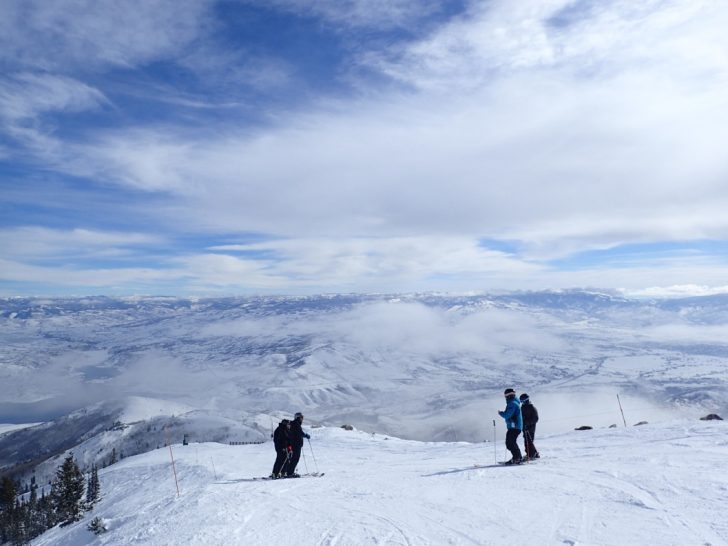
Blue skies, top of the world at Deer Valley. Credit: Tamsin Venn
We recently returned from our annual January family trip to Utah, with our 20-somethings joining us. Utah is currently experiencing record snowfall with more than 300 inches and more on the way. Aside from snow, here are reasons why two generations love Deer Valley, ranked consistently as one of the top ten resorts in the country.
- Utah powder gets dried out and fluffed up on its way over from the Pacific Ocean, so it’s easy turning for both old and young knees.
- Free valets greet you and put your skis in ski racks, more energy for powder skiing.
- Free overnight boot and ski check, less schlepping, even more energy saved for skiing.
- The number of feet you have to walk from a base lodge door to a lift might be written into the area’s mission statement. See previous energy statements.
- Truly varied and sophisticated food, always with a few extra special ingredients for the piece de resistance, fosters lingering, providing rare commodity of uninterrupted family time. WiFi is available.
- The Rossignol High Performance Test Center located next to the Empire Canyon Lodge gives you two hours of free ski trials, as many as you want. Match your boards to conditions and try out new Rossignol technology. Both old and young stretch comfort zones in moguls and powder.
- At the posted trail maps, very upbeat, green-uniformed hosts tell “guests” where they are and where to go. You never have to be lost on the area’s six mountains, six bowls, and 2,000 acres

Young, really young, and seniors love the DV. Credit: Tamsin Venn
- Stein’s Way, a black diamond off Bald Mountain’s right shoulder, overlooks Jordanelle Reservoir and is a popular first run groomer with the senior set. And the 20-year-olds, who will do a couple of warm-up runs on Stein’s then switch to the more gnarly Mayflower Bowl.
- The less expensive IKON base pass gives you five days at DV, plenty of time to play out the equation between willing spirit but flagging body. If you still have vacay time, the IKON base pass lets you ski five days at Alta/Snowbird, five at Brighton and unlimited at Solitude. Blackout dates apply.
- No snowboarders. Yup, even the 20-something-year-olds who ski with us do not like the sound of a thundering snowboarder coming up from behind. That rule does preclude skiing with some of our favorite people.
- The sharing economy. Our AirBnB in Park City was roomy and tucked away, but just steps from a stop on the free town bus system. Millennials support public transportation.
- Ski instructors are everywhere leading their charges, often in semi private lessons. Eavesdrop to pick up a few pointers on powder days.
- Limited ticket sales —7,500 a day—ensure quick moving lift lines, enhanced by 21 chairlifts (12 are high speed detachable quads,) and one gondola.
- A well protected, well staffed learning area with magic carpets helps make DV one of the best places for the little guys, generation 3 TK.
Why go anywhere else?
Lift Ticket Rates: Senior (65 plus) Daily Lift Ticket Rates start at $120 when prepaid online. Senior Season Pass: $1,236. IKON pass no longer available for 2019-20: Check prices here. https://www.deervalley.com/plan-your-trip/tickets-and-passes
Find Out More: Click Here For the Deer Valley website
Trail Map: Click here
Web Cams: Click Here
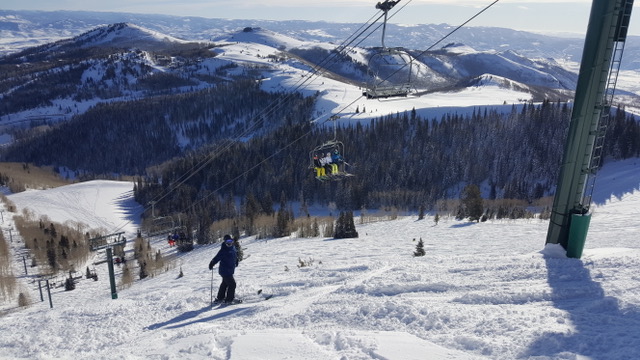
So far this season, the snow has been abundant.
Credit: Tamsin Venn
[authors_page role=contributor]