


Eat Your Way To Fitness
Cross Country Ski and Snowshoe Food Events Offer Exercise And Gourmet Food.
Nordic Nibbles are happening across the country. Eat and lose weight.
[Editor Note: This article first appeared in XCSkiResorts.com, published by Roger Lohr.]
Want a guilt-free way to indulge yourself with food while exercising? Cross country (XC) skiing and snowshoeing are some of the best forms of aerobic exercise, but if you go on a “Gourmet Ski Tour” on your XC skis or snowshoes, you may very well eat your way to fitness at a number of trailside food stops. What a grand time so go ahead, eat, ski, and be merry—appetizers, wine, champagne, fondue, entrees, desserts, and more.
Here’s a cross section of the culinary XC ski events that are planned this winter across the country with a varied menu of fun and fine cuisine.
East
Smugglers Notch, VT has the Snowshoe Adventure Dinner at the mountain summit on Tuesdays. The Maple Experience is on Tuesdays on a tour to learn about maple sugaring and get to take home a sample. The Sugar on the Snow snowshoe tour is on Wednesdays. The Hot Chocolate Warm Up is daily at 3:30 PM with a bonfire.
Notchview Reservation, Windsor, MA hosts the the Breakfast Ski Club with a short tour followed by beverages, pastry and fruit (9 – 11:00 AM on Jan 18, Feb 1 and 15).
The Chocolate Festival at Mt. Washington Valley Ski & Snowshoe Center, Intervale, NH on Sunday, February 23 is an inn-to-inn affair at about 12 stops to experience your chocolate fantasies including moose and fondue. Go on a tour of any length and actually gain calories, even if you ski as far as 20 kilometers. A shuttle is also available for those that have overindulged at the event dubbed the “Sweetest Day on the Trails.”

Check out those goodies, then burn cals.
Central
Treetops Resort, Gaylord, MI has the Skiable Feast Getaway Package that features a winter gourmet adventure with five buffet food stations along six km of trails. It is offered at 8 AM – 2 PM on seven dates on Saturdays during January-March. Also the Wilderness Sleigh Ride Dinner is on Saturdays at 5-9:30 PM on a tour to the cabin for a culinary adventure.
Cross Country Ski Headquarters, Roscommon, MI has the “Around the World Wine & Ski Tour” is a new event with XC skiing, and Ribs & Blues food music event, and the Gourmet Chili Bard. Look for the Fill at the Grill and Fire on the Mountain food events.
The Upper Peninsula of Michigan in Ironwood features cuisine from local restaurants that can be purchased at a nominal fee for a food court with local restaurants at the Taste of the Trails on the ABR trails on March 14.
Mountains
Just Desserts Eat & Ski in the Enchanted Forest, Red River, NM on February 22 features goodies from 20 different local restaurants at three trailside stations with up to 100 desserts within a four kilometer loop. Their motto is, “It’s not a race, just a gorge fest.” Additionally, on Feb 14 there is a Yurt Dinner Party for Valentine’s Day.
Look to the Galena Lodge, Ketchum, ID for the Full Moon Dinners on nights with the full moon, whereby you can go ski or snowshoe ($5 snowshoe rental offered) and then return to lodge for a four-course dinner at $40 or half-price for kids under 12. There are also special Wine Dinners, Holiday Dinners, and Valentine’s Day Dinner scheduled from mid-December to mid-March.
At Devil’s Thumb Ranch Resort & Spa, Tabernash, CO, the Ski, Sip & Spa is an all day event that includes lunch and wine & cheese is scheduled for Feb 9, 2020. Also, set for Jan 25 is the Stagecoach Classic Race & Tour starting at Devil’s Thumb into the town of Winter Park followed by an event with a beer garden and hosted by multiple food vendors.
The Rendezvous Trails, West Yellowstone, MT, features cuisine that is homemade and from local restaurants that can be found along a designated route on the trails at the Taste of the Trails on Feb 16. Pay in advance at West Yellowstone retailer Free Heel & Wheel.
Frisco Nordic Center in Colorado has the Ski, Eat and Be Merry event on Feb 1 from 6:00 – 10:00 PM with a progressive dinner along the trails featuring food, drink, 3 bonfires and luminaries on a 2 km loop.
West
Bear Valley Adventures, in California, hosts the Wine Tasting in the Meadow in late November to sample local wineries with appetizers.
Tahoe XC, Tahoe City, CA, has the Fish Taco Night is a fundraiser on Jan 29 at the Sunnyside Restaurant & Bar in Tahoe City.
Cypress Mountain, outside Vancouver, BC has Fondue Dinner Snowshoe Tour, S’Mores Tour, and Cheese & Chocolate Fondue Tour all scheduled with a snowshoe trek to the Hollyburn Lodge Building to start in January. These programs include rental equipment, trail access, and guides/instructors.
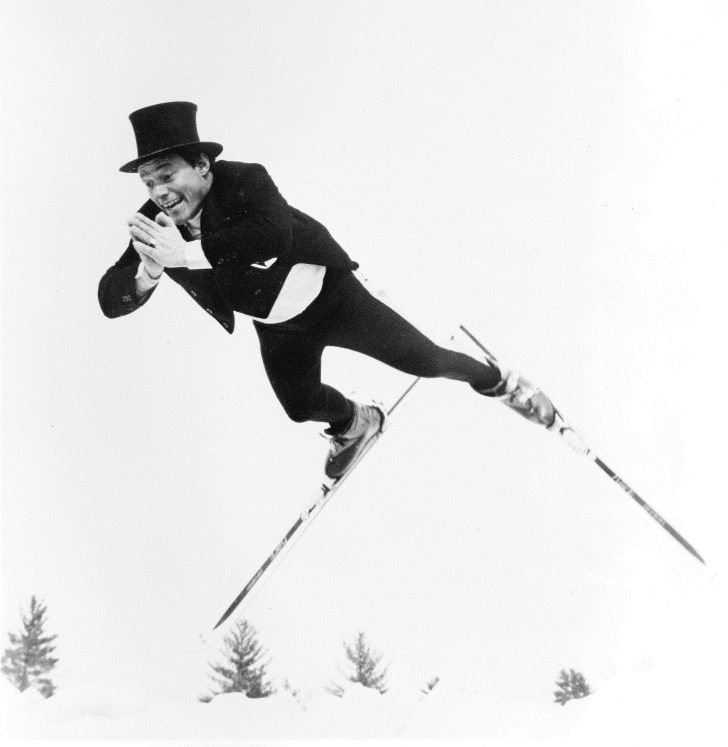
Mystery Glimpse: Top Hat
Flippin’ Clown.
This should be easy for some old timers. Who is this guy? What’s his back story?

Thanks to the amazing historic ski photo archive at Peak Resorts for this pic.
Last Week

This is Linda Meyers and Buddy Werner in April, 1963. Linda competed at the 1960 and 1964 Winter Olympics. In 1960 she tumbled in the downhill event, but completed the descent and placed 33rd; she failed to finish the giant slalom. In 1964 she placed 12th in the slalom and 30th in the giant slalom.
Meyers grew up in Bishop, California, near Mammoth Mountain, and took up skiing following Jill Kinmont Boothe. Besides Olympics she competed at the 1958 and 1962 World Championships and finished fifth in the combined event in 1962. After retiring from competitions she coached skiers in Colorado.
Buddy Werner was a top US ski racer, retiring from racing after the 1964 games. He was killed in an avalanche while filming a ski movie in the Swiss Alps later that year.
[Note: This Mystery Glimpse was updated, correcting the identity of the woman skier.]
Incidents & Accidents: 7
Safety Is Up To All Of Us.
[Editor Note: Dave Irons contributed this article on skiing safety which first appeared in the Lewiston Sun Journal. Dave is a veteran ski journalist and ski patroller. SeniorsSkiing.com is collecting stories from readers about incidents and accidents that they have experienced. We intend to review these for patterns and themes and use that data to influence the safety policies of resorts and other stakeholders. ]
 Each ski season the issue of safety comes up. Some years it’s a fatality at one of our ski areas. It might be a famous person, like Sonny Bono who died while tree skiing at Heavenly Valley on the California/Nevada line. One year it was a couple of teenagers who left the trail at Sunday River and had to be rescued at night. Whatever the trigger we all need to be reminded at times of the need for safety while skiing. I remember years ago when I walked into Tom Reynolds classroom at UMF. On the board was the saying, “If it is to be, it’s up to me”.
That pretty much describes safety on the ski slopes. How often have we heard someone say about a particular situation, “There oughta be a law!”? You might be surprised to know that there are some laws when it comes to skier safety. Mostly we are not restricted in our skiing, but there are certain activities that are limited, most not by law but by ski area policy. One example is skiing too fast in an area posted, “SLOW SKIING”. Skiing fast in an area set aside for beginners or approaching lifts can bring about a warning from the ski patrol. It will usually be nothing but a warning. Some ski patrols will mark the lift ticket either with a marker or by punching a hole in the ticket. Stopped by a second patroller who spots the mark will result in loss of ticket.
But that’s not law. When are skiers likely to be subject to law? Unlike on the highway, there are no radar guns on the ski slopes, but if there is a collision and injury, the law can be involved. The Colorado Skier Safety Law states clearly, “The person higher on the hill has the responsibility to avoid people below and if something happens that skier or boarder is at fault”. Notice that there is no mention of the ski area being responsible. As a ski patrolman, I used to sum it up this way, “If you are good enough to overtake another skier, you should be good enough to avoid them.”
We often hear, “He cut me off” from skiers who hit someone while passing them. I would make the point that the skier downhill from us cannot be expected to look up the hill before making a turn, especially if that downhill skier is a lower level skier. The better skier has to be aware that he is sharing the slopes with skiers of all ability levels. And we should all know the Colorado law. It may not be the law in Maine, but we can be sure it will cited by an attorney representing a skier who has been hit from above.
This should be all we need to know about avoiding collisions on the hill. Add the common sense parts of the Skiers’ Code Of Responsibility such as slowing down and looking up hill when entering a trail intersection, looking uphill before entering a trail and always stopping on the edge of the trail.
The next area is skiing closed trails and out of bounds. I can tell from years of experience that no ski patroller wants to close a trail. If it’s closed it’s because the ski patrol judged it to be unsafe. Also, no ski patroller wants to have to explain to management why they closed a trail if it was skiable. I would also point out that if any of those skiers who patrolled for me felt uncomfortable on a run, you probably don’t want to ski it, and the average skier certainly doesn’t belong on it. Trails are closed for our safety. Stick to the runs that are open. And to those that are within your ability.
Out of bounds is another issue. This is not to be confused with skiing in glades within the area, but this skiing also calls for special precautions. Sonny Bono lost his life within bounds, but he was skiing alone in the trees. We don’t know if he died instantly or if he might have lived had rescuers reached him quickly. His body was found the next morning. Never ski in the trees alone. It should be a group of three or more, one to stay with the injured skier while another goes for help. Cellphones help, but if you don’t know where you are on the mountain it can still be a long time before rescue.
Leaving the ski area boundaries is taking an extreme risk, not only to the skier, but to those who will be involved in the rescue. If you survive a problem even if it’s no more than getting lost and having to be led out, this can involve the law. In these cases it’s not uncommon for a number of services to be involved such as warden services and police. For this you could receive a bill, and it could be quite large. Just figure the hourly pay for dozens of searchers for a full night, along with the equipment. Do you know what it costs an hour to keep a helicopter in the air? The next time you consider skiing out of bounds remember this sign at the top of Killington, “The mountains will be just as cold and lonely tonight as they were 200 years ago”.
[authors_page role=contributor]