

Skiing Weatherman: For The East, Enter Winter
A Comeback For The East And Midwest, More Pow For The West.
I spent the first two days of this week with fellow members of the North American Snowsports Journalists Association at Windham Mountain, NY, where the crew did an outstanding job of providing a fun surface in the wake of a mid-season meltdown last Sunday. One of the presentations was by Masterfit University, an outfit that boasts having the best boot fitters in the world. It was a fascinating seminar, and after spending a couple of hours one on one with Windham’s Masterfit representative, I came away convinced that if you want to maximize your skiing, you absolutely should find a Masterfit shop in your area.
While this week started on an unseasonably mild note in the East, the skies kept unloading in parts of the West. A persistent series of low pressure centers loaded with Pacific moisture has utterly buried resorts in Washington, Oregon, northern Idaho, the Tetons, and northern Wasatch in the past week with anywhere from three to six feet of new snow. Lookout Pass in Idaho checked in with a 101 inch storm total! Lighter snows fell elsewhere in the West, and if you are heading in that direction, you can’t make a bad choice right now.
In the Midwest and East, a major pattern change is getting underway, one that delivered some fresh snow in the mountains of the Northeast late this week, with another round coming this weekend. For the first time in weeks, once the low pressure center moves through the Great Lakes and East, a bonafide cold air mass will follow in its wake, leading to great snowmaking conditions and productive lake effect snow in favored snowbelt areas, especially the upper peninsula of Michigan.
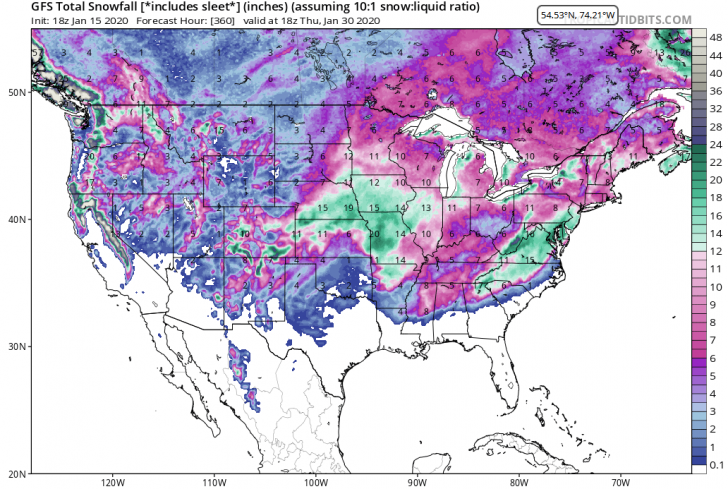
Over the next 10 to 14 days, temperatures will be stepping down over the eastern half of the country as an upper level trough becomes the dominant jet stream feature. At the same time, an upper level ridge will be found more of the time in the Northwest, so the “snow hose” that has been pointed at that region lately will back off quite a bit. The southern Sierra and southern Rockies could see periodic snows as disturbances in the southern branch of the jet move through that part of the country. If a southern branch disturbance manages to phase with energy in the eastern trough, we could see a major storm in the East before too long. The pieces will all be there soon and hopefully they will come together. For your viewing pleasure, here is a forecast map of snowfall for the next 15 days. Don’t focus on one specific spot as much as take note of the breadth of the area, particularly over the eastern half of the country, where significant snow is forecast. The pattern is rounding into shape for meaningful snow events, but the devil will be in the details.
There is reason to believe that once the colder pattern gets established in the Midwest and East, it will remain in control much of the time going forward. My analog years suggest it, as does this jet stream map for two weeks from now:

The broad trough that you see for late this month looks cold and stormy to me.
Here AreThe Regional Details
Northwest U.S./Western Canada: Another rather snowy week coming up, but the recent amazing rate of snowfall will start to back down as an upper ridge takes up residence.
Cascades and Sierra: Snowy (Cascades) into the middle of next week, although snow levels will be a little high late this weekend before settling back down. Lighter snows Tahoe area. Snowfalls back off late this month as ridging develops.
Rockies: Dry weekend into midweek when a new trough will bring some light snow. Longer term, central and southern Rockies favored for snow thanks to disturbances in the southern branch of the jet stream
Midwest: Arctic air dominates for the foreseeable future. Each frontal passage sets off lake effect snow. Great spell of snowmaking temps underway and conditionS. Trail counts will be improving.
Northeast/QB: Moderate snow event this weekend (north of I-80) starts the comeback. Great snowmaking temps for several days in the wake of the storm. Another sizeable snow threat next weekend. Conditions and trail counts will be getting better each day until further notice.

Foam Roll Out Those Nasty Knots
An amazingly simple and immediately effective DIY massage relaxes stiffness and removes pain
The foam rolling technique of self- massage is exceptionally beneficial in increasing athletic performance, reducing pain, and helping with injury recovery/prevention —especially for older snow enthusiasts.
The medical term for rolling out is self-myofascial release. “Myo” means muscle, and “fascial” refers to the fascia, a framework of
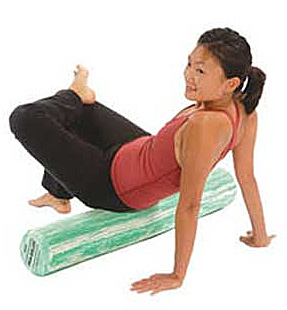
Foam Roller gently elongates tight muscles and relieves pain.
Credit: Protherapy Supplies
connective tissue that covers the muscles and organs in one continuous structure from head to toe, like a tight sweater over our musculoskeletal system. A restriction in one area can affect fascia and muscles in a completely different part of the body, not unlike pulling fitted polypropylene long johns in one direction and causing the fabric to twist and tighten on another part of the frame.
When fascia is restricted (e.g. injuries, surgeries, poor posture), the muscle beneath may not be able to return to its normal length after contracting, resulting in compromises in range of motion, blood flow, nerve stimulation, and lymphatic drainage. This produces an inflammatory response and nasty little trigger points—or “knots”—that develop in the muscle and/or fascia. Any pressure applied to these trigger points can cause pain.
It’s not uncommon to feel areas of referred pain from another part of the body when compressing a particular trigger point, something to expect with the rolling device.
The good news about trigger points is that when pressure is repeatedly applied against a rolling device in a slow manner with the person taking FULL, DEEP breaths, the pain dissipates quickly, eliminating the myofascial
A massage ball can really concentrate gentle pressure on knots.
Credit: Pro-tecathletics
restriction and allowing the muscle to elongate and nearby joints to move fluidly with increased blood flow to the area. The result is enhanced athletic performance.
It’s best to roll out before heading to the mountain. Your muscles will be more supple, and your joints limber and pain-free. For maintenance, roll out daily, either at night or in the morning (or if you can, both.) Start small and progress to longer sessions of myofascial release. While this technique works for all physical activities, skiers should focus on the lower body–hamstring, IT band, Achilles, quads. That said, don’t forget to include the back and any other areas of chronic pain. And for your (HIGHLY recommended) post-skiing stretch, roll out first.
You may have some pain at first, but that should subside after a few times rolling out. In fact, your muscles may soon crave the roller at the end of a long day on the mountain, even more than you crave that après ski beer. And with some dedicated time to rolling out, don’t be surprised if your body feels years younger! It may hurt at first, but the pain should subside after a few times rolling out. In fact, your muscles may soon crave the roller at the end of a long day on the mountain, even more than you crave that après ski beer.
[Ed Note: We have tried myofascial self-massage and can report immediate relief from lower back pain stemming from tight hip flexors and knotted piriformis muscles. Your mileage may vary, but we are very impressed with this technique. As these videos show, you can use a foam roller or a massage ball. We used a hard lacrosse ball to really focus on tight knots. Here are some links for rolling exercises and products:]
Runners World Foam Roller Instruction Series
Finally, some rolling device vendors:
Ask The Expert: New Bindings, Old Skis
The Opposite Question From A Couple Of Weeks Ago.
A Question From Reader James Davis:
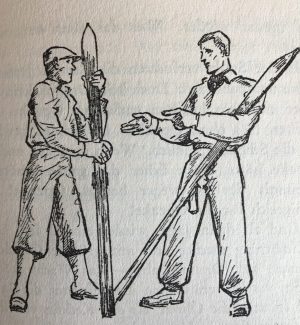
Ok I fully understand the mechanical aspect of old bindings, but what about the skis underneath? I have several pair of older skis in excellent visual condition that I like to use occasionally. How many times is it safe to put on new bindings?
Response from Dave Irons, long-time Ski Journalist, Ski Patrolman, And Venerable
This is an interesting question. There are so many variables there can be no definite answer. In my pro patrol days, (120 days or more each season) my skis usually looked fine at the end of the season, but I got rid of them bindings and all. They had been tuned so many times, there was little left of the edges and when skis are flexing, the fiberglass is actually breaking. By spring, these skis were noodles. Fortunately, I always had a ski company or shop to furnish new skis each year. My concern with mounting new bindings would be how many times new holes would need to be drilled. This would be a question for the ski shop mechanic as each situation would have to be evaluated separately. James, take the skis to the shop. They will also know what binding would work best with the fewest new holes
[authors_page role=contributor]