

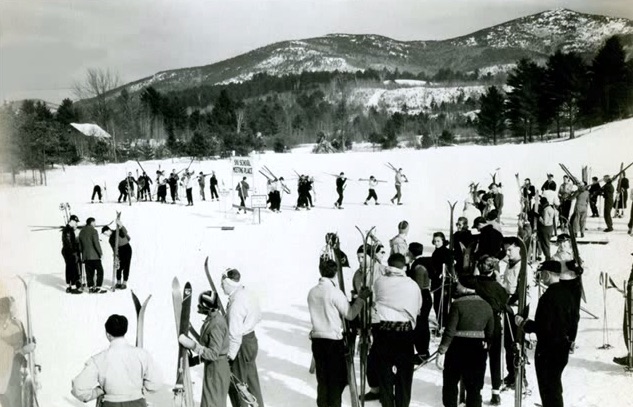
First Turn, Icy Snow Advice
Instructor Pat McCloskey Recommends An Approach To Early Days.
I had an interesting discussion with my lift mate this weekend at our local ski area.
I asked the fellow beside me how his day was going. He remarked, “Well, the hill is fighting me back a little today.” I chuckled because the guy was a certified PSIA instructor but was feeling a little uneasy with the current conditions. After all, it is early days for the season, and the snowmaking can bring terrain to life but can also provide less than adequate conditions if you are not prepared.
What did he mean the hill was fighting him back? As I exited the chair, I began to think about how to tackle ice, scraped snow, and the inevitable sand-like conditions that occur with a big crowd on not so big terrain. If you started out too fast, you ended up defensive in your stance, and the timing of turns was compromised by too much speed too early, resulting in a skid for life.
So, my recommendation to anyone starting out on their first run on limited terrain and icy conditions is to begin slowly and finish your turns. Make a series of turns by finishing them and reducing your speed by the radius of your turn. Your timing will come back to you and you can eventually increase your speed.
If you start out slowly and allow the cadence of finished turns to happen at a lower speed, you can eventually ski with a faster cadence once a comfortable series of turns are made. Be aware of your ankles and make them flex in the bottom of the turn to assist the ski in making a finished, rounded turn.
I did this for a while and really concentrated on rounded turns and feeling my edges grip the ice. Then I became more aggressive and said, “Come on Pat, you’ve got this” and increased my cadence and speed but didn’t compromise my turn. I was able to do this because of starting the run conservatively and making rounded turns.
I end up doing this all season long. If you can start slowly and make the first couple of turns correctly and rounded, you can ski any terrain anywhere.
My First Run
Do You Have A Plan For Your Debut? Marc Does.
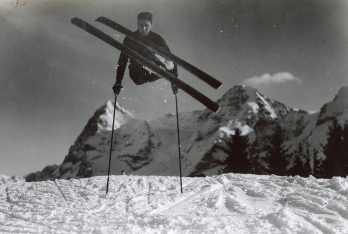
My favorite condition for my first run on my first day of skiing on any trip is freshly raked frozen granular. Why? Because I can feel the edges of the ski carve in the snow.
Early enough in the season, even if one skis out west, you’ll see more hard packed snow than powder which works. But, only on frozen granular can you can hear the skis cut through the snow. The crunching and scraping sound of skis on frozen granular is unique and it sends a confirming message to my brain that I am skiing again. On hard packed powder, you have to listen for the singing sound of the skis cutting through the snow. It is there, just hard to hear above the ambient noise.
For each first run, I follow the same drill that puts the racer, the rec skier, the instructor and the ski tester in me in instant conflict.
The racer in me wants to go fast, straight down the fall line. At my advanced age, I still like to ski fast but force myself to ski slower because can at 74, my bones don’t break, they shatter.
The rec skier wants to charge off, get to the bottom and up before the lift lines build.
The instructor part of my brain says make the perfect turn in, of course, perfect form, but not in the Final Forms that PSIA pushed in the 70s. Body position – square over the skis, knees flexed, back straight, arms out and bent, ready to plant the pole – is important to enable one to control the skis and speed.
Since I rent skis, I’m back being a ski tester. How does the ski carve? How easy are they to turn?
My technique is the same for my first turn. Pick-up some speed and as the skis come through the fall line, press forward with my knees and edge the ski. Plant the pole, unweight, roll my knees …. Yeah, yeah, yeah, I’m old fashioned. After three or four turns, I stop and look at my tracks.
Why? Because on frozen granular the tracks tell me where I unweighted and where I finished each turn. There edges should make straight lines and there should be a bit of feather at the end of the turn where I set the edge to build a platform for the next turn.
It is about muscle memory. My last turns were in April, eight long months ago. Technique is important because it is how one controls one’s speed on a steep pitch and how one navigates through any condition. And, I’m a year older.
First four turns examined, I make another set and look back. The snow tells me how good my technique is. Sometimes, it takes three or four segments to convince me that my turns are O.K., other years, it has taken only one or two. It just depends on the snow, the skis and me. But the joy is back because I’m turning skis on a mountain.
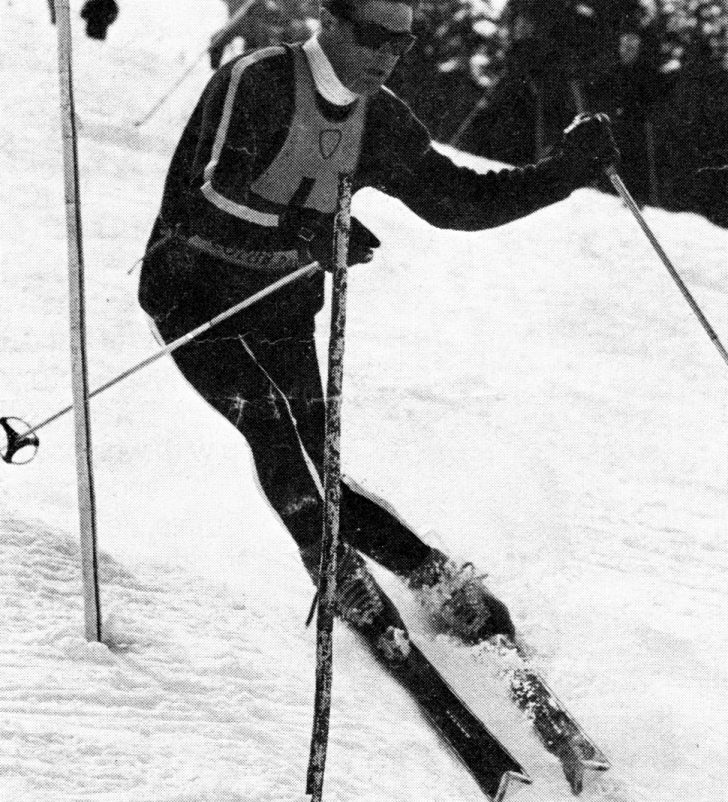
Mystery Glimpse: Racer R.
This Is A Challenge. Hints Below.

He was on Bob Beattie’s 1964 US Ski Team. He later worked for Head Ski and Lange Boots. Do you know who he is? Put your guess in the comment box below.
Last Week
Thanks to ski correspondent Dave Irons for supplying last week’s picture and this description:

“John and Joe Luc Roy Jr. got it right away. Pleasant Mountain in Bridgton (now Shawnee Peak) is Maine’s oldest continuously operated ski area starting with rope tows in 1938. In 1951 they built Maine’s first T-bar which is in the picture. The T-bar is long gone, but you can still ski the lift line, a narrow run lined by trees. The base lodge has expanded and is more than triple the original size. The lake in the picture is the real give away. Moose Pond is 13 miles long and provides the area with unlimited water for snowmaking, something many areas envy.
Sorry Marilyn, although my association with Sunday River is well known, we skied Pleasant Mountain in the fifties before Sunday River opened in 1959. We switched to Sunday River because as we were living in South Paris it was an easier drive, and Pleasant Mountain had become known for lift lines. That’s no longer the case, with two top to bottom triples, a quad and another triple for beginners. For more on the area, my book, Shawnee Peak at Pleasant Mountain is available on Amazon, and at Shawnee Peak. How’s that for a shameless plug? I’ll try to answer any questions about the area.”

[authors_page role=contributor]