

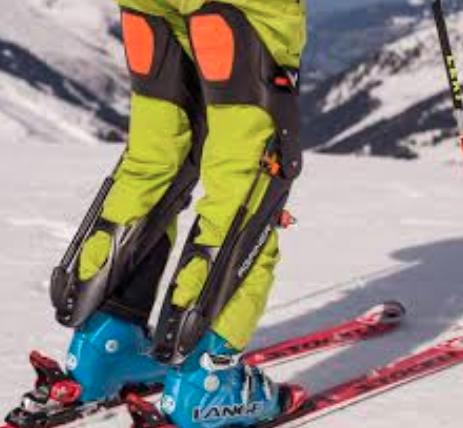
Againer Exoskeleton Supports Legs, Relieves Muscle Fatigue
SeniorsSkiing.com’s Reviewer Tried Againer Exoskeleton On His Second Day On Snow. Find Out How It Worked For Him.
I am a 75-year old, advanced intermediate skier with 10 years experience as a PSIA instructor in the East and mild osteoarthritis in my left knee. I currently ski at Alta; that’s where I recently tested the Againer Exoskeleton.
The Againer consists of a hinged plastic frame which runs from the upper thigh to the lower calf and is held in place by two straps. The key to the Againer system is a gas cylinder attached at the top to the upper section of the frame and at the bottom to a bracket on the rear of the ski boot. When the gas cylinder is engaged, it works like a shock absorber when flexing the knees and provides upward lift at the end of each turn.
The Againer helped me ski one of my favorite runs at Alta, Devil’s Elbow, a long intermediate run with a fairly gentle lower half. On my run, I made as many short radius turns as I could—probably 50 or 60 in a row—in the lower half . When I stopped, my legs were not tired, as they often are at the end of this drill, especially considering that this was only my second day on snow this season.
I can also see two advantages of wearing the Againer in case of a fall, which can be especially damaging to senior skiers. First, the Againer would prevent any lateral movement in the knee, reducing chances of ligament damage. Second, when I fall in powder, I often find one of my knees (usually my weaker left one) flexed underneath me. The Againer system would eliminate that problem and, of course, protect against the opposite occurrence, hyperextension.
The Againer was easy to use, thanks mainly to a well-illustrated and detailed instruction manual. I attached the brackets to my ski boots in about five minutes and put on the frames in another five to 10 minutes. The repetition of daily use would, I’m sure, reduce the time needed to get into the frames, and the brackets would stay on the boots all season.
For more information about the Againer Exoskeleton, check out the website at againer-ski.com.
[Editor Note: Below is a product demo video from Againer Ski.]
Incidents And Accidents: 4
Things Get Rocky On Bullwinkle
[Editor note: SeniorsSkiing.com is collecting stories from readers about incidents and accidents that they have experienced. We intend to review these for patterns and themes and use that data to influence the safety policies of resorts and other stakeholders. The following is the fourth article submitted by a reader in our new feature “Incidents and Accidents”. If you have a story to tell, please follow the format used below and send to INFO@seniorsskiing.com]
Jan Brunvand, Snowbasin, UT
What Happened
My wife Judy and I, both octogenarians, were skiing a blue run called Bullwinkle at Snowbasin, UT, on a nice clear midweek day with smooth groomed snow and few other skiers or riders. I had my helmet cam turned on, and I skied down first in order to get a video of Judy’s run. Looking back up the slope I noticed a skier and two snowboarders entering the run at the top, but Judy was on skier’s right, and they were on the left. What could possibly go wrong?
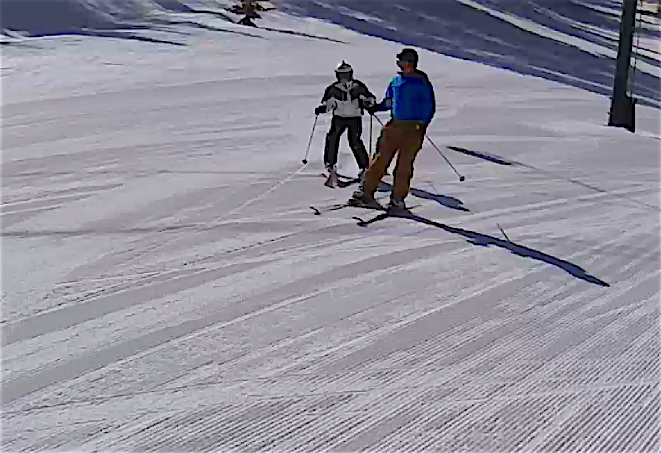
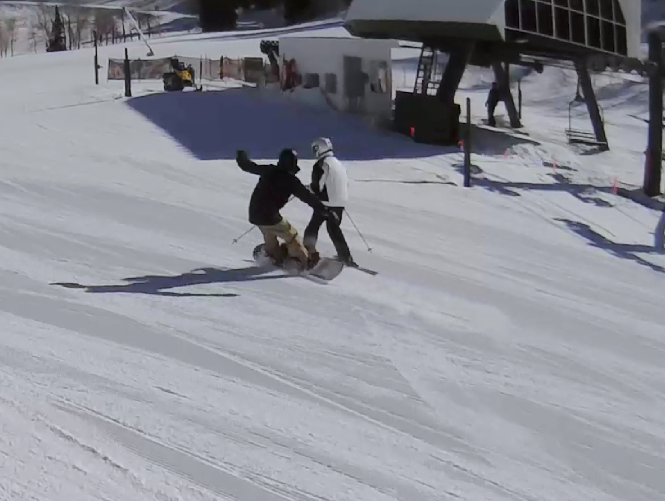
When Judy was about three quarters of the way down, suddenly the skier veered towards her and barely missed cutting her off. Then, just as she reached the run-out at the bottom, one of the boarder dudes cut straight across the hill towards her and ran over the back of her skis. The kid toppled, but Judy managed to stay upright by waving her poles to offset the collision.
The boarder, probably noting Judy’s white hair sticking out from under her helmet, apologized profusely. Judy checked her skis, and they had remained solidly attached. We proceeded to the base, keeping careful eyes on the others around us.
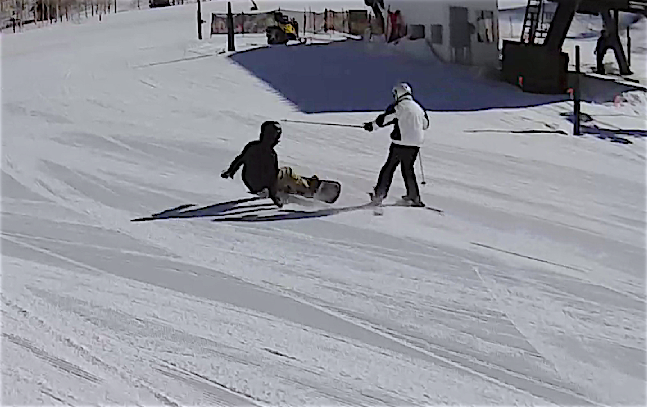
Back home I checked the video and saw again what close calls these had been. I took screen shots of three frames showing the two near misses plus the aftermath. In the last one it looks like Judy is poking the boarder dude with her ski pole—fighting him off. Not true, but it all happened too fast for us to realize how it might have appeared to a bystander.
Role of the Ski Patrol
No patrollers in sight
Lessons Learned
Danger can come from anywhere, no matter how much you try to stay in your lane and watch out for others on the hill. Not all skiers and riders are out of control or aggressive, but neither are they necessarily aware of their surroundings, so YOU have to be the aware one.
Advice
As in photo 3 above: Don’t Mess With Grandma!
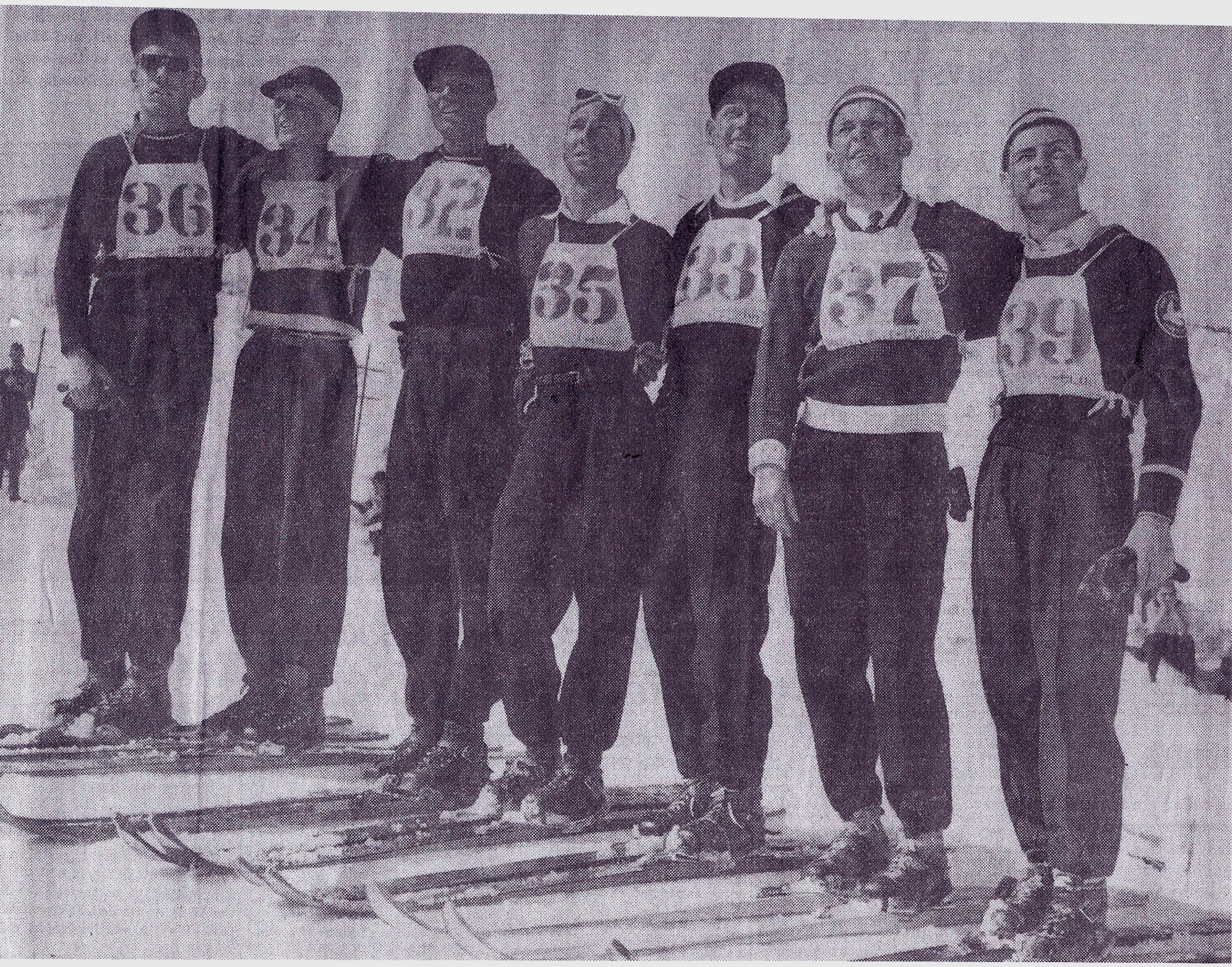
Mystery Glimpse: Seven Great Champs
All Inducted In US Ski and Snowboard Hall of Fame.
Hints: Photo from Feb. 1941, Sun Valley. One of these men later enlisted in the 10th Mountain Division and was killed in action. Can you name them all?
Thanks to Alan Engen for contributing this photo from his four-volume scrapbook series, The Engen Skiing Dynasty, currently at the University of Utah, J. Willard Marriott Library Ski Archives.

Last Week

Yes, Rip McManus. We were surprised to see so many correct entries, and even anecdotes from commentators about his colorful, but much too short career in the ski business and sport.
We remember meeting Rip at an SIA Ski Industry Trade Show, back in 1970 or so. He was a smiling, fun-loving guy with a lot of energy who left a positive impression with everyone he met.
Rip was born in Boston, raised in Connecticut, and raced in the East until he went to Denver University. In 1964, we was a member of Bob Beattie’s US Olympic team. He was a three-event racer who captured North American and Canadian GS and downhill titles. At one time, he ranked 11th in the world in FIS points.
Rip left racing in 1965 and joined the Head Ski Co. as product manager and director of racing. He later moved to Lange as director of the boot division. He also consulted in marketing, ski testing, racing and product development with the Olin Ski Company.

You may remember Ripper as a commentator and technical advisor to ABC-TV for the 1968 Winter Olympics, also covering the 1970 World Alpine Ski Championships for NBC-TV. He was an associate editor of Ski Racing magazine. What most people probably don’t realize is that Rip did the downhill racing sequences for the Robert Redford classic, Downhill Racer. He also played an onscreen role as a TV commentator.
He was clearly a unique character, coming up through the ranks of ski racing with few connections, little money, working on the trail crew at Stowe to earn entry fees and lift money. He did it all by himself.
Rip McManus’ life so full of potential was cut short by a traffic accident in 1982. As veteran journalist John Henry Auran wrote in a 1965 profile of McManus, “He’ll be remembered because he may be the last of his kind.”
[Note: This article was adapted from January, 1983 SKI magazine]
[authors_page role=contributor]