

SeniorsSkiing.com Analogy Test
[Editor Note: Thanks to SeniorsSkiing.com Correspondent Don Burch for this challenging test. Good luck, you’ll need it. Answers at the end.]


The Skiing Weatherman: Monster Storm Smacks Early
Snow At The End Of Summer Dazzles The Northwest.
How is it that a storm can produce a four foot snowfall before the first week of the new season is over!? That is exactly what happened last weekend as portions of Montana got absolutely buried. Parts of Idaho, Washington, California, Oregon, Wyoming, and Colorado also saw snow, which undoubtedly got skiers in those states really fired up, as well.
How does a storm of that magnitude happen in September? Well, first, you need a dynamic jet stream pattern, with plenty of amplitude in the troughs and ridges strung out across the hemisphere. Here is the jet stream map from Saturday morning.
Notice the strong ridge in the Gulf of Alaska. That feature is consistent with the warm pool of water discussed in last week’s article. The ridge’s clockwise circulation helps to tap colder air from the high latitudes of the northwest corner of the continent, and that cold air flows directly into the trough as it strengthens over the Northwest on the map.
The trough is where rising air is found, and the stronger the trough, the more effective it is at drawing cold air southward. Rising air cools, and in this fashion, strong troughs can actually “manufacture” their own cold air, which helps fight off the more seasonable air found away from the center of the circulation. Everything has to be just about perfect to create the cold for a snow producer like last weekend’s storm, and it pretty much was a perfect setup. Here is a look at the anomalies of air found in the mid-levels at the same time stamp.

You can see that the deviations from normal were on the order of 8 to as much as 18 degrees below normal (Centigrade) when the trough was at its strongest, plenty cold enough to support early season snow, even in the relatively lower elevations. Not surprisingly, if you follow the bulge of the coldest air southward from the core that is located in southern Canada, it points right at Browning and Cut Bank, Montana, two spots that saw some of the deepest snow. In order to produce four feet of snow, you need plenty of moisture, and the broad fetch off the Pacific delivered the goods.
While the storm was a record breaker in many locations, you might be surprised to know that autumn snowfall in North America has shown an increasing trend in recent years, as this chart clearly shows.

Early season snow across Canada and the northern U.S. helps refrigerate autumn air masses before they spread out and move further south, so I interpret this snowfall as a positive sign for the early stages of the upcoming season. If you are looking for the next early season dump, keep your eyes open for the next trough to dig into the Northwest/northern Rockies.
Shape Up 3: Challenge Yourself
Five Basic Exercises Ramped Up To High Intensity Levels.
[Editor note: This is the third and final in our series of preparation exercises for senior skiers from Rick Silverman, physical therapist and certified strength and conditioning specialist. We started with basic hip and leg exercises (Oct 25), raised the intensity of those (Nov. 7) and now present a more challenging level of those same exercises. As you can see, these are clearly a step up in intensity. Use these to extend your exercise program. If you haven’t been limbering up so far this season, don’t start here. Seriously. These are challenging. As always, if you have any issues, complications or questions, consult your medical advisor before beginning.]
Quad Squat Jump
Last time, we introduced the Static Quad Wall Sit. In this one, we get dynamic. Use a small exercise ball or a light weight. Squat down, jump up. Repeat. Try doing this for 20 seconds on, 10 seconds off for two minutes.
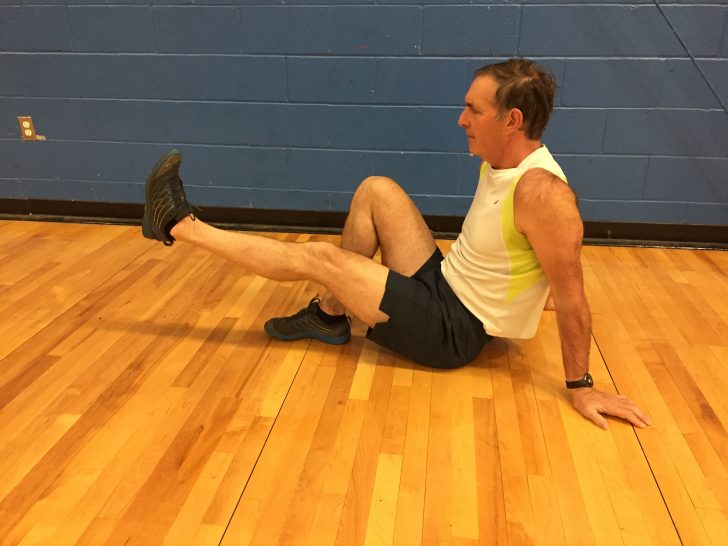
Leg Raise Sitting Up
The key is straight leg and toe pointing up. Support yourself on your hands. A variation is to point your toe inward on the way up and outward on the way down. And vice versa. Don’t let your heel touch.
Dynamic Lunges
Rick has been a Telemark skier for 25 years. He said this move imitates the same leg motion used in making Tele turns.
Hamstring Bridge
Keep the ball rolling in and out. Use a chair with rollers. Watch your lower back on this one.
Inner Thigh Lift
In previous articles, we showed you how to work your glutes and outer hip flexors. Here’s one to use for the inner thigh. You might want to rotate through all three exercises in your work out.

A huge thanks to Rick Silverman for showing us how to ramp up for the snow sports season. If you don’t have a regular exercise work out habit, consider starting with our first series of exercises here. But, please, don’t start the season without some physical preparation.
[authors_page role=contributor]