


Technique Tips For The Senior Skier
Sharpen Your Skills To Get The Most Out Of Your Skiing.
 [Editor Note: UK-based Bob Trueman is a long-time ski coach and instructor who will contribute occasional articles on technique for the older skier. He is the author of Ski In Control where he describes the skills needed to master “any piste”. He will soon be publishing a series of YouTube videos to demonstrate control skills. SeniorsSkiing.com welcomes him to our pages.]
What’s the best way to keep getting the most fun out of skiing as we get older? As a coach, I suggest that it’s the exercise of skill. This doesn’t preclude the great company, good food, and all the rest. Nor does it demand big, physical challenges. It’s a mind-set change.
Look around any piste, and everyone finds some way of negotiating it, but very often not nicely. Some folk don’t care how they ski, only what or where they ski. My clients do care, and it’s exercising precision skill that my pupils get the most out of.
Let’s define skill:
Skill is the learned ability to bring about pre-determined goals with maximal certainty, often with minimal effort. This has implications – “learned” = not instinctive: “pre-determined” = goal oriented; “maximal certainty” = demonstrated skill. It never fails to satisfy and is little related to physical strength or capacity.
Here are some ideas.

Unloaded tips, weight back = bad.
Look at the slope with a keener eye. Does the slope go exactly where the piste goes? Often it

Weight forward, tips loaded = good.
doesn’t; often it is canted. If you were to pour a bucket of red ink onto the slope, it may well go somewhat across the piste. You may see this and recognize that left and right arcs will not be symmetrical; they’ll be quick one way and slow and drawn-out the other. The skillful skier will be ready for this, and change rhythm. There’s satisfaction in that.
View the slope and decide if you will control your speed by applying some skid by pivoting your ski. If you do, be aware that the line you take down the slope will be nearer to a straight line—it won’t be straight, but it’ll be straighter. Take satisfaction out of knowing that and ski the line you predicted. How close did you get? That’s an exercise of skill.
Or choose to descend by having the ski carve. You still want to control your speed of descent but with a higher linear speed. So you can choose before you set off what radius of arcs you’ll do and how many arcs you’ll do. You will control your path down the mountain by the line you draw down it. That’s another exercise of skill, and very satisfying.
Anyone can ski a gentle slope fast, only skillful skiers can descend a steep one slowly. What do you need to do to achieve that? You can do it by drawing a straight line diagonally across it until you have no room left and then do an “Oh-s**t” turn. Or you can execute more arcs, tighter arcs, taking a more direct line of descent. This requires greater skill as well as pre-planning and determination.
So what would you need to DO to achieve these skills? Here’s a tip – THE TIPS! Concentrate your mind on the inside edge of your outer ski’s tip. Think of it as a wood carver would think of his chisel/gouge – you’re going to carve it into the snow, have it cut in. Mother Earth will then see to it that it gets pushed round ‘sharpish’.
You’ll need to load that edge more. So you’ll need to flex your ankle more, and probably faster. If you tuck your tummy in and lean forward, you’ll load it. You’ll unload if you do the opposite. It helps to keep your hands low and wide. That helps. And keep looking down the slope to where you intend to go, not where you’re going.
Just doing one of these elements, and especially if you know you pre-planned it, is an exercise of skill that you can take pride in and enjoy the memory of on that next visit to the restaurant. Do a bit of boasting!
The Skiing Weatherman: Predicting This Winter
SeniorsSkiing.com’s New Columnist Places His Bet on 2019-20.
[Editor Note: Herb Stevens is a veteran meteorologist and television weatherman. SeniorsSkiing.com is very proud to introduce his new column which will appear weekly throughout the season.]
When a long range weather forecaster starts to put together a winter forecast, the first element that has to be assessed is the state of the water temperatures in the Pacific, especially the tropical region. The oceans hold 1,000 times the heat content of the atmosphere, so changes in water temperature anomalies can produce major influences in the sensible weather, not only in the Pacific, but also downwind of the ocean. El Nino and La Nina are major players in the winter weather over North America and have to be accounted for.
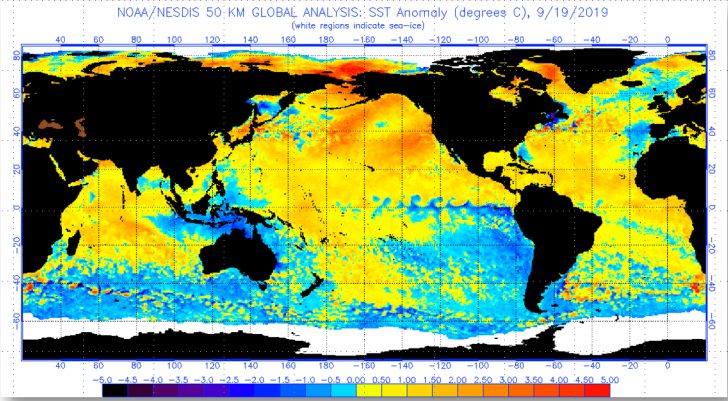
Last winter, a weak El Nino was in place but now the tropical waters have cooled to a neutral level, creating what a forecasting friend of mine refers to as “La Nada”. However, the waters of the northeastern Pacific are much above normal, as the following map indicates.
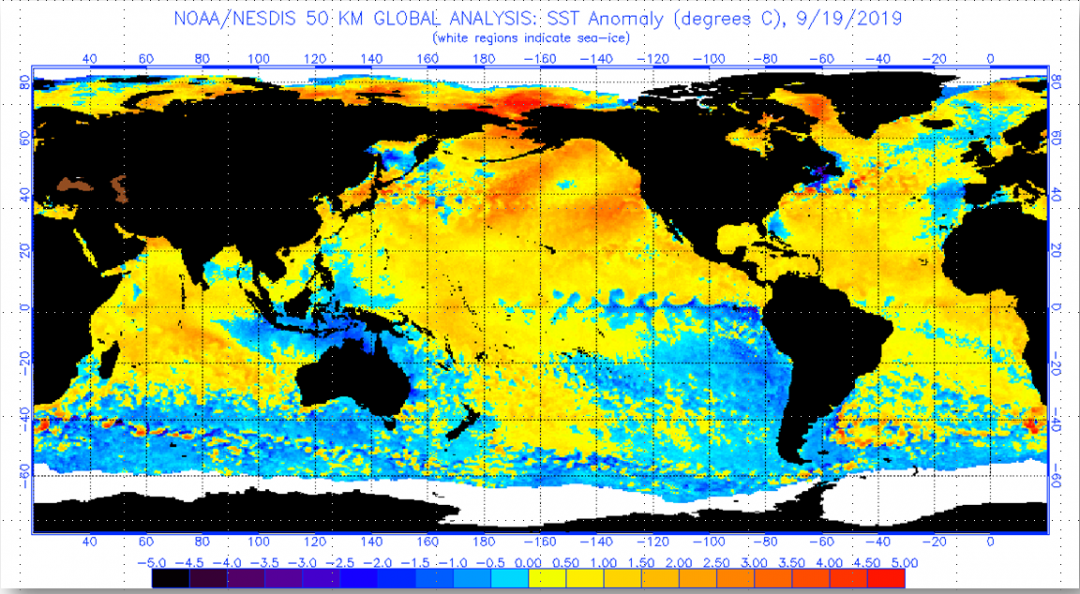
The warm waters support a ridge at the jet stream level over the Gulf of Alaska and western Canada and the clockwise circulation around the ridge can deliver cold air masses into the central and eastern U.S., some with origins in Siberia. Once the ridge forms, you typically see a complementary trough set up over the eastern U.S. Recently, the winters of ‘13-‘14 and ‘14-‘15 had a similar warm pool and jet couplet, and both of those seasons were cold and snowy from the Great Lakes to New England. I rely more on identifying analogs for forecasts rather than leaning on computer models, and the northeast Pacific warm pool creates an impressive lineup of previous winters. Over the past century many of the coldest, snowiest winters over the eastern half of the country have fed off such a warm pool.
Another factor in play this winter is the solar cycle. In terms of sunspots, we are very close to “solar minimum”, when solar output bottoms out which happens roughly every 11 years. This graph illustrates the cycle.

There is a significant correlation between solar minimum and blocking patterns at the jet stream level. With an eastern Pacific upper ridge and eastern North American trough, wavelength considerations would suggest another ridge taking shape over the North Atlantic close to Greenland. With above normal temperature waters also sitting between Labrador and Greenland in the Davis Strait, there would be support for a ridge there. Solar min also correlates with one other weather factor: persistence of a pattern. That is, once established, upper air patterns tend to hang around longer than they do at solar max.
So, based on analog methods, I tend to think that this winter will be favorable for skiing and riding from the center of the country eastward. A possible exception could be the southern Appalachians, where ridging could form and lead to more variability in temperatures at times. The West should be solid for the most part. The northern and central Rockies will be targeted by disturbances sliding down the eastern flank of the offshore ridge. The southern Rockies will benefit from the warmth of the water off of northern Mexico—storms in the southern branch of the jet will have ample moisture, but the ridging along the coast will likely limit the number of storms to an extent. If there is a region that I am concerned about, it would be the Northwest and the resorts of British Columbia, due to the proximity of the anticipated ridge.
That’s my first look at winter. I look forward to providing forecast guidance for your time on the slopes on a weekly basis through the season. I will take another shot at winter in about a month. let’s see what happens to the water temps in by then.

Shape Up 2: Up A Notch
Revving Up Intensity For Our Five Basic Exercises.
[Editor Note: Last month, we reprised a set of baseline exercises focusing on legs and hips as part of a get-ready strategy for this season’s snow sports activities that was originally published in 2016. This week, our exercise guide, physical therapist, certified strength and conditioning specialist and teleskier Rick Silverman, shows us how to up these exercises to the next level. As with any exercise plan, make sure you don’t overdo it; recognize your limits. If you have any issues or complications, please check with your medical advisor. In a couple of weeks, we will show you the highest intensity level for these activities.]
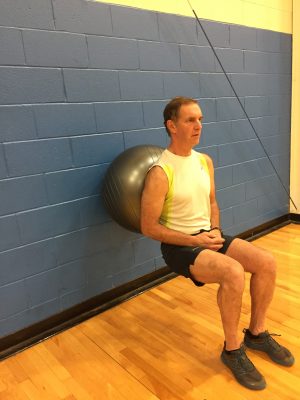
Static Quad Wall Sit
We used to do this in our college freshman dorm as a macho challenge. Sit against the wall, legs at 90 degrees. You can use a ball, as Rick does here, or just lean against the wall. Start with a relatively comfortable time, say, 20 seconds. Work your way up to 60 seconds. And don’t overdo this one!
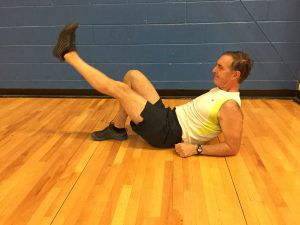
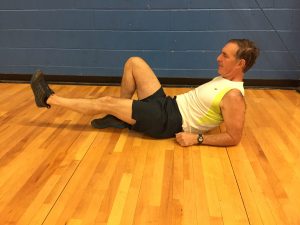
Sit Up Leg Raises
Bring your upper body up, support yourself on your elbows. The key here is keeping your leg straight and toes up. Don’t rest your heel on the ground on the downbeat. A variation is to point your toes to the right on the up and to the left on the down and vice versa.
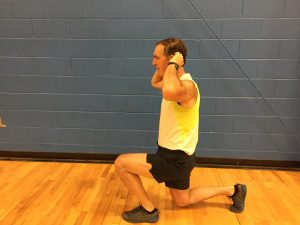
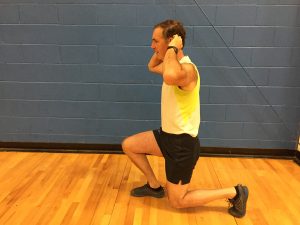
Alternating Lunges
Bend knee to 90 degrees and no more. Alternate right and left if you want or do eight reps on the right, eight on the left and repeat.
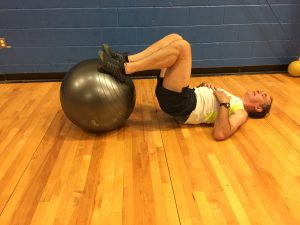
Hamstring Bridge
You can use an exercise ball for this or a chair with rollers.
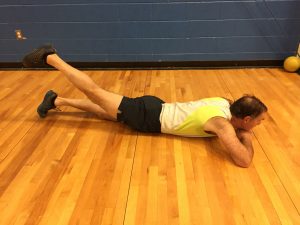
Glute Leg Raise
Add this hip area exercise to the Outer Hip Abductors we showed you last time. Remember, hip strength plays a big role in all snow sports moves. You will feel this in your butt, for sure. Don’t raise your leg too high. Again, work your way up to 16 reps x 2 sets.
The most important take-away from all this is to do something to get into shape for the snow sports season. Cycling, hiking and all those other summer sports are terrific conditioners. If you’ve been active all summer, try some of these as a test of sorts to see where you stand, conditioning-wise. If you’ve not been as active, please take time to run through some of exercises. If you do these every other day, you will start seeing results in a couple of weeks.
[authors_page role=contributor]