

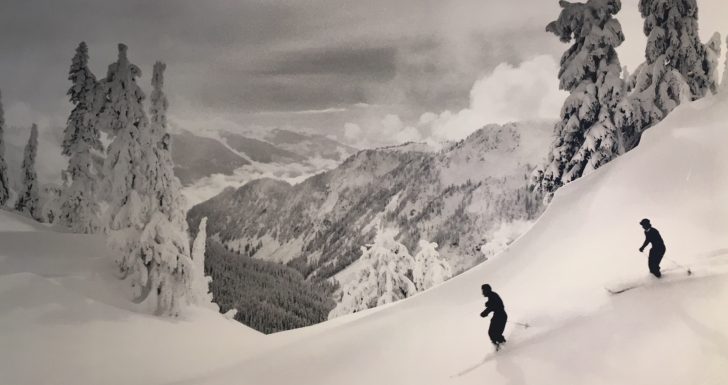
Mystery Glimpse: Trackless World Of Snow
Alpine Universe
Now here’s an amazing picture from the Alf Engen Museum, Park City, UT. What are we looking at? What’s the place? And, more importantly, who took the picture? No, not Ansel Adams, but close.
Last Week
 Yes, indeed, the Very Special Guest was Princess Elizabeth who visited the Mittersill Alpine Resort near Cannon Mt., NH, in 1951, probably in connection with her trip to Canada that year.
Why would the future Queen of the Realm stay at a then-remote ski resort in Northern New Hampshire?
We infer that she was visiting a member of the Hapsburg royal family, Mittersill’s founder Baron Hubert von Pantz, a wealthy Austrian sportsman and hotelier. His Tyrolean-themed Mittersill Club in Austria—a mecca for royalty from all over Europe—came to a sudden end in 1938 when the Nazis invaded. He resettled in New Hampshire and in 1945 opened the Mittersill Alpine Resort, which consisted of an Inn and number of unique, mountain-themed cottages, reflecting the Austrian style.

From the Mittersill Inn.
We visited the Mittersill Alpine Resort last February, checked out some of the original chalets, and found a collection of unusual illustrations posted on the walls of the Inn. These charming pictures reflect another time, a Tyrol where horses and sleighs carried sports people dressed in “ski costume” around the mountains. We asked the Inn’s staff what the history of these magnificent pictures was but no one knew. We strongly suspect the Baron brought them with him from his club in Austria.
 And here’s a poster from the Mittersill Mountain Club’s early days. Cozy, eh?

SeniorsSkiing Guide: Brian Head Resort

Brian Head is Utah’s southernmost ski resort. But its base elevation is the highest. At 9600’, the bottom of Brian Head is higher than the top of Deer Valley. It took about a day before I got acclimated.
In terms of Utah ski resorts, Brian Head is relatively small: 650 acres and a 1320’ vertical. It’s possible to add another 300’, but that would require a steep out-of-bounds climb.
Because of its location, Brian Head can be a snow magnet, especially when southern storms are prevalent. I skied the resort after a modest but windy storm. Every now and then the clouds lifted to reveal glimpses of the dramatic red rock countryside. On a bluebird day, the views must be magnificent.
The resort got going in the mid-60s when Alta’s Alf Engen was invited down by the first of several owners to help lay out the trail system. The place has developed significantly over the years.
Today, there here are two mountains connected by a ski bridge. Navajo Mountain is gentle; Giant Steps Mountain, a bit more challenging. Eight chairs are available. The #7 chair and the black diamond area it serves were closed during my visit. My impression is that Brian Head’s blacks would be considered blues at other resorts,
Getting from parking lot to lifts is effortless. We only visited Giant Steps Lodge where we booted up in the lower level (coin-operated lockers available for storage) but needed to exit and walk a short slope to get to cafeteria and restrooms…a minor detail unless you have the urge.
Senior pricing is good: If you’re 65+, weekday tickets are $30; weekend tickets are $43. Holidays, the price climbs to $57. Season passes are available to 62-69 year olds for $329; 70+ for $219. Season pass holders also get three days at each of 15 other smallish areas in Arizona, California, Colorado, Idaho, Michigan, New Mexico, Utah, and Wyoming. It might be worth the purchase for that benefit alone!
Another Brian Head price advantage is the low cost of its ski school. A weekend lesson is $75. The resort has other attractive instructional offerings as well.
Lodging options are limited to two hotels and a whole lot of condos. We stayed in a pleasant one bedroom in one of the hotels, Cedar Breaks Lodge. It has underground parking and easy elevator access to all floors. The first night we ordered pizza and wings in its restaurant. All I can report is that the beer was good and the hamburgers delivered to other guests looked edible.
The other hotel is the Best Western Premier. It’s nice looking, serves a respectable sit-down breakfast, and features a basic-menu steakhouse.
Other than the day lodges there are only two non-hotel restaurants: Pizanos Pizzeria (which we didn’t try) and Sook Jai Thai Cuisine, a Thai home-kitchen with acceptable dishes and a lack of central heating.
Contemplating a stay of more than a few days? Investigate the many condo offerings and stock up on food in Parowan (at the bottom of the 13 mile access canyon) or in the larger community of Cedar City, 32 miles away.
Brian Head is a 3-hour drive, from Las Vegas, where winter flights often cost less than flying in and out of Salt Lake City, 4½-hours north. The resort would pair well with a visit to Vegas or one to nearby Zion National Park and/or Bryce Canyon National Park.
If I wanted a laid-back, inexpensive, Western ski vacation, perhaps with grandkids learning to ski or board, I’d look into the southern comfort of Brian Head.
For Brian Head Trail Map Click Here.
For Brian Head Giant Steps Webcam Click Here.
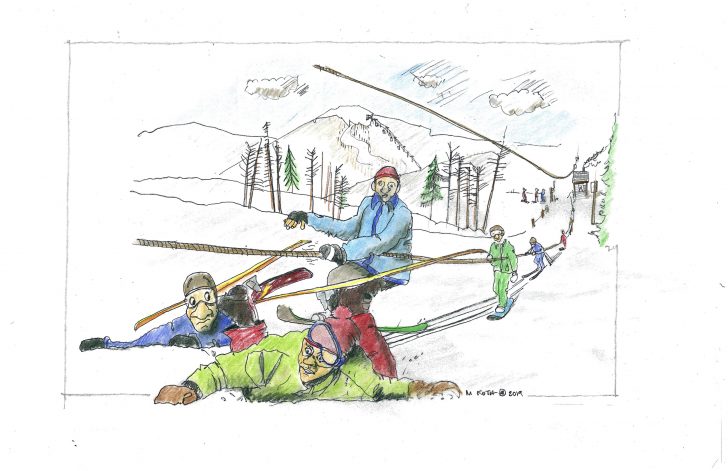
Rope Tow Escapades
Grabbing That Twirling Rope Was Not Easy.

We’ve all been there. Cartoon Credit: Mike Roth
It was the early 1960s, I was in first or second grade and learning to ski at Mohawk Mountain in Connecticut. At the time Mohawk had just installed the first chairlift in Connecticut but most of the experiences I remember where on their numerous rope tows.
The first thing newbies had to master was slowly gripping the rope. Despite instructions to slowly grasp the rope, all first-timers, including myself instantly use a death grip. As a result I’d get hurled up the mountain about five feet before doing a face plant.
To my relief (and later amusement) there was no shortage of people making the same mistake. Every so often there’d be heaps of beginners tossed about on both sides of the tow. Sometimes people got so jumbled up it was impossible to tell whose arms, legs, skis or poles belonged to whom.
After repeating this several times in front of my laughing, older siblings and their friends I finally learned to adjust my acceleration by gently grabbing the rope. Once underway it was an exhilarating ride up the hill.
It was exhilarating because the rope tows at Mohawk moved at about 16 mph. To put that in perspective, modern-day high-speed chairlifts travel at about 12 mph.
After a few tiring rides up the hill someone showed me how to reach my left hand behind my back and grasp the rope while still holding on with the right hand. This did wonders in making the ride physically tolerable.
Another essential skill was learning how to stop once underway. This skill was needed when someone further up the tow fell and blocked the path. Until this skill was learned there would be spectacular pileups. Easing up on your grip wasn’t sufficient because the friction of the rope would tear your gloves apart. Instead you would have to turn one of your skis perpendicular to the hill and use it to keep you from sliding backwards.
The people who didn’t learn this skill would inevitably slide backwards down the hill bumping those behind them. I remember struggling to maintain my place on the tow while two or three skiers slid back into me.
Being six or seven years old the last thing I wanted was to be on the rope tow without others close ahead and behind me. Without other riders close by I would desperately try to hold the rope up off the snow. Being so heavy I’d have to bend over and hold the rope just inches above the snow; a backbreaking way to ride up the hill.
Another challenge was following a tall skier and when you’re a little kid they’re all tall. One of my friend’s fathers was 6’2″. When I rode behind him I’d have to reach up at head level to hold on to the rope. This was another excruciating way to ride up the hill. In the lift line there was always jostling among my friends to be in the middle of the pack among like-sized skiers.
Being the youngest of three brothers and skiing with a bunch of boys from our neighborhood there was no shortage of mischief. When unloading from the rope tow the older boys would whip the rope in an attempt to knock those following off the tow.
The art form was perfected when one could whip the rope enough to knock off a follower but not so much as to get yelled at by the lift attendant. Those who excelled at this learned to look innocent and express dismay over what happened.
Years later it occurred to me that it was ironic that rope tows, one of the most difficult lifts to master, were most often found serving beginner slopes. I guess they served to toughen us up.
End note: I just recently learned about rope tow speeds at Mohawk having read Nicholas Howe’s fabulous article The Wonders of Walt in the December 2004 issue of Ski Heritage Magazine. Walt Schoenknecht was the ski visionary who founded Mohawk and soon after Mount Snow, Vermont.

Fryeburg, ME, 1936. First rope tow. Credit: MaineSkiMuseum
[authors_page role=contributor]