

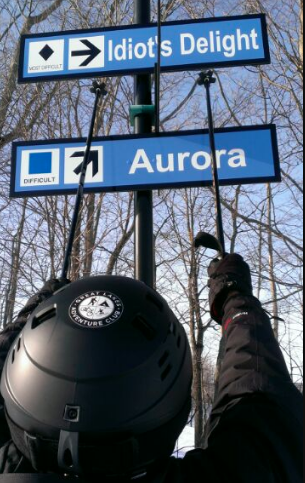
Trail Name Series: Michigan
Idiot’s Delight, Fun Bubble and Crisis.
[Editor Note: Last week, we launched Don Burch’s Trail Name series with a round-up of trail names from resorts in California. This week, we move to Michigan. If you have some trail names that stick in your memory, please let us know in the comments section below.]
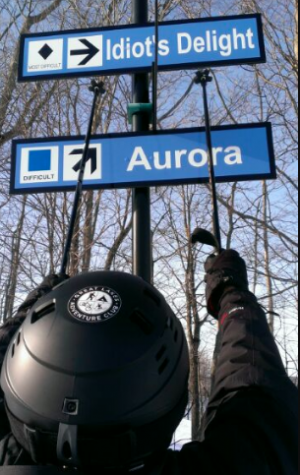 Look at some resort maps and you’ll find some very creative trail names. Among resorts in Michigan, I found some gems. Making the top ten are Idiot’s Delight at Boyne Mountain, Fun Bubble at Marquette Mountain and Crisis at Pine Knob.
Marquette Mountain has another trail in the top ten, Oh, Zone. Nub’s Knob also has two in the top ten; Hot Flash and Bark Eater (there is also a Bark Eater at New York’s Titus Mountain). Rounding out the list are Don’t Chute at Big Powderhorn, Coffin Canyon at Mt. Holly, Elf Buster at Schuss Mountain and Old Face Full at Treetops.
Michigan has a slew of great trail names making the Honorable Mentions list: At Alpine Valley there are Mineshaft and Hidden Splendor. At Big Powderhorn Crazy Trail and Vertical Drop make the list as do Lois Lane and Joust at Boyne Highlands. Big Snow has No Name Trail making the list which is also the name of a trail at California’s Mt. Waterman and New York’s Labrador Mountain.
Crystal Mountain has three trails on the Honorable Mentions list: Abbey Road, Penny Lane and Giggles. Mountain Slayer Chute at Caberfae and both Old School and Bear Trap at Cannonsburg are also noteworthy (there is also a Bear Trap at Vermont’s Mount Snow).
Bonsai and The Sweet Spot at Mount Ripley, Mogul Mania at Mt. Holly, Chicken Chute at Brighton, Kingdom Come at Schuss Mountain, Whitewater at Ski Brule and Boneyard at Marquette Mountain round out the list ( there is also a Boneyard at Dodge Ridge in California).
Mount Bohemia deserves its own paragraph for the number of creative trail names at the resort. These include Cursing Werewolf, Thirsty Vampire, Hungry Vulture and Wacky Jackrabbit. Not to be overlooked are Dynamite Blast, Forbidden Cliffs and Ghost Trail.
A final note about the popularity of skiing in Michigan: Michigan ranks number two as the state with the most ski resorts (42). It is only surpassed by New York with 48. Tied for third are Colorado and Wisconsin each with 30 (based on 2015-16 data from SnowBrains.com).
Do you have a favorite trail name that’s been overlooked? Please let us know in the comments section.

Mount Bohemia. Credit: Ramada Hancock

Olympic Visionary And Snow Safety Team Earn Honors At Ski History Gala
Their Behind-The-Scenes Work Makes The Winter Sports We Love Even Better.

Honoree Howard Peterson (r) is warmly congratulated by Ski Archives Advisory Board members Tom Nielson (l) and Richard Hughes. Credit: Harriet Wallis
Soft-spoken Howard Peterson grew up in a skiing family in Maine, became the ski director at New Hampshire’s Bretton Woods, and then moved west where he became the executive director of the U.S. Ski Team. He was already making an imprint on the ski industry.
Then, while the 2002 Winter Olympics plans were on the drawing board, Peterson rallied officials to build venues that would endure as training sites long after the Games were over.
Soldier Hollow, a venue of rolling hills and vast open space near Salt Lake City, became the 2002 Olympic Games venue for cross-country, biathlon, and Nordic combined. But it didn’t stop there.
Since the Games, thousands of children have been introduced to the sports there, and it’s a renowned training site for elite international athletes.
Mission accomplished!
Peterson earned the Joseph Quinney Award at the recent Ski Archives gala in Salt Lake City. The award is named for the late ski visionary and founder of Alta.
The other top award, the J. Willard Marriott Library History-Maker Award, went to the Utah Avalanche Center and U.S. Forest Service.

Part of the US Forest Service and Utah Avalanche Center team. Credit: Harriet Wallis
Here in Utah where the snow is legendary, the Utah Avalanche Center and the U.S. Forest Service work hand-in-hand to educate snow-lovers so they can “stay on top of the snow and not be buried underneath it.”
Predicting avalanche potential combines science, experience, and total dedication to help keep snow-users safe. Educating the public is crucial. Avalanches play no favorites.
In 2003 on the day after Christmas, three young snowboarders hiked into the back country to try their new gear. An avalanche swept them to their deaths.

The other part of the US Forest Service, Utah Avalanche Center team. Credit: Harriet Wallis
As a result, and with the support of the snow safety team, forecaster Craig Gordon spearheaded the “Know Before You Go” program—basic avalanche savvy 101. The program was presented to every outdoor group possible: snowmobilers, Boy Scouts. high schools. And then the program went worldwide.
What is Ski Archives?
The Utah Ski Archives is the country’s largest ski history research organization and repository of historic material. The Archives collection currently contains 500,000 images, 250 manuscripts and 6,000 audio,video and films.
Every year, it holds a gala fundraiser to help support its mission. And the gala honors individuals and organizations that set a high mark for their influence on the ski industry.
The Ski Archives collection is open to the public and is located in the University of Utah campus library in Salt Lake City.
To read more from Harriet click here for her stories on SkiUtah.
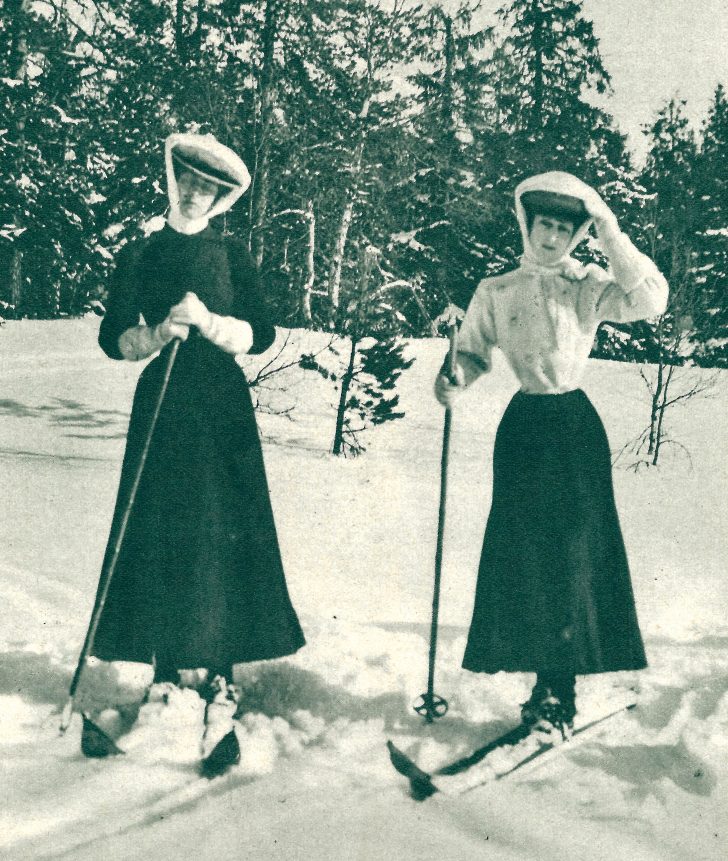
Mystery Glimpse: Who’s Skiing In Skirts?
It Looks Royally Uncomfortable.
Here’s a picture from long ago. The woman on the right is the mystery lady. Who is she? You can probably guess the era from the skiing “costumes”. Probably foreign. Last hint: Think Scandinavia.

This week’s picture was contributed by Vesterheim, the National Norwegian-American Museum & Heritage Center, in Decorah, IA. The center has over 33,000 artifacts, 12 historic buildings, a Folk Art School, and a library and archives. This treasure showcases the most extensive collection of Norwegian-American artifacts in the world.
Vesterheim’s exhibitions explore the diversity of American immigration through the lens of the Norwegian-American experience and highlight the best in historic and contemporary Norwegian folk and fine arts. USA Today named Vesterheim one of “ten great places in the nation to admire American folk art.”
Last Week
 This is the famous Engen Bell, a fixture in Utah ski history and an official “treasure” of the state.
The bell was used for many years on an old locomotive from the Denver & Rio Grande Railroad. It is estimated the bell was made in the mid-1800s, but no official records are available to verify its exact age. Rio Grande Railroad officials stated that the bell made hundreds of trips through Utah in the late 1800s and early 1900s.
In 1955 the bell was acquired by Martha M. Engen as a gift from the railroad. She gave it her son Alf for use at his Alf Engen Ski School at Alta, Utah. For 24 years, the bell was used every day to toll the start of the morning and afternoon ski school sessions. It became a landmark at Alta; everyone listened for the bell to sound. When Alf Engen retired as the ski school director, it was deemed appropriate to also retire the bell in his honor. The bell rang for the last time in 1989, when Alta celebrated its 50th anniversary as a ski area. Alf gave the bell to his son, Alan, who commissioned a solid oak stand and brass plates identifying it as “The Engen Bell,” in honor of his dad and his grandmother, Martha.

Look closely. There’s the bell on the old steam engine.
In 1995, the old bell was selected as one of the “100 Treasures of Utah” and was put on display at the Utah Winter Sports Park as a featured attraction of the 1996 Utah Centennial celebration. The reasons for being named a Utah treasure are twofold: First, the bell holds historical value due to the time period in which it was used by the Rio Grande Railroad. Secondly, it is the only ski school bell ever used at Alta, and as far as can be determined, is the only bell used by any ski school in Utah’s history. The only other Intermountain Region ski school to use a bell for announcing the start of classes was at Sun Valley, in the late 1930s and early 1940s.
The bell is on display at the Alf Engen Ski Museum located in Park City, Utah.
[authors_page role=contributor]