


Skiing With Confidence: Advice From The Ski Diva
Practical Advice On How To Regain And Maintain Your Confidence On Snow.

[Editor Note: The Ski Diva (Wendy Clinch, our friend and colleague) has given us permission to re-print a transcript of advice on confidence in skiing. The Ski Diva site is a community of women who love winter sports and the outdoors. The site has been honored by the North American Snowsports Journalist Association for excellence. We think this is an important article and are happy to present it here in edited form for our readers. To read her expanded article, click here. Many of the references to women characteristics and tendencies can be applied to older skiers, too.]
In skiing, lack of confidence can be a real game changer. It can hold us back and make it difficult for us to tackle harder terrain or even keep up with our family and friends. And when we don’t feel like we’re good enough, we let that take over. We have negative thoughts, which leads to poor skiing, which leads to more negative thoughts, which leads to more negative thoughts, which leads to more poor skiing, until your confidence is so shot you may not even want to ski anymore.
What we want is to develop a deep, lasting, and resilient belief in our abilities as skiers. We want to stay positive, motivated, and emotionally in control when we need to be. We don’t want to let lack of confidence or fear take over and drag us down.
There are a number of things we can do to help if we don’t have the inborn confidence we need.
First, confidence is something that has to start way before we get to the hill. And you can’t overlook the effect of how you feel, physically, in all this. Because if we’re not physically fit, if we don’t feel like we’re in good shape, we’re going to have a rougher time when we get out there, and that’s going to affect our confidence when we ski.
Second, you have to pay attention to your equipment, because poorly functioning equipment can be real confidence shaker, too. Which means have your skis waxed and tuned and your binding checked. But your biggest priority has to be your boots. Too many of us don’t have boots that fit properly. Boots are the one piece of ski equipment that comes in close contact with your body. So you don’t want to feel your feet move or your heel lift up. If your feet are moving and your ski boots aren’t, your skis aren’t doing what you want them to do. You’ll ski less well, and definitely less confidently.
You know what’s a real confidence crusher? Peer pressure. When friends push you to do something you’re not ready for. Do yourself a favor and give it a pass. I know that skiing with people who are at a higher level can be frustrating and even embarrassing, but don’t let it get to you. Remember, skiing is supposed to be fun — not stressful. One solution is to look for easy runs that parallel steeper terrain. Ride the same lift as your friends, and then take a different way down.

Ski School, Austria, circa, 1930s.
Another alternative: Break away and take a lesson. Personally, I think lessons are the best way to build your confidence. Because it’s easy to lack confidence when you don’t have the skills.
Whatever you do, though, don’t take a lesson from a spouse or a significant other. There’s way too much emotional baggage tied up in that. You want an objective third party, and you want a professional ski instructor.
So let’s talk about fear for a minute. Because what is fear, but a lack of confidence? And I think every skier has been afraid, at one point or another.
One of the best is to just breathe. When you’re nervous or scared, your body tends to tense up and your heart rate increases and you hold your breath. Deep breathing sends a signal to your brain that everything’s ok and you can relax.
Along these lines, I’ve found mindful meditation extremely helpful. Mindfulness is simply being aware of the present and paying attention to our thoughts and feelings at any moment, without passing any judgement. It’s not about rehashing the past or worrying about the future or things you can’t control. Instead, you focus on what’s here and now: On the feel of snow beneath your feet. On the feeling of the cold air on your skin. And while you’re doing that, you breathe positive energy in, negative energy out.
 So some other tips for building your confidence. Another good tool is positive self talk. Talk to yourself the way you’d like a good friend to talk to you. You want to focus on your strengths – we all have them — and instead of tearing yourself down, build yourself up. Studies show that maintaining a positive attitude can do wonders for your confidence. If you keep telling yourself you can do this, amazingly enough, you will.
And there’s one more thing that I think really helps with confidence: a good support system, like TheSkiDiva.com. One of the things that make it such a great community is the way we work to build each other up. Let me give you an example: I was on a trip with TheSkiDivas where a number of us went down some pretty difficult terrain. The ones who went down first stopped at the bottom and waited for the others. And as each one came down, we all cheered. You can’t beat that.

Mystery Glimpse: Ding Dong Bell
Yes, It’s A Big Bell.

What’s the significance of this old bell? Do you know where it came from? What it was used for? Who used it? Your guesses below most welcome.
This week’s Mystery Glimpse was contributed by the Alf Engen Ski Museum, Park City, UT. The museum was established in 1989 with the mission to preserve the rich history of skiing in the Intermountain Region. Browse their online collection of photos and videos of legendary pioneers, champions and significant contributors to the sport of skiing in the Intermountain Region. This library includes numerous vintage photos and video clips.
Last Week’s Glimpse
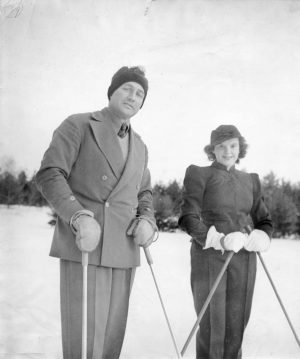 Nope, not Gary Cooper. Yes, Judy Garland. This is Otto Schniebs, shown here with the young movie star, who settled in Waltham, MA, after immigrating from Germany in the late 20s. He set up one of the first ski schools in America there and was soon discovered by AMC members as a talented ski instructor who had vast ski teaching experience in his native country.
Before moving on to become a ski coach at Dartmouth, Otto Schniebs introduced formal ski instruction to the region. With John McGrillis, he wrote the first instructional book on skiing in 1931. He was the director of the first ski school for instructors organized by the US Eastern Amateur Ski Association.
“For the first time learning to ski became easy in this country,” noted AMC ski leader William Fowler. Schniebs coined the well-known phrase, “Skiing is more than a sport; it’s a way of life.”
Otto Schniebs was inducted into the US Ski and Snowboard Hall of Fame in 1967.
Everyone knows Judy Garland.
Many thanks to the New England Ski Museum for sending along this Mystery Glimpse picture.
Trail Name Series: California
Consider The Name Of A Trail. You Will Often Find Uniqueness And Whimsy.
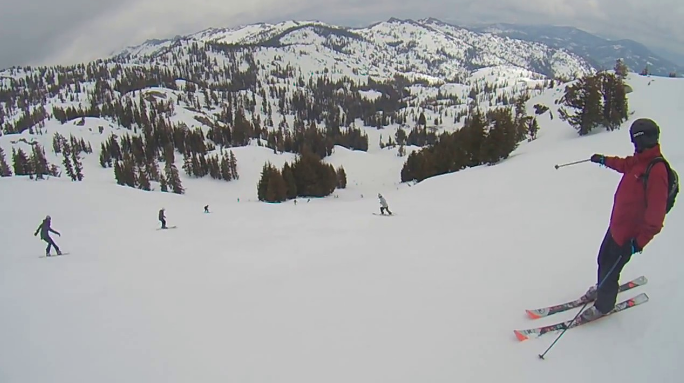
High Voltage, Squaw Valley. Credit: Patrick Saffarian
Peruse a few resort maps, and you’re sure to come upon some great trail names. Doing so with California resorts was no exception. Training Wheels at Mammoth is a wonderfully apropos name for a beginner trail. Amusement Park at Big Bear is fitting for a trail designed for park skiing and riding and Bone Yard at Dodge Ridge is a trail calling for respect.
Top honors also go to Secret Spot at Mammoth (there is also a trail named Secret Spot at Michigan’s Alpine Valley), Chute That Seldom Slides at Alpine Meadow, Lost in the Woods at Mammoth, Mambo Playground at June Mountain and Hogwild at Summit at Snoqualmie. Rounding out the top of the list are Ewe Turn and No Name Trail at Mt. Waterman (there is also a No Name Trail at Michigan’s Big Snow and New York’s Labrador Mountain), Ditch of Doom and Trench of Terror at Kirkwood and His and Yours at Boreal Mountain.
Honorable mentions go to:
High Voltage Squaw Valley
Elevator Shaft Kirkwood
Snowsnake Gully Kirkwood
Hornets’ Nest Northstar
Cop out China Peak
While viewing trail names at California resorts a few unexpected patterns emerged. First, several had the word stump in them. There is a Stump Alley at both Mammoth and Northstar, Stump Farm at Crystal Mountain and Stump Run at Kirkwood.
Two resorts have named trails after a traditional samurai practice. These are Hari-Kari Gully at Sugarbowl and Hari Kari Gate at Bear Valley.
Several trails are named after animal anatomy. At Squaw Valley there are Mule’s Ear and Red Dog Face. At Northstar. there’s Cat’s Face. At Sugarbowl, you will find Crow’s Face, and at Sierra-at-Tahoe there is Horsetail.
Do you have a favorite trail name that’s been overlooked? Please let us know in the comments section below.
[authors_page role=contributor]