

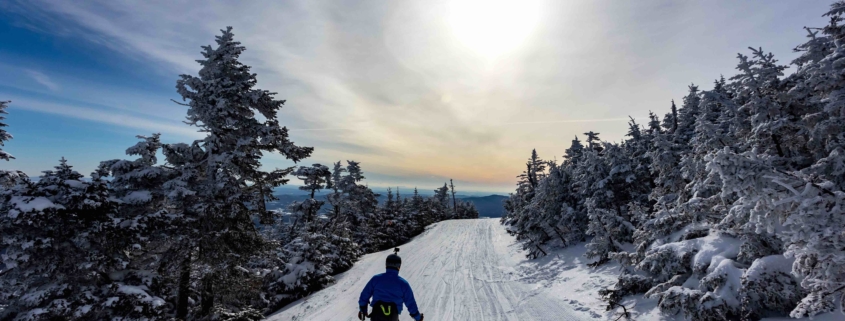
Sugarbush Supporting Mental Wellness

Photographer Credit: John Atkinson
Getting out in nature triggers the biophilic hypothesis (human tendency to connect with the natural world and other living organisms) which involves lowering human stress, boosting mental health, restoring attention, empathy, and cognitive clarity by getting outdoors and benefitting from its support for mental wellness. Studies have been conducted to measure the impact of exercise for people diagnosed with depression, anxiety, eating disorders, and even post-traumatic stress disorder. This research shows beneficial effects that produce a statistically relevant and significant reduction in these mental maladies. There is also evidence for the effectiveness of exercise training in patients with panic disorder impacted by a number of psychological factors such as increased self-efficacy, a sense of mastery, distraction, and changes of self-concept.
The Sugarbush Resort in Waitsfield, Vermont is coordinating a challenge program called “Descent to Rise Above” intended to make people more aware of and provide support for mental wellness and resilience. The program invites skiers and riders to participate in a challenge to raise up to $50,000 for mental wellness and resilience by skiing and riding a BILLION vertical feet in a single season at Sugarbush Resort. Additionally, the Challenge looks to create chances to connect and possibly share some of the less-than-comfortable stories we all may carry. Riding the lifts and stopping during long runs tend to be great times for conversations. The infinite healing power offered by the outdoors and exercise has a potency that has been penned about by poets and proved by scientists—getting outside provides enormous restorative effects to our states of mind.
The Descent to Rise Above Challenge is a partnership between Sugarbush’s Be Better Here Fund and NFI—a New England nonprofit specializing in the healing of mental and emotional trauma. NFI is an agency that works with states to provide a comprehensive system of care, including crisis stabilization, residential care, and therapeutic foster care with resource centers in all of the New England states and New York. It is the hope of the Challenge to bring some light to what NFI does and provide resources so that they may continue to provide services to the youth and adults that rely on them.
Click here at Sugarbush Rise Above program for more specific details about participating. Sugarbush’s Communication Director John Bleh stated, “Skiing and riding a billion vertical feet in a single season is a big lift, but it can be achieved. Participants need only fire up the app and track their vertical every day they are at the ski area.” Sugarbush will post updates on the Challenge’s progress every week and award Descent prizes to participants, whether it be for their vertical, braving a particularly un-fun weather day, or simply for sharing their experience.
The top three participants from each New England state and New York will receive an Ikon or Sugarbush season pass for first place; a Quad Pack for second place, and a $250 Sugarbush Gift Card for third place. Each of the participating “vertical getters” will receive a commemorative Descent to Rise Above trail sign with their vertical accomplishment burnished into it along with some Challenge SHWAG.
Descent to Rise Above Challenge participants are also invited to share their stories about navigating mental health challenges. These stories can be shared anonymously, allowing for openness and honesty in a safe space.
Whether it’s a moment of vulnerability, a breakthrough, or a small step toward healing, peoples’ sharing their experience can help inspire others on their own path.
More About Mental Wellness and the Outdoors
Will there come a time when psychologists prescribe an exercise and outdoor intervention as part of therapy for their patients? These activities would seem to integrate perfectly with cognitive behavioral therapy strategies such as situational analysis, self-monitoring, homework activities, and supportive follow-up to help compliance.
Physical fitness associated with other snow sports such as cross country skiing or snowshoeing can also improve self-esteem for those facing mental challenges, and as patients feel better about themselves they’ll develop a more optimistic and energetic frame of mind. There is also an association between aerobic exercise and increased alertness. The exercise improves circulation and increases the availability of oxygen to the brain while it also causes the body to produce chemicals such as adrenaline to promote mental alertness. Fitness can instill a sense of pride and confidence and allow the mind a pathway to escape from everyday stress. Biologically speaking, exercise is said to cause the brain to release beta endorphins, which are essential in relieving pain and create a sort of euphoric or light happy feeling. This overall mood enhancement can be prescribed to help treat depression and anxiety. Regular exercise will also invoke focus, determination, and discipline which are mentally strengthening.
“The Nature Fix” a book by Florence Williams published by W.W. Norton & Company in 2017 provides some of the most compelling arguments for people to spend more time outdoors in nature, based on an increasing amount of biological, psychological, and medicinal scientific evidence.
Over the years, efforts have been made to quantify nature’s impact on mood, well-being, ability to think (remember, plan, create) and sociability. Nature also effects a social component like the feeling that is shared among people who spend time together outdoors or people who perform exceeding acts of kindness in the aftermath of a severe environmental event such as a tornado, earthquake, firestorm, and such.
The evidence (20 pages of cited notes and credits in the book) about nature impact involves details with cortisol levels, sympathetic nerve activity, heart rate decline, and hemoglobin in the brain’s prefrontal cortex. The Nature Fix is replete with plenty of information, but for the average person suffice it to say that programs that get us outdoors and exercise such as Descent to Rise Above Challenge is just what the doctor ordered.
Skiing/Snowboarding Indoors Year-Round in New Jersey
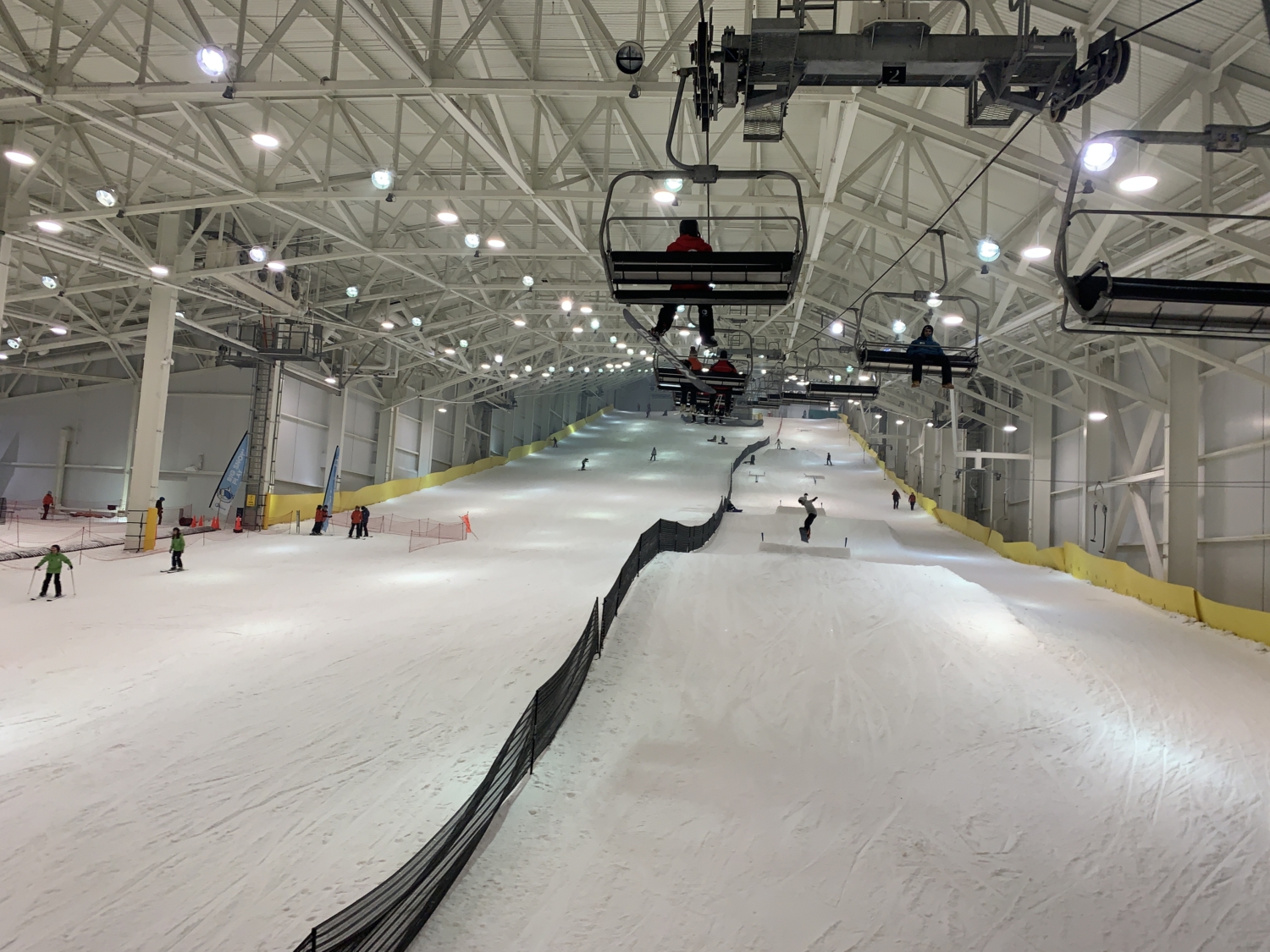
Big SNOW is the only indoor ski and snowboard area in North America. It is part of the American Dream Entertainment and Retail Center in The Meadowlands, East Rutherford, New Jersey, and a great place to learn year-round, get a jump-start on the new downhill season, or tweak your turns between outdoor trips.

Photo Credit: Big SNOW
The complex also offers other recreational activities, including what it claims is the world’s largest theme park.
The slopes at Big SNOW are 1,000 feet long, with a 160-foot vertical drop and a maximum 26-percent pitch, climate-controlled environment at 28 degrees. One slope is a dedicated terrain park, perfect for skiers and riders working on new tricks or just wanting to get some fun in on a relatively short run.
According to Marketing Director Hugh Reynolds, the consistent temperature ensures the optimal mix of snow quality and guest comfort. Snow is machine made. Capacity is 4.4 tons per hour, which is comparable to machine-made snow at outdoor facilities.
Big SNOW encompasses 180,000 square feet, with four acres of terrain, including a specific learning area, four lifts, including a four-passenger fixed grip chairlift, two “Magic Carpets”, and a Poma lift. Maximum slope capacity is 500.
The complex opened on December 5, 2019 and has hosted more than a million guests since. Most are locals, but Big SNOW gets its share of out of towners. Reynolds says a robust local community has built up around Big SNOW. He notes that the operation has thousands of guests who hold either a monthly subscription or multi-visit card product.
For the 2024/2025 season, the facility is open 1pm to 8pm daily. Day passes are $99.99 including equipment and clothing rental, but there’s nothing on the website that tells you the price if you have your own equipment and clothing. There’s also a season pass for unlimited visits.
https://www.bigsnowamericandream.com/snow-day-packages/
Big SNOW Background Story
Big SNOW’s history dates to the early 2000s, when a project called Xanadu was in the works to bring indoor skiing, shopping, and entertainment to the Meadowlands. When it stalled for lack of interest and funding, the state of New Jersey approached the owner/operators of Mall of America to save it.
Enter Joe Hession and his company SNOW Partners. Hession is the founder and CEO of SNOW Operating, and a recognized leader in the field of resort operations. He also created SNOW Operating’s Terrain Based Learning®.
Hession and Reynolds met at Northern New Jersey’s Mountain Creek (formally Vernon Valley). Both are strong advocates of introducing newcomers to skiing or snowboarding, and secured the lease to run the business in 2016.
Big SNOW programs include equipment rentals, outerwear (pants and jackets), a helmet, a two-hour slope access ticket, and complimentary access to the Terrain Based Learning skills area and instructors.
To prevent overcrowding, guests are asked to book lift ticket time slots in advance, similar to tee times in golf and ticket-limited resorts such as Powder.
Ski Bikes also are available for those who want to try something different. The bicycle-like devices are engineered with skis instead of wheels. The “bike” package includes outerwear (not gloves), a helmet, and snowboard boots.
Big SNOW is especially popular in summer, when outdoor skiing and snowboarding is unavailable, and as an early season warm up for practicing before the snow flies.
“On an annual basis more than half of our visitors are new participants to the sports trying them for the first time,” Reynolds says. “We see a good number of tourism guests visiting NYC”.
Big SNOW is just four miles from the Lincoln Tunnel, and the NY/NJ Port Authority offers direct bus service from NYC to American Dream daily.
Roth on Ski Safety
In many of my entries, I talk about skiing safety, but I think it needs more emphasis, maybe even continual emphasis. Here are the seven rules of slope safety to keep you and others out of danger:
1. Always stay in control and be able to stop or avoid other people or objects.
2. People ahead of you have the right of way. It’s your responsibility to avoid them.
3. Don’t stop where you obstruct a trail or aren’t visible from above.
4. Whenever starting downhill or merging on to a trail, look uphill and yield to others.
5. Always use devices to help prevent runaway equipment.
6. Observe all posted signs and warnings. Keep off closed trails and out of closed areas
7. Prior to using any lift, you must have the knowledge and ability to load, ride, and unload safely.
 I’ve been thinking hard about the code of skiing. The most important in my mind is number two which doesn’t apply to you but really applies to all the people who are going to pass you.
As a senior skier I tend to ski slower and more carefully along the side of the trail and respect the code by announcing when I’m going to pass a skier well before I do. I ski at a speed that allows many people to pass me. I feel there must be a way to educate others who, when passing me, don’t say a word or shout “watch out”. I learned to ski in the 60’s and 70’s and announcing my intention is ingrained in me. The big question is how to indoctrinate many others who don’t apply this simple safety and courteous practice? If this was the armed service, their teaching methods would be to repeat it 100 times until it was engrained into your brain.
I think one solution would be to put up a permanent banner in the lift line where no one will miss it. If they take 10 runs a day they’ll see it 10 times. Unless they can’t read, it should eventually sink in. Wouldn’t that be nice? It’s the most important rule on the slopes and would prevent many accidents. I also think the logo for the Snow Angel Foundation is one we should all adopt. I plan on getting a patch to wear on my jacket just to give them the exposure. I know that Killington and other ski areas have partnered with the Foundation and will give the cause a great deal of exposure.
Last year at Whiteface the Foundation did have signs up in two locations in the lift line that said, “respect the zone”, meaning the 15-foot radius that is the “no ski zone” as one is passing. The signs were very small. They should be banners across the entire lift line so no one can miss them.
I avoid weekend skiing just because it’s crowded with hundreds of people zooming by you at speeds where they may be in control of or not! I also try to ski the wider trails and stick to the edges to give people the most room to pass. Lastly, I look for the most out of the way, unpopular trails on any mountain. Believe it or not there are many.
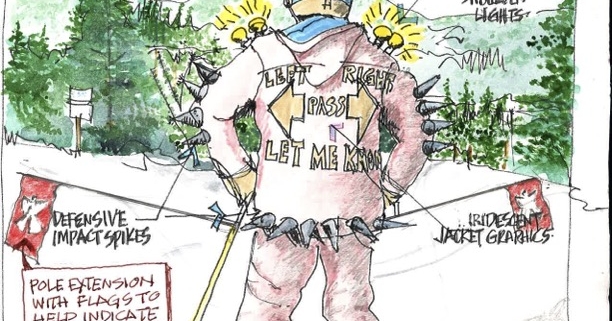
Today, our equipment is designed better and better for safer skiing. We have helmets to help prevent head injuries, heated equipment to prevent frostbite, and even inflatable vests for speed racers who might have a bad fall. Maybe someone should design ski clothing with airbags!
However, no matter how much you do personally, it’s the other guy you must worry about! I now have the ski pole extensions designed by SKI GUARDIAN and called MY SKI SPACE. Let’s see how much they’ll help keep people away.
[authors_page role=contributor]