

What’s New for the 2024-25 Season—Southeastern Edition

Virginia’s Massanutten Resort moves up in the rankings of the South’s best resorts thanks to a flurry of improvements coming to fruition this year. Courtesy Massanutten Resort.
Research on the southern ski industry shows that below the Pennsylvania/Maryland state line, resorts boast a nationally significant rate of infrastructure reinvestment.
“Incremental” and “annual” spending on snowmaking improvements, more modern lifts, and new slopes tell most of that tale (as they do everywhere). But when resorts spend big bucks on big changes it gets enthusiasts excited and can shake up the competition. That registers with snowsports fans even when improvements take a few years to accomplish, which is happening this winter in West Virginia at Timberline Mountain, in Virginia at Massanutten, and in North Carolina as the one-time Wolf Laurel ski area gets ready to open as an upscale boutique resort.
The Rundown

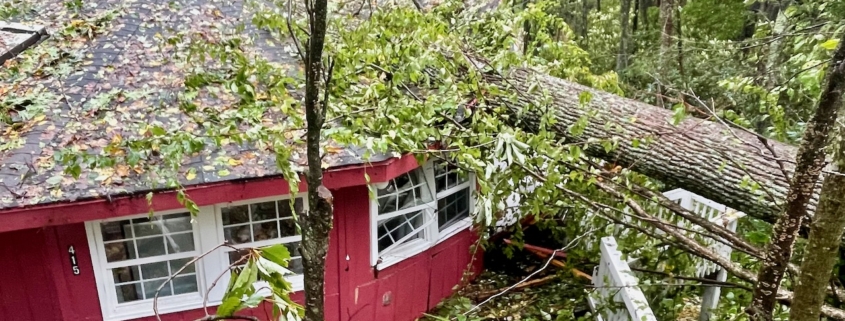
From Asheville’s River Arts District, to Banner Elk and Boone, Helene damage was evident all over southern ski country. Photos by Randy Johnson
Instead of going straight to those stories, I’ll start with North Carolina “in honor” of Hurricane Helene. The storm’s massive destruction makes it a bit of a miracle that North Carolina’s southernmost Appalachians would even have a ski season this winter. (If this buries what you’re interested in, just drop down to “Big News.”)
When I cleared the debris from my own property below Grandfather Mountain in the Watauga River Valley near Boone (north of Asheville), and the lights and water finally came back on weeks later, it seemed that destruction at the state’s six Western North Carolina ski resorts would likely be significant. Since then, with vaporized, even major roads being rebuilt—I-40 north of the Great Smokies will take a year!—I confess to head-shaking, mouth-agape awe at the tear-jerking ruin I discovered when I could explore.
As I drove past the flank of Grandfather Mountain, a state park and likely the East’s most ecologically significant summit, the flattened forests look like someone dumped a pile of toothpicks on nature, a lot like the damage to Puerto Rico’s rain forest-covered mountains that I recall seeing shortly after Hurricane Hugo decimated the island’s Caribbean National Forest in 1989.
Luckily it turns out being at the top of these lofty southern summits minimized flood damage to ski areas, the biggest impact of the storm.

From Asheville’s River Arts District, to Banner Elk and Boone, Helene damage was evident all over southern ski country. Photos by Randy Johnson
Even so, when I drove the few miles from my home to Sugar Mountain to survey the crowds of Thanksgiving skiers, the road on the way to the slopes and others in the incorporated town around the resort were lined with snapped power poles, wires, and massive debris piles waiting for DOT pick up.
Oddly, the piles of boughs and other evergreen slash from white pines and the indigenous, highly prized Fraser fir looked like a happy hunting ground for wreath makers and lent the drive a Holiday feel. In fact, in this high elevation area, Holiday decorations are big business that makes North Carolina the country’s number two Christmas tree growing state. The 18-foot, Fraser fir towering right now in the Blue Room of the White House made it’s way to DC in mid-November from a tree farm in the shadow of Sugar Mountain.
This winter skiers won’t miss the lingering scars of land slides, match stick-snapped trees, and flood-gutted, dislocated, boarded up homes and businesses as they respond to the North Carolina ski industry’s plea “don’t forget us!” The infusion of tourism dollars that a successful ski season will bring is critical this year, especially in rural areas where ski resorts fuel the winter job market and deliver the bulk of the year’s occupancy tax revenue to municipalities, even those known for bullish summer tourism.
Cities and towns with names like Asheville, Chimney Rock, and Banner Elk, with centuries-old summer cultures, are now recognizable all over the country to people following the storm and its shocking scenes of devastation. A drive through Asheville’s River District and the Biltmore Village shopping and dining neighborhood still leaves people shaking their heads with the years of rebuilding ahead.
Nuff said. The recovery continues and we’ll definitely be leaving the light on for you.
Big News
Starting with the Old North State, let’s hit some bigger stories.
Hatley Pointe Ski Resort, NC

Alpine-appearing Big Bald rises over Hatley Pointe’s summit quad lift in this picture from 2010, when the resort was called Wolf Ridge. Photo by Randy Johnson
The news in North Carolina is that the modest 1970s ski area formerly known as Wolf Laurel, later Wolf Ridge, is likely to debut this year as Hatley Pointe, what owners Deb and David Hatley call a “boutique ski area.” The widely anticipated reinvention was slated for last winter but the task took longer than expected.
Luckily, the Hatleys success manufacturing golf carts and hot tubs appears up to funding the rebirth of Wolf Ridge while also building another upscale resort just across the state line in the mountains of East Tennessee.
The changes are sparking high hopes for what is surely one of the most connected ski areas in the entire South. The resort lies a few minutes off I-26, which makes Asheville—desperately in need of tourist dollars—a very enticing base for skiers, just a half hour away.
That means Hatley Pointe has a rarity in the South, cruise control access (so does West Virginia’s Winterplace). Urban areas to the north and west in Eastern Tennessee and Virginia are both just across the state line via the highest interstate in the East, a heated stretch of asphalt across Sam’s Gap at 3,760 feet. To the south and east, I-26 and a web of other interstates link the urban lowlands of North Carolina, South Carolina, Georgia and beyond.
Thus homeowners in the Wolf Laurel vacation community perched under the snowy, treeless summit of Big Bald, traversed by the Appalachian Trail, are hoping Hatley Pointe and Madison County become a major presence in North Carolina’s ski and summer tourism scene.
This year’s countdown to opening has finalized a greatly expanded lodge with an upscale restaurant called Smoke and Timber, along with extensively refined slopes, updated lifts, and snowmaking.

Though this picture is from 2010, the upper elevation Ridge Runner lift and slope is expected to operate this winter at the new Hatley Pointe. Photo by Randy Johnson
Not having ever owned a ski area, the Hatleys are bringing a can-do attitude, some local experts from years past, and Colorado-based Mountainworks, a global ski resort designer, to the table. Everything from new summer activities, lodging, and expanded “backside” slopes are envisioned. By early December, the resort’s core slopes were covered with snow, but there were still final lift inspections and tweaks needed that spokesperson Sarah Woodward expected in time for holiday skiing.
What’s not fully known is how fast the new owners will reinstate a slope network that made the resort promising in its early 2010s heyday. Back then the nearly 60 main acres of diverse slopes served by a summit quad also abutted an attractive set of upper elevation beginner slopes and the massive timber frame Ridge Lodge—which burned in an unexplained 2014 fire. That and adjacent lift damage scuttled access to the upper runs and what looked like a bright future.
That may change. The central slope system is ready, say the owners, and indeed part of the old upper runs, the quad-served Ridgerunner slope, is also expected to open this season. But the next layout below that, the former “Backside” runs accessed via another lift and a ski tunnel under a road, await future action.
If it all comes together as expected, Hatley Pointe could be a noteworthy new wrinkle in regional skiing.
Timberline Mountain, WV

Whitegrass Ski Touring Center, the South’s best Nordic resort, flanks the rapidly improving Timberline Mountain downhill resort. Photo by Randy Johnson
One of two alpine resorts in West Virginia’s Canaan Valley, Timberline Mountain always seemed poised for greatness, without ever getting there. A different future arrived in 2019 when the 1,000 vertical feet of fall line terrain was purchased by Indiana’s Perfect North Slopes.
Lift changes came first—a six-person detachable summit lift and a fixed grip quad to mid-mountain. A major day lodge expansion and the twenty-room slopeside Timberline Hotel reinvented the base experience. Annual improvements have consolidated the progress, making this winter a great time to appreciate this resort’s arrival as one of the region’s top ski experiences.
That status includes the South’s longest run, two-mile Salamander, that abuts the Monongahela National Forests’s Dolly Sods Wilderness, an awesome backcountry Nordic ski location connected to the adjacent White Grass Ski Touring Center, the region’s top cross country ski resort. Two adjacent state park Nordic layouts, and the state’s Canaan Valley Ski Area, round out Canaan Valley’s rising ski reputation.
Insider tip: It’s pronounced Kuh-NANE, not KAY-nin.
Massanutten Resort, Virginia
Last winter’s finalization of a major slope expansion at this Shenandoah Valley resort moves Massanutten up among the South’s ski destinations.
The last few years have seen four new slopes, including a third long drop from the summit, this one a double-black called “No Hessitation.” That slope, covered by automated snowmaking and LED lights, runs the lift line under a new four-person high-speed detachable called the Peak Express (replacing a conventional quad). Another of the existing summit slopes Paradice also has had a makeover and snowmaking upgrade. There’s expanded seating and menu options at the Mid-Mountain Grill.
Massanutten’s recent Director of Skiing Kenny Hess (namesake of the “No Hessitation” expert run), promised that the flurry of recent changes would be “a game changer” for the four season resort, the only employee-owned ski area in the region. This year Massanutten has it dialed in, ready to impress. As Hess promised, “Mass will ski much bigger than in the past,” and this winter proves it. Best of all, the new runs link the entire top of the mountain creating an almost separate system of slopes.
The Best of the Rest
Appalachian Ski Mountain, Blowing Rock, NC

“App” Ski Mountain’s snowmaking keeps getting better. Photo by Randy Johnson
Back in NC, snowmaking ramps up at “App” with an automated system keyed to weather stations on each snowgun. Marketing manager Drew Stanley says that makes it possible to customize snow quality and usher in mid-season snow conditions virtually overnight.
New slope lights have been installed on four slopes along the resort’s right side switchback, all fine-tuned for uniform illumination and superior night skiing. Another modernization of the family-friendly lodge decor adds undermount sinks, automatic soap and water, custom granite countertops and rustic wood-framed mirrors.
Not completely new this season, the resort’s RFID ski ticket system integrates ski rentals and lessons at the slope’s French-Swiss Ski College with timed arrivals to eliminate congestion. The resort’s flex-ticket this year adds an hour of free ski time if bought online.
Sugar Mountain, NC

Massive Grandfather Mountain dominates the skyline of the NC High Country ski region. Photo by Todd Bush
Despite the storm, Sugar opened the ski season the weekend before Thanksgiving touting expanded snowmaking. Sugar was among the first southern slopes to make great grooming a specialty decades ago back when it wasn’t. Its trademark combed corduroy gets better this season with two new Pisten Bully 600 free groomers and a new winch cat aimed at the resort’s double blacks.

Sugar owner Gunther Jochl maneuvers a Winch Cat at the top of double-black Whoopdedoo. Photo by Randy Johnson
Sugar’s mile and a half, 1,200 vertical foot longest run begins on a big switchback from the mountain’s 5,300-foot summit on the Northridge slope, then swings past the start of the super popular Gunther’s Way (named after owner Gunther Jochl). Busy Northridge doubles in width this winter and gets new LED lights. “Giving skiers and riders more space and brighter lights always makes the night session a more pleasurable experience,” Jochl says.
Upper mountain snow quantity and quality also benefits from new automated SMI snow machines on Northridge and just below on Flying Mile, all fed by a second centrifugal 4,000 CFM compressor that replaced two aging ones.
This season Sugar initiates an RFID chip-based, digital ticket system from SKIDATA using onsite ticket purchasing agents or kiosks. An online-only ticket system should also make tubing and ice skating more convenient.
Wintergreen, VA
Happy anniversary Wintergreen—a half century this year, overlooking the Charlottesville area from the crest of the Blue Ridge. To celebrate the resort will stage special events throughout the winter and offer a free learn to ski and ride program. Participants sign up for three free 2-hour group lessons that include beginner area lift tickets and beginner equipment rentals, and after completion they can buy a discounted season pass for the rest of the year and the following winter.
Snowshoe Mountain Resort, WVA
Alterra Mountain Company resort Snowshoe Mountain, one of the company’s seventeen Ikon Pass destinations, also celebrates a 50th anniversary this winter.
Wisp Resort, MD
Resort sprawls above Deep Creek Lake in Maryland’s westernmost Garrett County. This season debuts an assortment of snowmaking and slope lighting upgrades around the resort’s 33 trails over 132 acres, more than 90% of which is lit for night skiing. Like Wintergreen in Virginia, Wisp is a PGRI Pacific Group Resort company and shares the free learn to ski and ride program.
Indy and Ikon Pass Update—
The Indy Pass discount ski ticket program has spread to six participating ski resorts in the South, including Bryce Resort, Massanutten Resort, and Wintergreen in Virginia, Canaan Valley Resort and Winterplace Resort in West Virginia, Wisp ski area in Maryland (a sister resort with Wintergreen in the PGRI Pacific Group Resort company), Cataloochee Ski Area in North Carolina and Ober Mountain in Gatlinburg, Tennessee. Alterra Mountain Company’s Snowshoe Mountain Resort in West Virginia, the region’s biggest ski area, is part of the Ikon Pass network.
A Look Back at the Learn to Ski/Snowboard Month Program Which Introduced Thousands to Snowsports

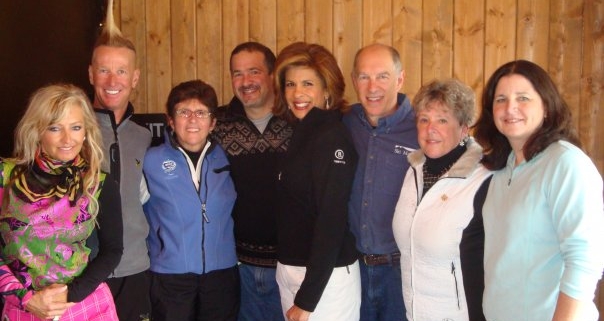
Credit: Mary Jo Tarallo Left to Right Kimberly Plake, Glen Plake, Mary Jo Tarallo, Scott Brandi (Ski Areas of NY), Hoda Kotb (NBC Today Show), Greg Sweetser (Ski Maine), Margie Bell (SkiPA), Linda Irvin (Ski PA)
Sixteen years ago, the ski/snowboard industry embarked on a venture known as Learn to Ski and Snowboard Month for the entire month of January. Over 10 years, from 2009 to 2019, it introduced many thousands of newbies to snowsports. But how it came to be was somewhat serendipitous.
A group of state ski areas associations came up with the concept of offering special “learn to deals” in a specific time frame – the month of January. An effort to secure a declaration from the White House did not materialize. However, the PR director for SnowSports Industries America (SIA) at the time and the Marketing Director for Ski Utah (who is still there) came up with the idea of simply declaring January as Learn to Ski and Snowboard Month while breakfasting at a popular cafe in Salt Lake City in January 0f 2009.
There were so many “National What Evers” that it just made sense to establish one for the ski/snowboard industry to generate new skiers and snowboarders, a goal on which the industry has long been focused.
On a press trip to New York later that year, the Ski Utah team managed to secure a segment on the TODAY Show for January 2010 to kick off the second year of the program. The plan was to have NBC’s Hoda Kotb come to Camelback Resort in Pennsylvania to video a segment where Glen Plake would give her a ski lesson.
The concept had a touch of humor. The opening scene showed Hoda in a children’s class. After a few pointers from Glen, Hoda turned into an expert skier. Her “double” truly was an expert skier who apparently heated up the jacket they both shared. She commented on it in good jest!
Representatives from Ski Areas of New York, Ski Maine and Pennsylvania Ski Areas Association all attended to filming at Camelback along with Glen and Kimberly Plake and the LSSM Executive Director.
Many industry areas and organizations already were on board with Learn to Ski and Snowboard Month, but the Today Show visibility attracted SO many more, including the attention of Michael Berry who, at the time, was the president of the National Ski Areas Association (NSAA). Unlike SIA, NSAA had not been initially involved, but Berry recognized the value that LSSM brought to the effort to attract newbies.
When the SIA PR director left the organization, Berry infused funds to expand the program with said director at the helm. Funding included SIA and NSAA plus clothing and equipment companies, state ski area associations and more. In fact, state ski area associations always formed the backbone of the program that became a collaboration of about 75 industry organizations.
A steering committee was formed with Ski Utah Marketing Director Raelene Davis as chair. Ski areas could determine what constituted its “learn to offer” based on its position in the marketplace. A web site tied the offers together to make it easy for the public to find information and benefit from tips on lessons, what to wear and other helpful hints for beginners.
Together we introduced more than a million newcomers to the sports from 2009 – 2019., the last year for the national Learn to Ski and Snowboard Month. I’m proud to have helmed the program.
Then, priorities within the industry seemed to be changing, with a greater focus from conglomerates on selling season passes and NSAA leadership changed as well.
Today, although there are some groups in the snowsports industry which “honor” the month of January, there is no industry-wide program that draws attention to the sports. Some programs focus on “skier visits”, but the grass roots approach to getting newbies involved ended in 2019 after an 11- year run.
It was a good run.
Tips For Elder Cross Country Skiers
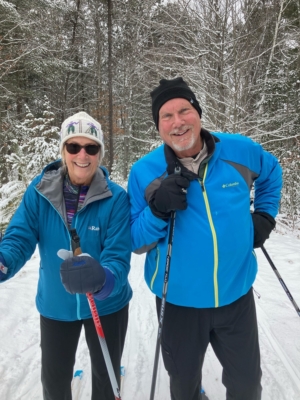
XC skiers at Cross Country Ski Headquarters in Michigan
Before the Golden Bachelor created a hoopla and appeared on TV, Herman Smith Johannsen also known as Jackrabbit Johannsen was known for cross country (XC) skiing at 102 years old. He was a man who popularized XC skiing in Quebec and later in America. He lived until he was 111 and was always inquisitive about what was on the other side of the hill. The Jackrabbit kids’ ski program in Canada was named for him and there was also a Jackrabbit ski wax. I don’t know if there is a direct correlation for Johannsen proving that XC skiing helps you live longer, but it is a plausible theory.
Among the 4-5 million American XC skiers, about 11.2% are aged 55 or older while 30% of the general population falls into that age group. For those elder individuals who live in or near snow country, they might want to consider the benefits of XC skiing to help them live healthier and longer lives like Johannsen.
As a recreational activity, XC skiing is one of the most acknowledged forms of aerobic exercise and there is scientific evidence that the sport’s characteristics are excellent for mental well-being, too. Recommendations are for older people to undertake vigorous physical intensity (exercise) for 75 minutes per week or moderate intensity for 150 minutes each week. XC skiing is a sport that even when done at a slow pace can raise the heart rate for fitness. The well-being associated with XC skiing is derived not only from the physical exercise involving all the body muscle groups, but it is an outdoor activity that takes place in nature in the winter. This “forest bathing” or immersion in nature has been explained in the book “The Nature Fix” and according to scientific evidence besides the fitness biological benefits, there are very positive psychological and medicinal impacts derived from the activity. The sensory experience of getting outdoors is a kind of eco therapy and a prescription for lowering stress, restoring attention, and boosting mental health and cognitive clarity.
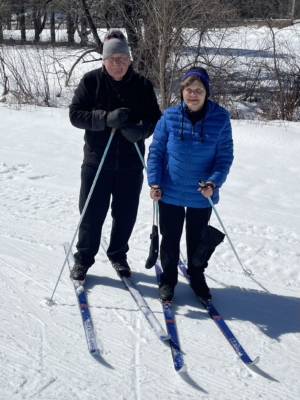
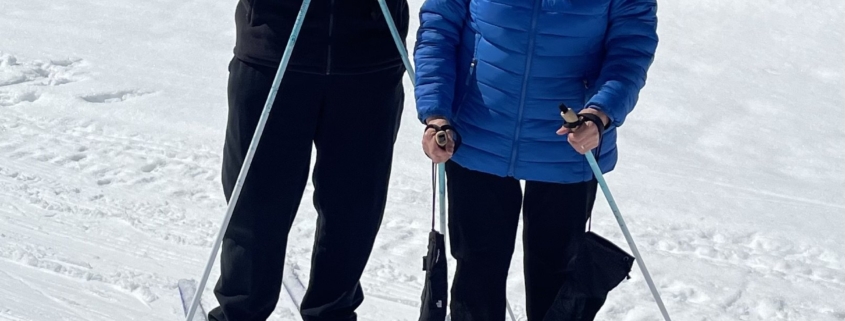
Cross country skiers at Woodstock Nordic Center in Vermont
Many XC ski areas offer programs catering to elders from weekly meet-up group outings to special lesson programs and of course, discounted rates for those aged 65 and older. The social aspect of XC skiing occurs when meeting others on the trail junctions or in the lodge and evidence shows that interacting with friends and family is significant factor for living a long and healthy life.
Ski lessons (or a refresher clinic) are recommended to make the sport easier and more satisfying. Ask for an instructor who specializes in teaching older skiers.
Some recommendations for older XC skiers include talking to the doctor if uncertain about strenuous exercise (and remember that you are able to take it easy and ski at a slow pace). There are tips for first timer XC skiers which suggest to stay within your limits and not to ski too long or too far. Going to a XC ski area is a great idea because the trails are groomed and tracked which makes the sport easier. Additionally, the ski area will have patrollers, rental equipment and ski instructors to provide technique pointers if needed. The new XC ski gear for skiing on a groomed trail is light and lively. The bindings are adjustable to give the skis more glide (go faster and glide further) or more grip (go slower) and this adjustability can also help address how the ski performs in different snow conditions. If a trail is too steep another option is available as it is not a crime to remove the skis and walk down the difficult section (or side step on the skis to avoid speeding out of control).
Another good idea is to know where you are going and where you are on the trail network. Many trail configurations can be confusing and you don’t want to get lost particularly if you are tired. Check the trail signs along the trails and carry a trail map if one is available – and check the map to know where you are in the trail network.
Dressing for cross country skiing is about layering (see What to Wear article) with a light base layer, a shirt and a light jacket. Only use heavier layers when it is very cold because overdressing can be a problem as you create heat when XC skiing. Keep in mind that you can remove layers if you become overheated. Socks, gloves and a hat are important components of your outfit and each plays a key role in keeping you comfortable.
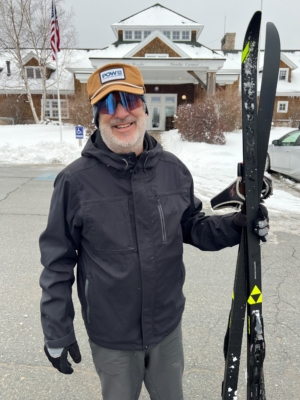
The author in front of Bretton Woods Nordic Center in New Hampshire
Socks should be comfortable and keep your feet warm and dry. There are many brands of ski socks that are produced to perform. XC ski gloves are available in various thicknesses and if you have problems with the cold, get a heavier XC ski glove or mitten but avoid alpine ski gloves because they are too heavy and are not made for the movement with XC ski poles. Hats could include a lightweight knitted cap or a headband. If your jacket has a hood, that works perfectly on a very cold day.
Sunglasses can minimize the glare off the snow but they also keep the wind out of your eyes. Another job for sunglasses may include improving flat light on the trails, but for the most part this is less important because XC skiing is not too fast so you can handle terrain without worrying about the visibility due to flat light.
Injuries are minimal with XC skiing but be aware of issues such as falling, exhaustion, dehydration (always bring water and take gulps a few times on your outing), and frostbite (if it is very cold). If you are not a regular XC skier, expect to be sore in some muscles (such as back, neck, arms or legs) on the day following your outing and Advil should successfully address such soreness.
When done regularly XC skiing is soft on the body and delivers a general well-being that it can bring you. Hopefully these tips will help you to enjoy the winter outdoors on XC skis!
[authors_page role=contributor]