


Tale Of A Baby Robin
You Can Find Adventure In Your Own Back Yard. This Adventure Began In A Window Well.
Found: Baby Robin in distress. Credit: Harriet Wallis
[Author’s note: I’m stuck at home with an arm in a cast. Can’t drive. Can’t hike. Can’t, can’t, can’t. The baby robin tale is a good reminder that adventure and joy can be right at home.]
Laurie called to me: “A baby bird has fallen down into the window well.”
A little robin sat as still as a stone. His little beak pressing against the glass, and his eyes looking in. He couldn’t fly out with his stubby little wings, and his mom couldn’t get down into the narrow space to feed him. There was no other choice. The little fledgling had to be rescued.
Laurie climbed into the window well, put the little fluff into a bucket, and lifted him out. But then what? He was limp and weak. His one foot curled uselessly under him. How long was he in the window well? How long since he’d been fed? Instinctively he opened his mouth wide.
When I was a child, I raised a baby robin by feeding it worms. My dad and I would go into the back yard after dark and get onto our hands and knees. We’d shine a flashlight onto the grass and spot the night crawlers coming up out of the soil. We’d catch them as food for my little robin.
Worms. Robins eat worms. We have a box of fishing worms stored in the refrigerator. Laurie put a fat worm onto a paper plate and cut it into bite size pieces with an old knife.
The little mouth opened wide and she dropped a piece in. Gulp. Down it went. Then his little mouth opened wide again. Repeat. Repeat. He consumed the whole worm.
We got on the internet and read up on what to do with a fledgling bird. We were relieved to find that birds have a poor sense of smell, and handling the baby would not cause his mother to abandon him. And we learned what to do.
The next step: Build a temporary nest for him from a little box and shredded paper towels. We put the worm-fed baby robin into the temporary nest, and put the nest on a stool beneath the tree where he was born. We hoped his mom would find him.
The passive, weak little robin came to life. Did the good meal revive him? He jumped from his cushy nest onto the edge of the box and called loudly: Mom! Mom! Mom!
Adult robins flew in with bugs in their beaks to feed their fledglings on the ground. But they ignored him. He wasn’t one of their own. He called and called— but he was all alone.
Daylight was fading, but we saw him jump off the edge of the box and stumble over some long blades of grass. Then he disappeared.
To read more from Harriet click here for her stories on SkiUtah.

Free: Baby Robin, well-fed and alert, about to head out to the world. Credit: Harriet Wallis

Fat Bikes Are A Boon For Senior Cyclists
New Technology In Mountain Bikes Can Keep Seniors On The Trails.

Here’s a Fat Tire bike; carbon frame has room for wider tires. Credit: Pat McCloskey
Remember when you first bought your first pair of “shaped” skis? I do. I jumped on them to take advantage of an easier turn and less work. Fast forward, I have a nice quiver of skis now with some 107s under foot for powder, loose snow, and crud. Just point and shoot with total confidence. Equipment keeps senior skiers in the game.
Same thing with mountain biking. For several years now, the rage has been “fat” bikes and plus size tires with lower pressures for traction and control. Recently, while watching some friends maneuver very easily over tombstone like rocks and greasy roots here in the East, I marveled at the control that the plus tires and full suspension give the rider.
For those of you who are not familiar with the plus tire revolution, the description of plus refers to any tire width that is basically 2.6 inches and wider in diameter. Most mountain bike tires have traditionally been in the 1.95-2.3 inch diameter range. But in recent years, the technological advances in mountain biking have developed carbon frames which are compatible with wider .35 mm rims that accept a wider width tire. With lower tire pressures around the 12-psi to 15-psi range, the plus technology allows the rider to have a more plush ride with suspension that grips gnarly terrain like glue. For the senior rider who wants a challenge but wants to maneuver safely through rocky, rooty, terrain, the plus bikes are just like our wider width skis—just point and shoot.

Knobby Fatties grip any kind of trail and make the going smoother. Credit: Pat McCloskey.
While riding behind one of the best riders I know who happens to be in his late sixties, I noticed that he didn’t even pick his lines anymore on a technical trail. He just points the 3-inch tire and rolls over everything. So, I recently purchased a 29er plus, full suspension bike from Salsa and VOILA, I do the same. I feel much more confident with the plus technology. A definite “plus” for a senior rider who still wants the challenge.
Many of the current generation of the plus bikes now (either 27.5 or 29ers) come equipped with the SRAAM Eagle components. Simply put, they have a wide range of gearing with a 50 tooth cog in the back that allows for easy climbing of virtually anything that is thrown at you on the trails. Even though the plus 29ers, for instance, are a little heavier than the standard carbon full suspension bikes, the Eagle gearing makes it easier for a senior rider to maneuver the plus bikes up a steep, rock strewn trail. Personally, I love the “old man” gear and even though my local bike shop employees say I don’t need it, I definitely want it, and I use it. I will take every advantage I can—on the slopes or on the trails.
So, take a look at plus technology. Those 3-inch width tires may be a little excessive for your local trails and you may want to scale back to 2.67 or 2.8, but the lower pressures, enabled by wider profile rims, make life a lot easier and more enjoyable on the trails for a senior rider. Modern equipment keeps you in the game, folks. Take advantage of it.

Here’s the big 50-tooth inside “old man” gear that provides mega leverage. Credit: Pat McCloskey

More Ski Chile: What To Expect From A Chilean Ski Trip
Some Adjustments Necessary To Ski The Legendary Mountains Of Chile.
For many, a typical Chilean ski trip will seem a bit like traveling back in time to the USA 30 or 40 years ago. Some of the lifts date back even further than that! While the ski areas around Santiago are progressively upgrading their infrastructure, snow making, grooming, and security, the ones further south remain, in a word, funky.
Most Chileans do not speak English, but those in ski schools, tourism, and management positions generally do. If you have no Spanish, you should still get by just fine, as people are mostly helpful and warm. The Chilean peso converts at 630 to the dollar.
Expect a lot of surface lifts, mainly t-bars and platters, but also the infamous “va et vient” lifts at Portillo (more on that later). On the plus side, these lifts are usually fast, run in windy weather (which is frequent), and you can bail out easily enough if they stop for whatever reason. Some of the chairlifts are second hand from Europe or the USA, and only one high speed quad exists, in Valle Nevado. Lifts open at 9:00 and close at 17:00, with most skiers coming out at around 11:00. Lunch runs from 12:00 to 15:00.
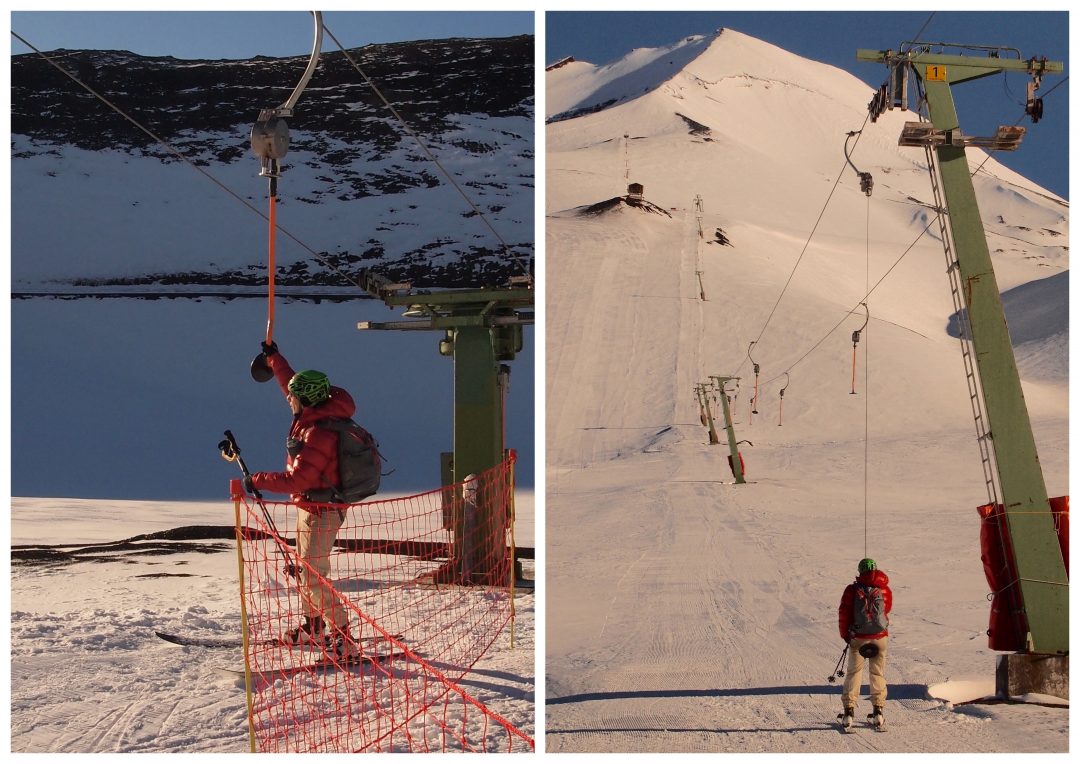
A lonely ride at Corralco. Remember those Poma lifts? Credit: Casey Earle
Don´t expect to get good snow conditions information from the ski area websites, often it is outdated, wrong, or simply non-existent. Portillo is very reliable, but for other ski areas you may have to resort to analyzing webcams or scouring their Facebook pages.
The weather and snow conditions in the Central zone are generally very good. With few but furious snow storms, and occasional extremely light, dry snowfalls, most days will be sunny, fine-packed powder skiing. Off-piste is often limitless, with the southern exposures accumulating triple the amount of the northern ones. With both the sun beating down, and the storm winds roaring in from the north, only in exceptional years can the true north faces be skied, and thus almost all runs are south facing. The season normally runs from mid-June to the end of September.

Casey grabs some pow at La Parva. Credit: Casey Earle
You have to go at least 400 km south from Santiago to the next ski area, Nevados de Chillan, the beginning of the southern climate zone. Here the storms are more frequent and wetter, and the mountains are lower, with skiing starting near or at the tree line. Most people consider skiing in this area more towards spring, when the weather improves. Packed base data is often referred to in meters, reaching up to 5 meters in places. The season in the south often starts late June, and extends into October, with backcountry excursions (on the volcanoes) going into November.
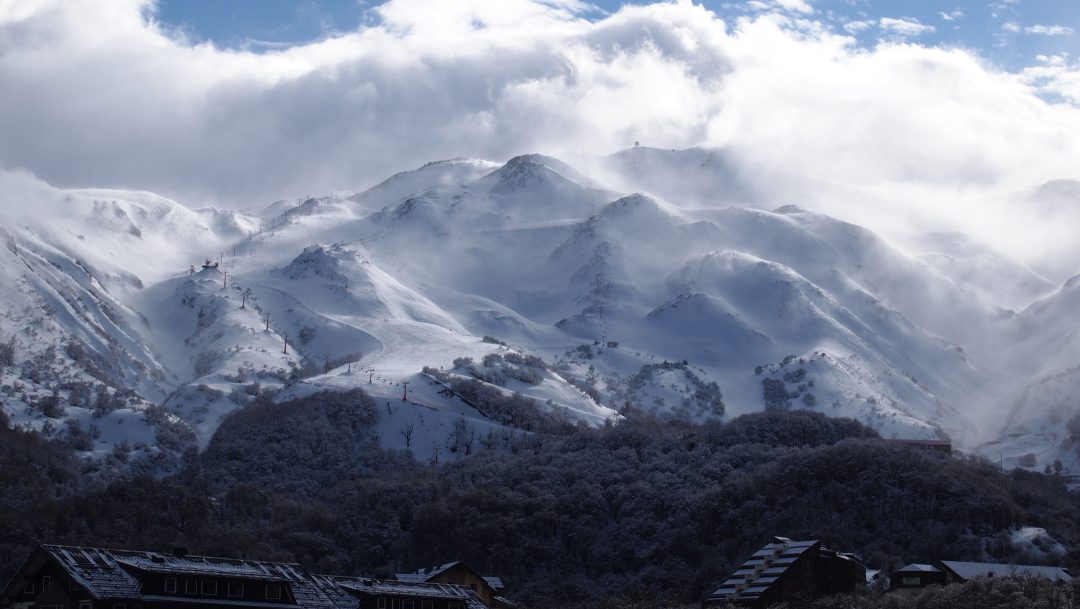
Nevados de Chillan on a windy day. Credit: Casey Earle.
Large hotels are few, at best one per area. La Parva has no hotels, large or small. Aside from Portillo, most people go for the day, or lodge in cabins, small hotels, hostels, or property rentals near the ski areas. Airbnb, Booking.com and other websites have a wide variety of lodging available. In general, what you see is what you get. Chilean food is quite palatable for American tastes, with lots of familiar (and some very unfamiliar) dishes, all accompanied by great local wine and beer.
Lift ticket pricing is based on high and low season, and age group. Avoid the two middle weeks of July, which is the kids winter holiday, as it is quite expensive and crowded. “High season” prices go from July to early/mid August in general, then just weekends, except for Sept 17-19 (National Independence holidays). Seniors start at 65, with about a 20-30% discount on normal adult prices, which run around US$70 in high season and $50 in low. La Parva has a class of seniors from 60-65, and then “super-seniors” as 66+, which only pays US$18 anytime!
Next up is a review of Portillo!
[authors_page role=contributor]