

Ski Chile: An Introduction For Neophytes
Chase The Snow To Summer’s Skiing Headquarters In The Southern Hemisphere.
Come May, you have probably set your skis into hibernation and begun patiently waiting for the snow to fly next fall. But you really don´t have to wait! Southern America’s greatest mountain range starts getting snowed on in May, and by June the ski areas are normally in full swing.
In Chile the resorts are sprinkled just east of the Pan Am highway along the 700 mile stretch from Santiago south, at roughly the equivalent latitude of central California. With an 80 year tradition of skiing, you will find a whole new world of winter adventure, lasting into October on good years.

Santiago and the Andean foothills, after a rare low altitude snowfall. Credit: Casey Earle
Visitors will be happy to know that within a two hour drive of the airport in the capital, Santiago, there are four good ski areas, and upwards of 70 percent of winter days are sunny. Closest are the Three Valleys, which hang above Santiago on the western slopes of the Andes. At night, you can see the snocats grooming trails from this metropolis of seven million!
The La Parva, Valle Nevado, and El Colorado ski areas are interconnected, and it is possible to enjoy a total of 40 lifts and dozens of groomed runs, with multiple options for lodging and dining. Skiing here starts at 8,000 to 9,000 feet, reaching up to 12,000 feet, and is entirely above the treeline. The sunsets are extraordinary.

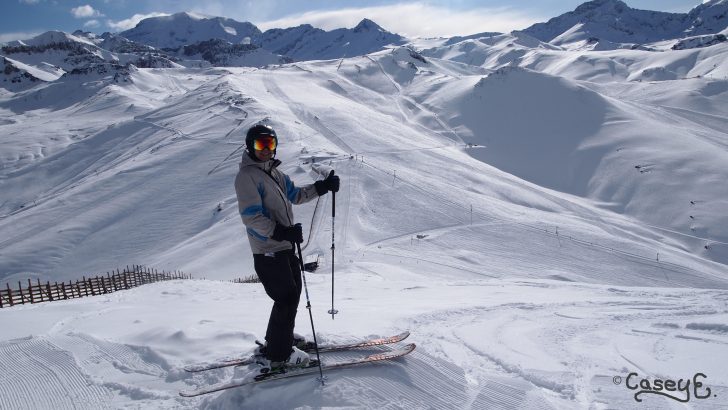
Casey looks out from El Colorado ski area towards the upper Valle Nevado and La Parva lifts. The 18,000 foot El Plomo mountain looms in the background. Credit: Casey Earle.
Two hours north of Santiago is the world-renowned Portillo hotel and ski area, smack in the middle of some of the highest mountains in the Western Hemisphere. The hotel sits looking north over the mysterious and beautiful Laguna del Inca lake and boasts a long tradition of great service and entertainment. Here you can rub shoulders with racers and ski fanatics from all around the globe.

Portillo and the Plateau chairlift (spot it!), with the Laguna del Inca. Credit: Casey Earle.
Further south, the ski area infrastructure and access may leave a bit to be desired, but I love it nonetheless. All of the ski areas are situated on volcanoes which have varying levels of activity. They are also surrounded by gorgeous temperate rainforests, lakes, rivers, and hot springs. The main ski areas are Nevados de Chillan, Corralco, Villarrica, and Antillanca. The first three have adjacent towns within a 30 minute drive with plenty of lodging and other touristic services. All but Villarrica have a good hotel at the ski area base.

Villarrica ski area, note the smoking volcano. Credit: Casey Earle.
My recommendation for potential visitors is to contact one of the tour companies operating in Chile, or book directly with one of the on-hill hotels such as Portillo. You will have one of the best and most unusual ski trips of your life. Most of the tour operators

Las Araucarias ski area, west side Volcan Llaima. Credit: Casey Earle
in Chile are mainly for younger, adventurous skiers, such as Casa Tours or Powder Quest. However, for the +50 crowd, I can recommend DreamSki Adventures which offers group guided resort based tours in Chile and Argentina for the 45-70+ skier. Their guides are seasoned ski instructors trained in the CSIA (Canadian Ski Instructor Alliance) and offer a high degree of customer service on and off the snow.
Come on down!
For the latest in conditions in Chile from Casey Earle, click here.

Here are the resorts mentioned.

Cycling Efficiency For Seniors
Bottom Line: Knoweth Thy Limits, Wise One.
Ride with younger guys? Then ride wise and slow down. Credit: Pat McCloskey
As I was pounding the rocks of Laurel Mountain on the mountain bike with a group of younger riders here in Pennsylvania’s beautiful Laurel Highlands, I was thinking strategy. At 63 years old, I am still in pretty good shape but the older I get, I start thinking about the old adage “age and treachery will beat youth and skill”. Not really applicable in most cases but at least I can try – right? So the first thing I think of is: don’t push the anaerobic limit to be the first up the hills and over the rocks. Let the young guns deal with that and I will just keep them in sight.
I have learned to ride within myself and only exert myself enough to keep a visual on the group, especially with a longer three hour + ride. A more scientific approach is the below which is done with a heart rate monitor:
- Zone 1: 60 to 70 %; very comfortable effort; use this for warmup and cool down
- Zone 2: 70 to 80 %; comfortable enough to hold a conversation; most training is done here
- Zone 3: 81 to 93%; “comfortably hard” effort; you may be able to say short, broken sentences.
- Zone 4: 94 to 100%; hard effort; the pace is sustainable, but conversation is a few words at a time.

Author Pat McCloskey ponders whether to go around a big section to get back to the parking lot.
Basically the zones are dictated by two theories. The original theory is dictated by the target maximum heart rate of 220 minus your age. Then you can calculate with a heart rate monitor which zone you can ride in. This calculation is not quite accurate because it does account for conditioning. A better way to use the zones is to calculate what is called Heart Rate Reserve which is your max heart rate minus your resting heart rate. Find out what your real max heart rate is by exerting yourself in Zone 4 with a monitor and then in the morning at rest, calculate your true resting heart rate. This allows for conditioning and the zones can be used according to that calculation on a heart rate monitor. All in all, I use a monitor on rides to tell me when I am exerting myself above my perceived rate of exertion which will lead to fatigue on a long ride if I am not careful. Use the monitor and slow down accordingly. As long as I keep the group in sight and can be in the Zone 2 area, I am a happy rider.
Another strategy is not to ride every section but take a breather and bypass a section and/or coast to the next meeting area. Sometimes that means taking a fire road instead of a technical trail.. I like to challenge myself and take the technical sections but I know if I take them all, I will not be able to keep up or complete the ride. Ride to ride another day is my motto, and I am not out to prove anything.
Lastly, know your limits and know when you are finished. You don’t want to get hurt and if you are too fatigued, it can happen easily on a mountain bike. Sometimes you have to cut out and take the fire road back to the parking area for a head start on the post ride beer. Hey, you had a good ride, with younger, stronger riders, but for a guy who is older, this is the way to stay involved without compromising your ride or theirs.
Riding season is upon us, and there is no reason not to challenge yourself within limits. Go for it. Have fun but as Harry Callaghan once said, “ A man has to know his limitations.”

Cross or divert? Use your noggin and your heart rate monitor to decide. Credit: Par McCloskey

This Week In SeniorsSkiing.com (May 18)
Survey Results: Summer Activities, Summer Trail Prep, Sacropenia Defense.
We are in high spring, as it were, as of this writing, and yet they are still squeezing out runs in Killington, VT, and will be until the end of May. Here’s a pic from last weekend from Aspen East Ski Shop’s Facebook page.
Still turning at Killington with one week to go. Credit: Aspen East Ski Shop
And also at Killington, Scott Howard, (65) a senior skier (!), has managed to break the unofficial record for the total number of vertical feet skied in a

Vertical record holder (unofficial) Scott Howard. Credit: Scott Howard.
season. According to Trace, his iPhone app, Scott has racked up over six MILLION vertical feet by skiing 60 runs a day, seven days a week. Just so you know, six million vertical feet is equal to 1136 miles. That’s a little short of the distance from Vermont to Colorado.
Couple more runs, Scott, and you can head to the hot tub.
For more about this achievement, click here to read story from our friends at Snowbrains.
Meanwhile, most of us have put up out skis and are into our non-snow activities. In case you are wondering, what do senior skiers do in the off season. Let’s look at the results from our recent survey.
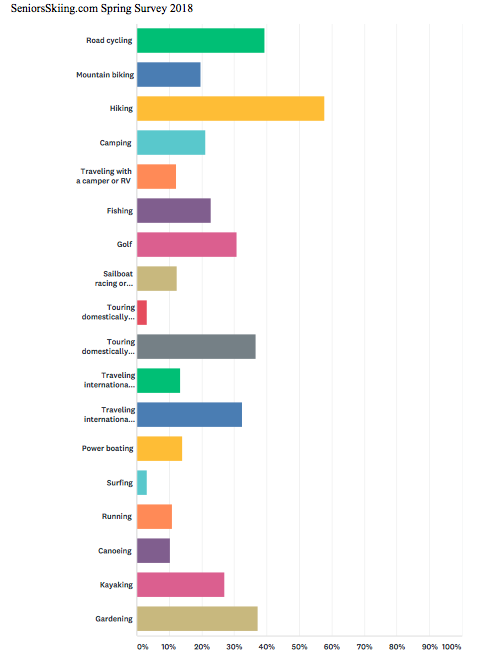
Non-Snow Activities From SeniorsSkiing.com Spring Survey 2018
We asked our readers what activities they participated in after the snow melts. Here’s the top ten.
- 57.83% Hiking
- 39.32% Road Cycling
- 37.31% Gardening
- 36.54% Touring independently domestically
- 32.44% Touring independently internationally
- 30.78% Golf
- 26.93% Kayaking
- 22.78% Fishing
- 21.18% Camping
- 19.69% Mountain Biking
The most interesting write-in comment was Dragon Boat Paddling. We also noted many write-ins for Tennis, Swimming, and Hunting. We should have made these choices in this survey and will include them next time. Your comments? Reactions?
This Week
Correspondent Yvette Cardozo takes us up to Sun Peaks Resort in British Columbia where we learn how trails are prepped for summer. Check out those cows! And we hear from Arthur Razee, a new contributor, who explains how do deal with sacropenia, the condition that causes muscle loss in older folks. It happens to us all, but we can manage to deal with through diet and a specific exercise.
Also, we say goodbye to our old friend and mentor, venerable and veteran ski journalist John Henry Auran. You can read a tribute here.
Meanwhile, stick with us through the summer. We have some interesting stories lined up and we do want to hear from you. Please, please tell your friends about us. Remember, there are more of us every day and we aren’t going away.
Meanwhile, here’s a shot of a May snowstorm in Charlotte Pass, New South Wales, Australia, where the season is just getting under way. It’s snowing somewhere in the world every day!

[authors_page role=contributor]