


Editorial: Tools Of Empowerment
Why We Publish Skis And Boots For Seniors Recommendations.
We don’t know the numbers in other countries, but in the U.S. one-fifth of all skiers and boarders are 52 or older.
Based on reader surveys, we, as individuals, have more time, ski more often, and make more frequent equipment purchases than the kids.
 Four years ago, when we started SeniorsSkiing.com, we set about to create a community of similarly aged people with a shared passion for playing in the snow. Then, as now, our goal was to provide you with information about the sport through the lens of the older participant.
Part of realizing that goal includes publishing the annual SeniorsSkiing.com Best Skis and Best Boots guides for older skiers. We like to think of these guides as—excuse the phrase—tools of empowerment: information you can use to assess the advice from sales personnel when shopping for your next pair.
Top equipment reviewers at realskiers.com and at America’s Best Bootfitters make the recommendations based on criteria relevant to older skiers.
In our experience, professional boot fitters are great at identifying the best product for your feet and your ability. But finding store personnel who can recommend the best skis for older skiers is a rarity.
During the recent SIA/OR show in Denver, we visited a ski company with more than one product on this season’s Best Skis for Senior Skiers list. Everything about the company’s products and personnel is oriented to youth. Yet, testers at realskiers.com determined some of its products would be good for the older set. The marketing people we met with were unaware their product had made the list and had difficulty envisioning their product being used by older skiers.
It made us realize that we seniors need to guide the conversation about what is best for us. It’s not coming from manufacturers, and, with the exception of professional boot fitters, it’s not coming from retail personnel. But armed with the knowledge that we at SeniorsSkiing.com are providing about the best skis and the best boots for seniors, it can come from you.
Jon Weisberg, Mike Maginn
Co-Publishers
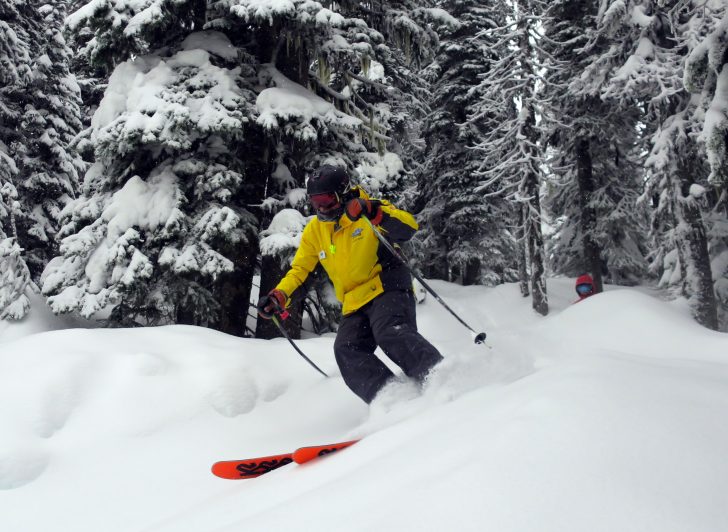
The Archetype Senior Skier? This Guy Sure Looks The Part
74 Year Old Long Time Ski Host Books 120 Ski Days A Year At Big White. Jealous?

Ski Host Carlan Silha is fit and fortunate to ski so many days at 74.
Credit: John Nelson
It might seem strange that an American from the Spokane area knows this sprawling British Columbia ski resort better than just about anyone.
Carlan Silha has been serving as a snow host at Big White for 20 years, longer than anyone at the resort. The lanky 74-year-old still skis like a 24-year-old, kicking his heels when he takes a jump and issuing a frequent “Woo-hoo!” as he turns in powder.
The story of how Silha got to Big White starts in 1992, when he was a Boeing executive working in Europe. He and his wife Lin were looking for a condo at a ski resort, and a friend suggested Big White.
“We ended up buying because it was a great price,” Silha said. “Then we got here, and realized we really liked it.”
Silha eventually retired, moved from Seattle to the Spokane area, and then began spending every winter at Big White, where he became a snow host, showing visitors the ropes. Now he logs 120 ski days a year and relishes every minute.
“Let’s ski the Rat Trees,” Silha said as he showed around another visitor recently. The trees are so named because regulars have been hanging toy rats from a particular tree deep in the forest near Big White’s Powder Chair.

If you were Carlan, you’d have a big grin, too.
Credit: John Nelson
Silha then shot off, cranking precise turns through the trees in four inches of new snow. “Woo-hoo!” he shouted for perhaps the millionth time of doing this.
“Being outdoors keeps you young,” he said.
During summers, the Silhas spend their time fishing and camping, using Spokane as home base. They like to travel around the West, and Silha keeps fit by hiking and biking.
In winter, they hang out with ski friends who own condos at Big White, a large collection that includes Australians, Brits, Kiwis and, of course, Canadians. The snow host job—showing visitors around Big White’s 7,355 acres—keeps him busy and provides its own rewards.
“The main attraction is meeting people from all over the world,” he said. “And it makes you feel good to show people this mountain.”

What Else Should You Have In Your Car?
Don’t Get Stuck Without This Extra Safety Gear.
Stuff happens. Be ready.
Credit: The Press Christchurch
Now that you have “The Box in the Back,” (see previous article) what else do you need to carry in your car? The list, strangely enough is short, but the items are necessary. The first four should be in your car all year round, not just the winter. So, without further ado, here they are with the rationale:
- Flashlight. It should be in the glove box, always. I suggest a Maglite (or equivalent) type flashlight that takes three D cells, not one that is rechargeable. Why? Cold is the enemy of battery life, and if a rechargeable one isn’t kept charged, you could turn it on and find you have little or no juice left. Then what? I’m so paranoid that I carry a spare set of batteries. But, if you don’t carry spares, keep them out of the flashlight and tape them together side-by-side with electrical tape and then wrap a second piece of electrical tape around the ends to protect the contacts. If you have to peel off the tape, do it carefully because it may come in handy during your emergency!
- Jumper cables. Car and truck batteries fail at odd times and Murphy’s law applies, i.e. they die at the worst possible time. Those of us who live in the southwest know that heat is also the enemy of batteries. Heat causes the fluid to evaporate and the battery won’t hold a charge. If it isn’t your battery that dies, it will happen to someone nearby.
- Chock or 2. Think about it. You’re going into the mountains and that means if you have a flat or need to jack up your car to put on chains, you need to chock two of the wheels that are not being jacked up. Ski boots work as chocks, but do you want to risk using them?
- Warning triangle, not flares. If something bad happens, you want to put this out a few hundred feet behind your car to warn on-coming motorists. Flares are pyrotechnics that age with heat and cold. Plus, once they burn out, then what do you use? Carry a triangle or two and forget the flares!
- Kitty litter. Some people prefer sand, I like kitty litter. If you need to spread some out for additional traction, you have it. Two reasons, one, it is lighter to haul around than sand, two, it is easier to find.
- Sections of two by fours. If you get stuck or need to put something down to distribute the weight of your car in the soft snow, three foot sections of ten inch wide planks or two by fours work well. They don’t take up much space and can, with a little kitty litter (or sand) on top, get you moving again.
None of these items, except for the kitty-litter take up much space. They’re million dollar items because you’d pay a million when one is needed and you don’t have it. Enjoy skiing and pray for snow!
[authors_page role=contributor]