


Lovin’ Snowshoes
‘Shoes Have Come A Long Way. Have You Looked Lately?

Old: Good for decorating rustic cabins.
Back in 1971, when I transferred winter affections from downhill to Nordic skiing (due to a spectacular fall in Austria that racked up one knee and stripped off my ski suit—but that’s another story), I also tried snowshoeing. After all, cross-country skis and snowshoes were both made of wood and quite beautiful; they’re both ways to travel over snow rather than wade through it; they’re both very low-impact sports.
But cross-country evolved into my lifelong true love, while snowshoeing became merely the affably boring cousin you contact every few years. Too much work; bindings were crappy (now you’re in, now you’re not—and your fingers are gonna freeze putting the damn things back on); ‘shoes didn’t slide like skis, except sideways downhill on crust; wood frames cracked; rodents enjoyed chewing the rawhide webbing in summer storage.
Modern snowshoes confirm the theory of evolution. They’re clearly descendants of the woodies but virtually a new species in design, materials, flotation, and fun.
I found this out one January about a dozen years ago, laying out ski trails at a resort in Montana. (Sadly, I hadn’t visited that cousin in almost 30 years.) The snow was too deep, buried underbrush and deadfall too catchy to use Nordic skis. So since slogging through waist-deep powder on foot was out of the question, what to do? Happily, intuition had suggested bring my new aluminum snowshoes along to test the frozen waters. They behaved magnificently, though I dumped a couple of times trying to back up, sinking the tails of the ‘shoes. (My style of absorbing knowledge always seems to be “education through error.”)
Modern: Light, durable, inexpensive. Credit: Tubbs
So what’s new about this next generation (or two – more on that shortly) of snowshoes? It may seem minor at first, but bindings have improved incredibly; they’re easy to use, they stay on, and they don’t stretch. The ‘shoes themselves are durable and have no food value to rodents, since they’re generally made with aluminum frames and synthetic decking that’s durable and gives great flotation. That combination is light weight, so there’s less effort. The addition of bottom cleats gives you much better grip on crust and even side-hills, though it’s still smart to avoid those when possible.
What else? Modern models definitely aren’t as pretty, but it’s a trade off of aesthetics for dependability, longevity, and convenience.
Snowshoes are nowhere near as pricey as Alpine or even Nordic gear, but it’s still smart to rent before you buy to see if you like the sport. You can use hiking or snow boots with today’s adjustable bindings, or even sneakers with neoprene booties.
There’s a new kind of ‘shoe that came on the market this fall ago from Crescent Moon Snowshoes, a Colorado company. They’re made of foam (!) but from my destructive testing are not just light but also sturdy, incredibly maneuverable. I backed up in them, did a 180 degree jump-turn for no good reason. They have great binding and are setting the snowshoe industry on its butt.
There are a thousand more subtleties to fun snowshoeing—using poles, running vs. walking, clothing, etiquette, and the like. They’re mostly unimportant. Snowshoeing has become easy, and easy on your bones and joints. And even if you don’t glide, just repeat too yourself, “600+ calories per hour!”, enjoy the burn, and head for the dessert tray.

Most Modern: Foam ‘shoes from Crescent Moon.
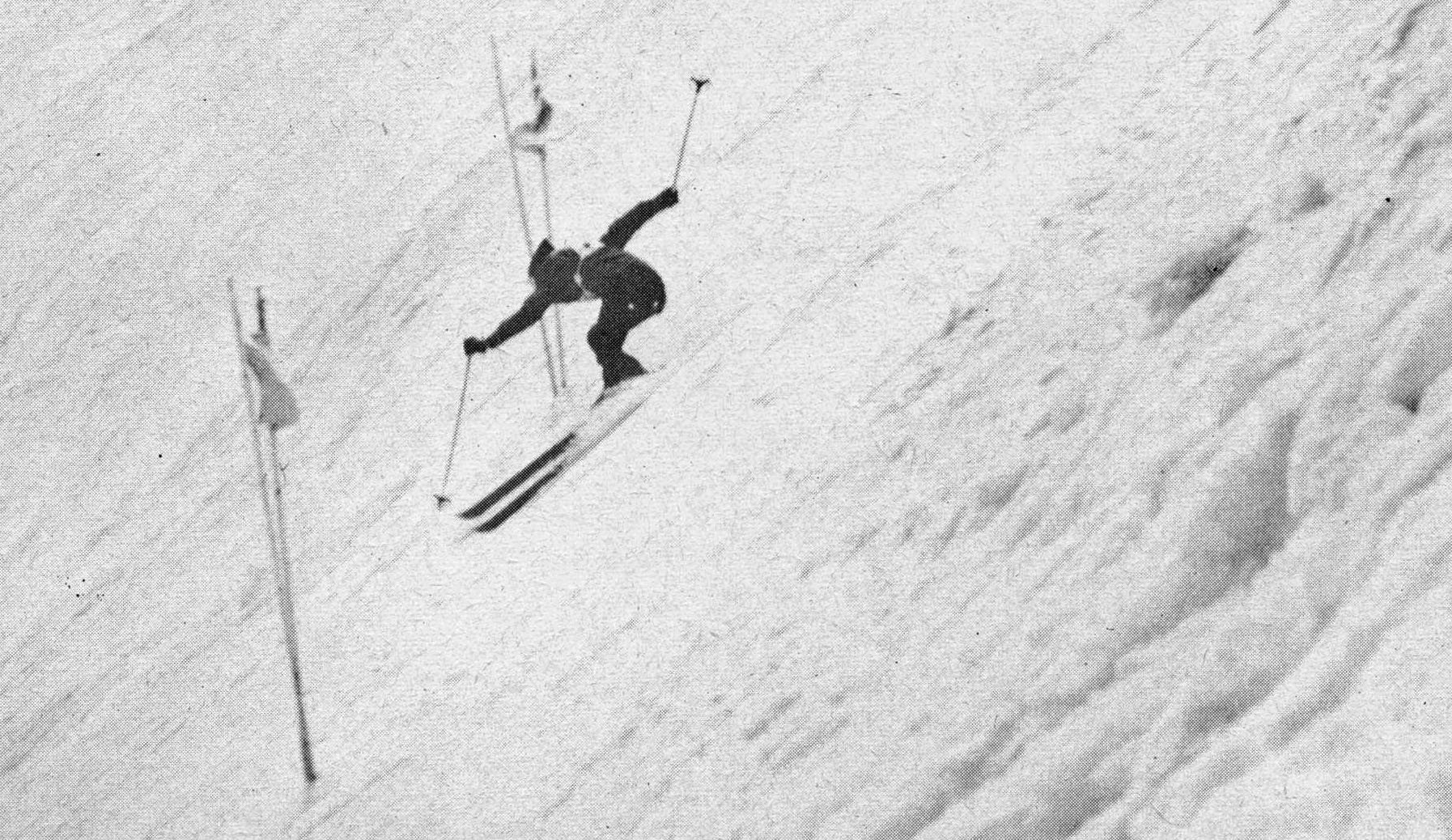
Mystery Glimpse: A Hot Time On This Hill
See If You Can Name The Race In This Old Picture.
Hint: circa 1969. Perhaps you know the name of the race this fellow is in and what makes it special. Put your best guess in the COMMENTS section below. Extra credit for naming an unusual chap who won the same race in earlier years and what the circumstances were.

Last Week

Credit: US Ski & Snowboard Hall of Fame
This is Seattle-born and raised Deb Armstrong with a tennis racquet. Deb won the giant slalom at the 1984 Winter Olympics in Sarajevo, the first won to win a gold since Barbara Corcoran’s 1972 victory in Sapporo.
After her retirement from ski racing, Debbie Armstrong led various humanitarian causes, including the Debbie Armstrong Say No to Alcohol and Drugs campaign; the SKIFORALL Foundation, which opens skiing events to the disabled; and Global ReLeaf Sarajevo, which seeks to reforest Sarajevo after the Bosnian war. According to Wikipedia, Deb is an executive at Steamboat Springs. Here’s Debbie (right) waving the flag in 1984.
Below is a short video of Deb Armstrong giving powder skiing lessons at Steamboat Springs. Two very lucky kids get a very clear and effective lesson from a gold medal Olympian. Perhaps you can learn something, too.

Tread Of Pioneers: A Blast From the Past
Quaint Museum Reveals Steamboat Spring’s Rich History.

Ski Joring was the way to get around the valley when the snows came.
Credit TOP Museum
In 1947 an AP dispatch to 1,000 daily papers dubbed Steamboat Springs, Colo., “Ski Town, USA” with the declaration that of its 1,700 residents, 1,685 were skiers.
The others were children under the age of one.
Enthusiasm for skiing run deeps in this town. And you can learn all about it at The Tread of Pioneers Museum in downtown Steamboat. Native Utes, trappers, Yampa Valley settlers, ranchers, miners, farmers, cowboys, skiers, ski jumpers, snowboarders, outlaws, and lawmen, they all shared a part in the creation of this friendly town, sitting just below one of Colorado’s best loved ski resorts.
Famed Norwegian ski-jumper and circus star Carl Howelson arrived in 1913 and taught early residents of Steamboat Springs how to ski and ski jump. Suddenly, the valley’s ranchers were exploring the surrounding mountains on homemade wooden skis, school kids filled recess with downhill races, and locals became expert jumpers.
Billy Kidd, first American to medal in Alpine skiing, has lived in SBS since 1970. Here he is at 20.
Credit: TOP Museum
Favorite fact: Three Wire Winter is agricultural lingo used in the Yampa Valley to indicate that snow has reached the third strand of barbed wire on a four-strand fence, roughly 30 inches. A three-wire winter is just about right, with enough snowpack for spring run-off; more makes it difficult for feeding cattle in winter as well as damage to the barb-wire fences, according to Bill Fletcher, an Elk River Rancher.
The museum has an extensive historic photography collection, a few of which are included here. Go to the museum website to view and purchase online.
The museum is located downtown at 800 Oak Street. New exhibits this year include Staking Their Claim: Pioneer Settlement in the Yampa Valley highlighting early Yampa Valley settlers; Pioneer Kids Bedroom: Hands-on Discovery, letting kids dress up in historic clothes and play with antique toys; and A Legacy of Learning: Celebrating 50 Years of Colorado Mountain College and the Bud Werner Memorial Library exhibit, highlighting these two key local institutions; and the works of portrait and Native American photographer Edward S. Curtis.
The Museum Gift Shop has locally made jewelry, postcards, and photographs. Hours & Admission: Tues.-Sat. 11 a.m.-5 p.m. $6 for adults, $5 seniors over 62, $2 children ages 6-12, under 6 free.

The Harbor Hotel sleigh picked up skiers from the train depot and delivered them to the popular hotel at 7th and Lincoln, circa 1957.
Credit: TOP Museum
[authors_page role=contributor]