


This Week In SeniorsSkiing.com (Sept. 15)
Down Under Snow Reports, Experticity Update, Early Winter Forecast.

A unique arrangement: No lifts at Charlotte Pass in Australia, just a 30-minute Sno-Cat Ride each way to the slopes.
Credit: Bernie Weichsel
While we start thinking about buying season passes, contemplating new boots, and enjoying the last of summer activities (btw: great sailing in New England these days), the snows of Australia have been falling mightily.
We have two reports from the land of Down Under. One focuses on the massive amounts of snow currently covering the ski hills of Victoria and New South Wales, Australia. Folks, it’s yet another weather phenomenon; it’s the most snow in a decade. Thanks to Snowbrains.com for bring this to our attention.
The second report comes from Ski and Snowboard Show Impresario and SeniorsSkiing.com advisory council member Bernie Weichsel who has just returned from a three-week trip to New Zealand and Australia. His report is a really interesting guide to some of the most popular ski hills in those countries as well as some differences in how resorts are run done down there. Thanks, Bernie.
Last week, we published an update on the new Experticity application process for our subscribers. We are publishing it again because we know that right now and the next few weeks are the start of the equipment and clothing buying season. The discount policy offered to our subscribers is different than before, and it requires that a subscriber demonstrate some type of “professional” connection to the ski industry. There’s contact information for Experticity if you have questions.
Meanwhile, the National Weather Service Climate Prediction Center has published its early winter forecast. Here are the late-fall, early winter maps from the NWS.
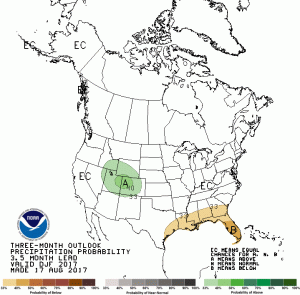
Precipitation forecast: Sept-Nov 2017

Temperature forecast: Sept-Nov 2017
So, above average precip in the Rockies and Wasatch, a drier Florida, and/but above average temps radiating out from Arizona. However, do not place your bets yet. We also hear from the folks who monitor the El Nino Southern Oscillation (ENSO) that the waters off western Peru are “neutral”, not too hot, not too cold. Since the ENSO drives a lot of the weather in North America and around the world, having a neutral ENSO makes the forecast much more difficult to predict. Again, these predictions are merely placeholders in an ongoing story. We will be watching and will let you know what evolves.
 Thanks for subscribing to SeniorsSkiing.com. We very much appreciate your presence and your input. If you’re interested in a free and wonderful 3″ x 3″ SeniorsSkiing.com sticker, please send a self-addressed, stamped envelope to: SeniorsSkiing.com, Box 416, Hamilton, MA 01936.
And remember, there are more of us every day and we aren’t going away.
Short Swings!
Something Old. Something New.
I just read two books about trails.
The old one is American Skiing, published in 1939. It’s author, Otto Schniebs, was one of the Arlberg Technique pioneers in New England and contributed to the development of several areas. He founded the American Ski School of Boston and coached at Dartmouth College and later at St. Lawrence University.

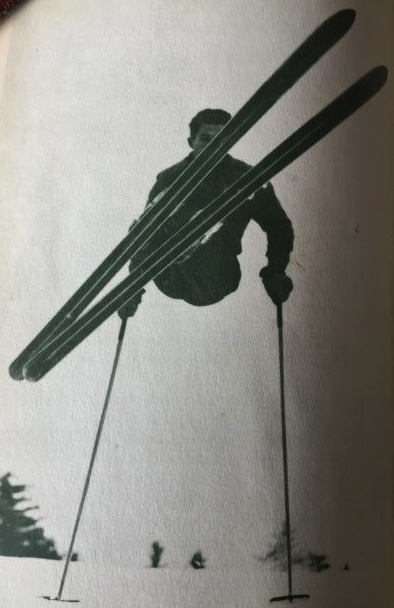
When was the last time you saw someone do this?
The first chapter, “Adventure on Skis in the Colorado Rockies,” is a colorful account of a Spring visit to the Elk Mountains between Aspen and Crested Butte. This was ’39 and Aspen didn’t start as a ski area until ’46; Crested Butte in ’62. Schniebs and his companions encounter a variety of terrain, snow and avalanches. The text is fun to read and is richly illustrated with photos. Throughout are page references to technique, which is covered in the next section, where he uses motion picture stills to explain a full range of ski moves ranging from those for beginners to achieving jump turns, and somersaults!
This is followed by ruminations about organizing ski areas, building trails and slopes, a single sentence on mechanical lifts, longer sections on ski patrol, developing instructors, ski schools, and equipment.
The book has many photos, including a fold-out panorama of the northern Adirondacks (Whiteface to Mt. Marcy to Redfield in Winter), a classic shot of Dick Durrance, skiers in Tuckerman’s Ravine, etc.
I’ve had my copy since 1962. Google shows first edition copies for less than $50.

The new book is On Trails: An Exploration, by Robert Moor. This New York Times Bestseller is a wonderful read. The information — it does not cover ski trials — is fascinating and presented with graceful and engaging prose. We accompany the author as he explores a multitude of ancient and modern trails. His observations take us into the realms of natural and human history, economics, philosophy, and literature. Who knew that studies of how ants travel have been digitized and the results used to inform flows in factories and warehouses? The trail and road walkers he encounters range from amusing to weird. I highly recommend On Trails. The pages turn on their own.
New Zealand
Mt Hutt has a 120″ base, and plans to remain open through October 15. The 6800’+ resort is one of the highest in New Zealand.
Vermont
Listed below are the deadlines for lowest season pass prices in Vermont. Note the threshold ages for skiing free (some may require a small processing fee).
- Bolton Valley: September 25 Ski Free: 75
- Bromley Mountain: October 15
- Burke Mountain: October 9
- Jay Peak Resort: October 9
- Killington Resort: October 12 Ski Free: 80
- Mad River Glen: October 15 Ski Free: 70
- Magic Mountain: October 15
- Middlebury Snow Bowl: November 30 Ski Free: 70
- Mount Snow Resort: October 18
- Okemo Mountain Resort: October 9
- Pico Mountain: October 12 Ski Free: 80
- Smugglers’ Notch Resort: October 31
- Stowe Mountain Resort: October 8
- Stratton Mountain Resort: October 9
- Sugarbush Resort: September 13; Boomer Pass (Age 65-89) Price: $139; includes midweek, non-holiday skiing at Lincoln Peak and Mt. Ellen. Ski Free: 90
Other
Take five minutes and give yourself a treat. The Man at the End of the World is a beautiful video about an older couple living in Tierra del Fuego, Chile. If you enjoy the clip, click “like’ in the lower right corner to help it score well in a video competition.
Oz And EnZed: Skiing The Antipodes
Ski And Snowboard Show Impresario Bernie Weichsel Reports On The Down Under Scene.

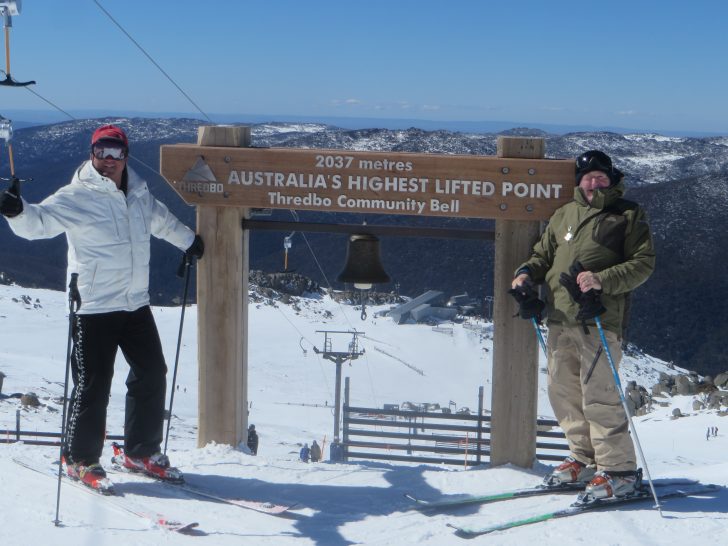
Bernie (r) at Thredbo’s highest lift.
Credit: Bernie Weichsel
For most of us in the international ski community, whether here in the US and Canada, or within the Alpine countries of Europe, there is good news to be found in Australia and, to a lesser degree, New Zealand. Over the past three weeks, I had the opportunity to visit a number of ski areas in New Zealand’s South Island and in Australia’s states of Victoria and New South Walks. I skied at the four areas around Queenstown and Wanaka (The Remarkables, Coronet Peak, Cardrona and Treble Cone and in Victoria (Mt Buller and Falls Creek) and New South Wales (Skiing at Perisher, Thredbo, and the unique Charlottes Pass. I am glad to report in both countries skiing, and, in contrast to the US at least, snowboarding, too, seemed to not only being doing well, but to be thriving.

Skiing The Remarkables, Queenstown, NZ. Anyone notice any hobbits?
Credit: Bernie Weichsel
New Zealand areas’ growth seemed to be coming from visitors from Asia. There were loads of Chinese and Koreans, plus a lot of athletes from Northern Hemisphere countries taking advantage of the snow to prepare for the upcoming Olympics, including Lyndsey Vonn among other US athletes.
But it was in Australia where the growth in the local market was most evident. All the resorts I visited were crowed with families and students, and it wasn’t even vacation time. Resort management all said that they were witnessing growing interest and participation in SnowSports which might be the only SnowSports market in the world where that can be said!
One effort that is propelling growth is a program called Inter-School, a regional wide, multi-discipline, competitive program with local races that lead to regional events and ends in a National Championship. The regional event I saw at Mt Buller—the Victorian State Championships—had 6,000 participants, in many cases, with their parents on hand for a whole week. I am not aware of a similar program in our country. I presume the best analogy is an NCAA program but for High Schools. We all know how school programs for soccer, football, etc. dominate American youths’ time and keeps them—and their families—away from the slopes. Maybe the Australians have found something for us to think about!
All the resorts had decent facilities—from lifts, snow-making and day lodges—and pretty good grooming. New Zealand, for us spoiled North Americans, is a bit of a challenge since there is virtually no on-snow lodging. Most of the lodging is in Queenstown and Wanaka, where it almost never snows; to get to the skiing you must drive with chains always at the ready in your “boot”—or take a bus.
Weather is also a consideration in New Zealand since all the skiing is above timberline, leading to some serious white-outs when the clouds hang low, which is often. But the snow quality is good, the runs decently long— think Northern New England. When it is clear, you can see some of the most stunning scenery anywhere.
Australia, on the other hand, has lodging right on the mountains making it possible to ski in, ski-out. However, the mountains are not as high as New Zealands’ and are wider rather than high, that is, many runs over a number of hills. That is, except for Thredbo which has a vertical of about 2,000 ft. What really intrigued me was how popular skiing was given that in Australia, there were many road-blocks one has to overcome to get the mountains. You have to pay an entry fee to enter the Park; all the ski resorts are in state or national parks, you have to pay to park and again pay for a snow taxi to take you to your lodging—not in all resorts but the majority. And lodging isn’t cheap. The resorts, though, have copied—or might have pioneered—the idea of expensive day tickets versus reasonable priced season pass.
Usually, so I was told, New Zealand gets the better snow. But, during my visit, it was the opposite: I had basically spring skiing in New Zealand and super mid-winter conditions in Australia—packed powder and blue-bird days. And recently Australia’s resorts have had some of the biggest snow dumps in almost two decades!
One oddity worth noting. The small area near Perisher, Charlottes Pass, might be —I can’t think of any other resort that can only be accessed—in and out—by Sno-Cat . It’s a 30-minute ride each way. Nice, but small skiing, once you get there, and it’s pretty private and worth the effort.
A unique arrangement: No lifts at Charlotte Pass, just a 30-minute Sno-Cat Ride each way to the slopes.
Credit: Bernie Weichsel
[authors_page role=contributor]