


Short Swings!
Thank You. Thank You. Thank You.
 It is the end of summer, and we’ll soon be back to our weekly schedule.
Mike and I want to take this moment to thank our readers, contributors, and advertisers for keeping SeniorsSkiing.com active and relevant.
Our combined efforts seem to be working.
All summer long, the number of new SeniorsSkiing.com subscribers kept increasing. The volume wasn’t as great as other times of the year, but the steady flow was both surprising and encouraging.
We have some data that shows the 50+ snow sports demographic represents almost 1/3 of all U.S. skiers, and the more who learn about the site, the more who sign up.
Our goal is to create community and help the ski industry better appreciate the value of all older snow sports participants.
I was in a meeting last week on the East Coast that had nothing to do with skiing. I mentioned SeniorsSkiing.com in passing. One of the people around the table is a reader. This morning, while hiking here in Utah, I met a couple from Washington, DC. They are skiers and have followed SeniorsSkiing.com for the past few years.
Please tell others about SeniorsSkiing.com.
UTAH
Many improvements and changes for the coming season:
- Alta’s new Supreme high-speed quad replaces its former namesake and Cecret lifts. Its base is near Alf’s Restaurant. This will be Alta’s 80th anniversary. 2017-18 open/close dates (conditions permitting): Opening Day: November 22, 2017; Closing Day: April 15, 2018 + April 20-22; April 27-29 & May 4-6, 2018.
- Deer Valley Resort, as reported earlier, is being acquired by an area consortium including Aspen, Intrawest, Mammoth, and Squaw.
- Park City Mountain has a new, enclosed-surface lift and a new designated beginner trail.
- Powder Mountain will cap day passes at 1,500 and season passes at 3,000.
- Snowbasin is replacing the Wildcat triple chairlift with a new high-speed detachable six-pack.
- Snowbird’s newly remodeled 13,500+ square foot Creekside Lodge, will open at the start of the season.
- Solitude Mountain Resort invested $1.5 million in several improvements to lodges. If you’ve got limited time, fly into the Ogden-Hinkley Airport. This small airport, serviced by Allegiant Air, is located five minutes from downtown Ogden and will be adding new flights from Los Angeles (LAX) and Las Vegas (LAS) this fall. Scheduled Thursday through Monday with starting prices at $35 each way, this is a great option for the weekend warrior.
VERMONT
Parker Riehle, who has been with Vermont Ski Areas Association (VSAA) for the past 20 years, has been named president and CEO of the National Ski Areas Association (NSAA). NSAA is the non-profit trade association that represents US ski area owners and operators. He replaces Michael Berry who will retire this winter following 25 years as NSAA president. VSAA represents Vermont’s $1.6 billion ski and snowboard industry. A search is underway for a new president.
- Trapp Family Lodge, North America’s first cross-country skiing center is turning 50!
- Bolton Valley is upgrading its snowmaking system
- Burke Mountain is installing a high speed T-bar which will substantially increase uphill capacity. Burke’s snowmaking is being extended.
- Magic Mountain has new base to mid-mountain chair and expanded snowmaking.
- Mount Snow doubled its snowmaking capacity.
- Okemo also upgraded snowmaking and grooming capacity.
- Stratton increased its groomer fleet
- Sugarbush installed RFID ticket-reading gates at all base lifts; improved its snowmaking guns and the size of its groomer fleet.
- Suicide Six instituted trail improvements, added new load/unload decks to the summit quad, and more snow making improvements.
OREGON
And here’s an amazing shot of Crater Lake from NASA taken in mid-summer 2017. The remnants of the colossal 2016-17 snowfall in the Cascades is there for all to see.

More Skiing Songs Of The Sixties And Beyond
Our Readers Search Their Attics For Old Ski Songs. Hear Them Now.

Wow, what a response! Thanks everyone for comments and emails on our reprised article, Skiing Songs of The Sixties. We not only heard about ski song memories, we had some folks sending us (digital) recordings.
We have to tip a pole to Boyd Allen, Exeter, NH, for taking the time to send us two digitized versions of the very songs that some readers requested as a result of the article. Boyd grew up listening to his dad’s Harry Belafonte, Kingston Trio and other folk records. In college, he says he came across an old Intercollegiate Songbook with skiing tunes bases on folk songs. That find launched a hobby where Boyd tracks down and collects old recordings and song books, especially about skiing! Boyd is a teleskier these days. Thanks so much, Boyd.
Boyd sent us two versions each of Let’s Go Skiing and The Skier’s Daydream by SeniorsSkiing.com reader Ray Conrad. Click on the links below to play.
Let’s Go Skiing by Bernie Knee and the Irving Fields Orchestra.
Let’s Go Skiing by Frank Yankovic
The Skier’s Daydream by Ray Conrad
The Skier’s Daydream by Oscar Brand
And to SeniorsSkiing.com reader Alison, we thank you for remembering and sending in a reference to Schifoan, a tune in German written by Austrian folk singer Wolfgang Ambros. As Alison says, it’s a catchy tune, even if your German is a bit rusty. Here’s a version we found on Youtube by Wolfgang himself.
Finally, here’s Cotton Pickin’ Lift Tower, another Ray Conrad tune, performed by John Sidle at a coffee shop in Santa Clara, CA.
Fun stuff, thanks everyone!
Hiking Caveats: How A Walk Can Go Wrong

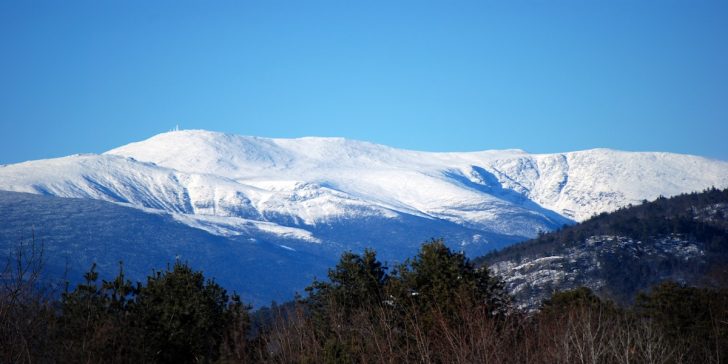
Mount Washington from Intervale, NH
Credit: Peabody & Smith
It’s Not Just Bad Weather That Can Make A Hike A Disaster.
[Editor Note: This article first appeared in the Boston Globe, August 16, 2017, and was reported and written by Martin Finucane. Click here to see the original version in the Globe.]
For years, hikers have shouldered their packs, inhaled the crisp air, and set out for adventures in the White Mountains. And for years, a small number have not made it back alive.
Sometimes it’s been a lack of proper gear. Other times it’s been a decision not to turn back when the skies were darkening. Still other times it’s been a simple slip while trying to get a look at a waterfall.
Julie Boardman has studied the fates of the unlucky ones, researching 219 deaths in the mountains, going back into the 19th century.
Boardman, author of “Death in the White Mountains: Hiker Fatalities and How to Avoid Being One’’ (Bondcliff Books, 2017), said the main reason people die in the mountains, which are just a few hours’ drive from Boston, is lack of preparation.
“People need to be educated about the dangers. I don’t think a lot of people are aware of the dangers that they’re getting themselves into,’’ she said.
She studied deaths that happened from 1849 until July (three more people died just recently). Her study focused on hikers, rock and ice climbers, and back-country skiers.
The leading causes of death were falls (74), natural causes such as heart attacks (57), hypothermia (46), and avalanches (14).
(Boardman’s book didn’t focus on rescues, which are the more common and happier outcomes of mountain emergencies. Those were up this year, New Hampshire Fish and Game officials told the Globe in May, blaming the need for rescues on a lack of preparation.)
How tricky can the White Mountains be?
One finding that surprised Boardman was that 21 of the hypothermia deaths occurred between Memorial Day and Columbus Day, a period during which you wouldn’t expect to die of the cold.
“It’s because people go out in the summer and they don’t have the gear they need, and then they run into bad weather and they get themselves into trouble,’’ she said.
The worst month for fatalities, because of the surprises provided by the weather and perhaps because of the higher volume of visitors, is August, she said.
Here are some of Boardman’s tips to stay safe in those beautiful mountains.
■ Study the weather forecast so you know what to expect.
■ Wear the proper clothing for the weather.
■ Bring enough gear. On winter hikes, bring a sleeping bag and enough equipment so if you get caught out overnight you can survive.
■ Know your route so you don’t get lost — and so you know what hazards you will face along the way.
■ Leave your plans with someone so they can alert authorities if you’ve gotten into trouble.
■ Hike with a companion. Two heads are better than one, she said, particularly because people with hypothermia can become confused. A second person can also help someone having problems with manual dexterity because of the cold or when someone is injured — in a fall, for example.
■ When in doubt, chicken out. Boardman says there’s plenty of wisdom in this saying, which she attributed to American mountaineer Miriam O’Brien Underhill. In a number of hypothermia cases, Boardman found, people had run into bad weather — and made the deadly decision to just keep going.
■ Stay on the trail. Boardman found that of 22 people who died of falls in the summers, 21 were off the trail. “A lot of them had gone off the trail to look at a waterfall,’’ she said.
■ In winter, go up and down the same trail so you’re familiar with what you’re facing on the way back. In six of 16 winter falling deaths, hikers were going down a different way than they had come up, she said.
■ Don’t hurry, and don’t push yourself. Hurrying can lead to rash decisions — and make you more prone to a fall. Pace yourself while hiking, and take breaks to avoid overexertion.
“They’re small mountains, but they can be very dangerous,’’ said Boardman, a veteran hiker.
Even experienced hikers can find themselves in trouble, she said.
“Don’t let down your guard. Don’t underestimate the mountains at all,’’ she warned.
[authors_page role=contributor]