

Nine Ski Tips Every Senior Skier Needs To Know
Subscribers Can Download A New eBook For Free.
For Baby Boomer skiers, low impact and low torque are the keys to more runs per day and more pleasurable skiing in general.
With the exception of the occasional kamikaze, older skiers want to remain in control on all types of terrain. And they want have a good time and look good when skiing with spouses, kids, and grandkids.
Boomers learned the sport when teaching techniques and equipment required considerable athleticism. They learned to react quickly with joint jarring rotational and up and down movements and excessive exertion when correcting for changes in balance and preventing falls.
Recognizing that old techniques can damage older bodies, even those in good shape, Seth Masia, longtime PSIA instructor in the Vail Ski School (and a member of the SeniorsSkiing.com Advisory Counsel), developed an instructional approach to help aging skiers change their ways. He teaches the technique in the three-day Ski Younger Now workshops offered throughout the season.
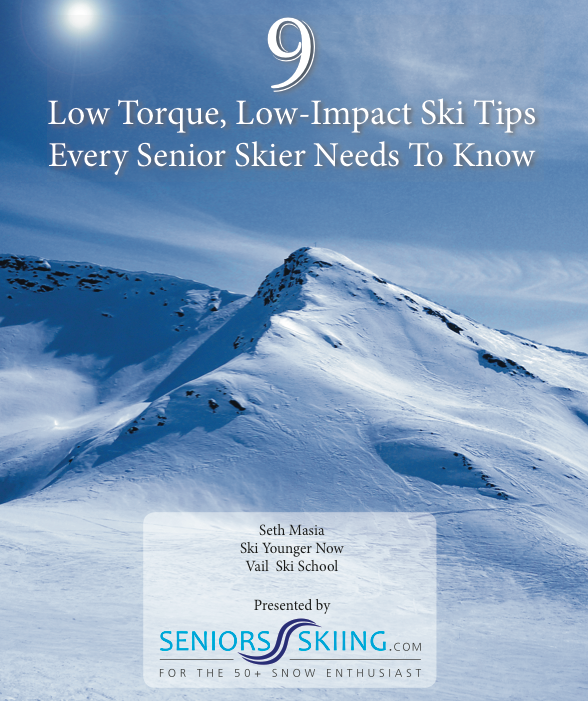
The technique is presented in a new, free, illustrated eBook developed with SeniorsSkiing.com. “9 Low Torque, Low Impact Ski Tips Every Senior Skier Needs to Know,” is available for subscribers. To download the book, go to Community in the top navigation bar, click on Subscriber-Only Content, confirm your email address, then find the eBook, click on it. You will be downloading a PDF file.
Masia studied how older bodies, without risk of injury, could navigate a variety of terrains gracefully and more slowly. His new instructional approach takes into account skiers with artificial hip and knees.
He uses a straightforward retraining progression that reduces rotational stress on the knees and lower back. The approach shows skiers how to utilize gravity, terrain, and ski shape to do the work when initiating turns. Similar principles work for controlling speed.
When successfully implemented, each turn is a continuous and predictable arc, requiring less effort and minimizing stress and potential sprains.
The first day of each Ski Younger Now workshop focuses on the nine simple steps explained in the eBook. They start with the “Patience Turn,” which allows the ski’s shape to start each turn with virtually no muscular input. Other steps include a) changing the timing and location of planting a pole to have greater control on steeps and in bumps, b) carving, buttering, or smearing skis to produce a variety of turns, c) an explanation of how to apply pressure on different parts of the inside of the boot to produce different types of turns, and d) the influence of terrain on rhythm and turn shape.
This brief and well-illustrated instructional gem will give senior skiers a new way to enjoy runs with slower, gentler, and more stylish turns. Most important, the tips should result in fewer strains and sprains.

Solitude Hosts Major FIS, NorAm Snowboardcross, Skicross Races
Jan. 19-22 Races Are A First For This Resort Located In Twisty, Winding Big Cottonwood Canyon.
Groomers finalize the steep course with its finish line right at the base of the mountain just a few steps beyond Solitude’s Village.
Credit: Harriet Wallis
It’s a test event for the FIS Freestyle, Snowboard and Freeski World Championships scheduled two years from now in 2019.
So what? Don’t yawn.
When Salt Lake City was chosen as the site of the 2002 Winter Olympics, the four resorts in Big and Little Cottonwood Canyons—Alta, Snowbird, Brighton and Solitude—were overlooked as possible venues partly because of the road. It’s one way in and one way out of each narrow canyon that was carved by glaciers eons ago.
However, professional and amateur races are frequently held in the two canyons, but this is the first time such a major event is scheduled there.
To paint the big picture, Deer Valley, located in Park City, bought the smaller Solitude Resort two years ago making Solitude part of Deer Valley’s family.
As to Deer Valley, this marks the 18th year that the resort will host international and world aerial and mogul competitions. It was a venue for the 2002 Winter Olympic Games, two World Championships and 15 World Cups. It’s had lots of practice hosting major events and the resort is an esteemed venue.
So Solitude is not just jumping into big time races. It has the expertise of its parent, Deer Valley.
The races are high adrenaline, high action events. A detailed schedule for the Toyota U.S. Grand Prix at Solitude Mountain Resort can be found here.
Boardercross is a snowboard competition in which a four to six snowboarders race down a course that’s typically narrow and includes banked turns, various jumps, rollers and drops designed to challenge each rider’s ability to stay in control while maintaining maximum speed. Mid-course collisions are common.
Skicross is a timed race event and with big-air jumps and high-banked turns. What sets skicross apart from other alpine skiing is that four skiers start simultaneously and attempt to reach the end of the course.
To read more from Harriet click here for her stories on SkiUtah.
Here’s a short video that previews the Snowboard Cross course at Solitude.

SeniorsSkiing Guide: Big White, Big Senior-Friendly
Big Choice Of Intermediate Runs, “Master” Lessons, Bring Seniors Back Each Year.
The Alpine T-Bar serves low-angle intermediate terrain near the 7,606-foot summit of Big White. Credit: John Nelson
It’s hard to find a resort better suited to older skiers than the popular British Columbia destination of Big White.
Located in Okanagan region of B.C. near the bustling, fast-growing city of Kelowna, Big White is indeed big, with a sprawling village that boasts the most ski-in, ski-out lodging in Canada.

A skier turns amid the snow ghosts near the top of the Alpine T-Bar at Big White.
Credit: John Nelson
The resort’s rolling terrain of predominantly intermediate runs is especially popular with older skiers. In its lesson programs, Big White offers discounted “Masters Mondays” classes, and two popular “Masters’ Weeks” designed to teach older skiers how to keep shredding.
“Our retention rate is over 60 percent,” says Ollie McEvoy, one of the masters instructors. “If they take a lesson from us, they’ll come back.” The many skiers who take part in the masters’ week programs return every year after making personal connections, McEvoy says.
“They end up making friends for life,” he says.
For U.S. residents, Canadian resorts are particularly attractive this year, with a favorable exchange rate of more than 30 percent. Add to that a discount on senior tickets at more than 16 percent and U.S. skiers make out very well at one of Western Canada’s favorite resorts.

Ski instructor Ollie McEvoy helps run the masters programs at Big White. Credit: Big White Ski Resort
Snow, Terrain and More
- Location: Big White is about 33 miles southeast of Kelowna, a city of more than 100,000 in the Okanagan Valley of British Columbia. Kelowna has an international airport with daily flights from Seattle, as well as major cities in Canada.
- Snowfall: “It’s the snow” is the marketing slogan for Big White. Located far inland from Canada’s west coast, Big White’s snow is colder and drier than rival Whistler-Blackcomb, and it receives about 300 inches a year.
- Terrain, lifts: Intermediate skiers love the rolling terrain of Big White, where all 15 lifts have a green run down. About 72 percent of the terrain is rated easy or intermediate; 28 percent is rated expert and extreme. Five of the chairlifts are high-speed on more than 2,700 acres of skiable terrain.
- Vertical: 2,656 feet from Big White summit (7,606 feet) to the base of the Gem Lake Express lift (4,950 feet).
Lot To Lift Access
- Parking: Day-trippers can park at the Gem Lake base or at the Happy Valley Lodge. This is one resort where you should consider staying on mountain because of the vibrant and affordable ski-in, ski-out village scene.
- Public transportation: Big White offers a shuttle service from the airport to the mountain village, so skiers flying into Kelowna do not need to book a rental car if they are staying on the mountain. In addition, an inter-resort shuttle operates between Whistler, Big White and Sun Peaks for skiers who want to try three of Canada’s biggest resorts.
- Accommodations: Big White is built for skiers who want to stay on the mountain. Thousands of ski-in rooms are available in all price ranges, with many package deals that include lift tickets and meals.
Culture
- The vibe: Friendly, with a pronounced Aussie accent. The resort, owned by an Australian family, attracts a large number of Aussie workers and vacationers, giving it a “no-worries, mate” feel.
- Dining: The resort has 18 on-mountain restaurants in various price ranges. Among the very best is the Kettle Valley Steakhouse and Wine Bar at the Happy Valley base area, serving excellent upscale entrees with a long list of tasty, British Columbia wines.
- Mountain life: Beyond the lift-skiing, Big White offers many other activities, including Nordic skiing, outdoor ice skating, tubing, snowshoeing and sleigh rides.
Bottom line
- Big White is a major resort that does very well by older skiers, with vast intermediate terrain and popular masters instructional programs.
- The strong U.S. dollar makes this Canadian resort particularly attractive for deal-hunters.
- Excellent snow quality keeps the lifts spinning well into April.
Trail Map Click Here
http://www.bigwhite.com/explore-big-white/mountain-info/maps-brochures
Webcam Click Here
_____
John Nelson is a freelance outdoors writer based in Seattle. Follow his blog at skizer.org.

Big White’s vibrant village has the most ski-in, ski-out lodging in Canada. Credit: Big White Ski Resort
[authors_page role=contributor]