


Snow In Literature: Snowbound by John Greenleaf Whittier
[An excerpt from Snowbound by John Greenleaf Whitter (1807-1892) to reflect on the tremendous snowfalls in the US and Canadian West.]

Alpine Meadows

Squaw Valley
No cloud above, no earth below,—
Sugarbowl
Lift A Ticket? A Ski Patrolman Speaks
There Are No Easy Answers. It Might Hinge On Ski Resort Policy.
Editor Note: Last spring, we received a note from Frank Dolman, a 43-year member of the National Ski Patrol and a long time guide for the Over The Hill Gang at Steamboat. His comment: “Problem—Some owners of ski areas are cutting costs by lowering headcount and hours of the ski patrol. Consequently, reckless behavior can be out of control. Solution—A ‘license’ to ski, based on passing a test on the Skier’s Responsibility Code. License earns discounts, etc., as incentive.”
Our Spring Survey 2016 revealed a lot of comments about controlling speeders. We’re still searching for an answer. This article by John Brown, a 38-year NSP veteran and patrolman at Ragged Mountain, NH, suggests lifting tickets really depends on the policies of the resorts.

Know it, practice it, tell your friends.
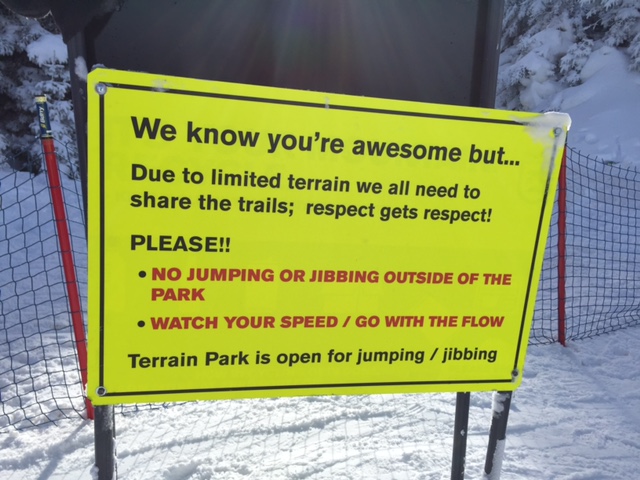
Responsible behavior on the snow at times doesn’t seem to be a habit of a lot of skiers/riders today, and many people wonder who is responsible for the development of this go fast and take chances attitude. Is it the ski patrol? Is it area management? Is it equipment that may be too easy to use? Perhaps it’s the “point ‘em downhill and go” approach. And maybe it is a general apathy.
My answer is: “All of the above”.
So what can we do? Bring back and/or bring forward the skier responsibility code! Remember when it was posted everywhere, printed on napkins, the back of your ticket, on brochures and even a billboard or two? Look for it when you get a chance, and let me know where it pops up. Simply adhering to these common sense rules will make the slopes safe.
What should the ski patrol do? Well, first we would have to visit the individual ski area’s policy. Does the area encourage the patrol to be visible? Are there enough patrollers to actually patrol? Or does the patrol have to standby on top and wait to be dispatched?
Should the patrol take tickets away and under what circumstances? First offense? Based on a report? Before we build a long list of offenses, let’s first remember the patrol is not the police, and their primary mission is to keep the area safe and render aid when necessary.
There are various ski area policies that range from marking a ticket/pass to recording the name of a pass holder who has hit someone or otherwise skied/rode recklessly. An informative admonishment can be a valuable tool as well. A ski patrol that is visible can deter the potential speeder or reckless skier.
The ski area has a responsibility to take some sort of action when a report of reckless skiing is made. Whether it is customer service, the ticket counter, ski patrol or ski school, there must be a positive response to each visitor’s concern. You can’t ignore a ski area patron who takes the time to report what they feel is errant behavior which invariably could result in injury or worse, resulting in an unpleasant experience of a customer.
Of course, many people believe the easiest thing to do is to take away the ticket, and most certainly there are occurrences that warrant such action. Consider this though. After driving two hours and paying $80 for a ticket not to mention a $3 bottle of water, should we take away the ticket of someone who may or may not have skied too close to someone? Of course, if there is reason to believe recklessness resulted in injury or complete disregard for safety, then maybe the ticket should be taken. But what about gray-areas? Second-hand reports? Not easy.
Just like the myriad of resorts in North America, the solutions will vary as well. There is one very proactive element that begins with all of us, and it is communication. No one will know there is a problem if it is not reported whether in person, by email, snail mail or by phone, once an area is aware of a concern there is a responsibility to act to make skiing and rider safe for everyone.
Hot Finds For Seniors At The Winter Outdoor Show
The Innovations Are Amazing. Here Are Three Top Picks For Seniors.

Vibram’s Arctic Grip soles won’t slip on ice no matter how hard you try.
Credit: Harriet Wallis
Vibram – the company known for its hiking boot soles – has a new sole material it calls “Arctic Grip.” You can walk on solid ice and not slip. Really! To prove it, Vibram demonstrated on blocks of ice at its show booth.
Arctic Grip is used by six shoe companies on dress shoes to work boots: CAT, Hush Puppies, Saucony, Merrell, Sperry and Wolverine.

Stay toasty with heated ComfortWear in many styles.
Credit: Harriet Wallis
ComfortWear hooked up with Heat Factory which is known for its hand warmer packets. Now you can keep your entire body warm with clothing that’s designed with heat coils that are battery operated. Stay toasty as you ski, hunt or sit through a game in an outdoor stadium.
The most popular item is the heated neck scarf, said ComfortWear President Charles Hollcroft who owns the technology.
High tech Finbulvetr snowshoes have a funky egg-crate look, but they are made from a thermoplastic with flex underfoot and in the right places for steep uphill climbs or tough downhill descents. They’re designed and made in Norway where they really know their snow. They flex and move like no other snowshoe.
They were originally designed for the Norwegian military to carry heavy loads in the backcountry, said Christian Brunsvig, chief executive officer. Then the company created an additional model to suit a professional snowboarder who needed light weight but extreme performance for his uphill climbs. The long model is for long haul expeditions.

Norwegian snowshoes are lightweight and efficient.
Credit: Harriet Wallis
The Outdoor Retailers show is the largest product show of its kind in the US, and it’s staged in Salt Lake City. It brings product manufacturers from all over the world together with retail buyers who can see, touch and try new products and then place orders for the coming season. A few passes are issued to media writers and photographers – such as SeniorSkiing.com. That’s how I got in.
To read more from Harriet click here for her stories on SkiUtah.
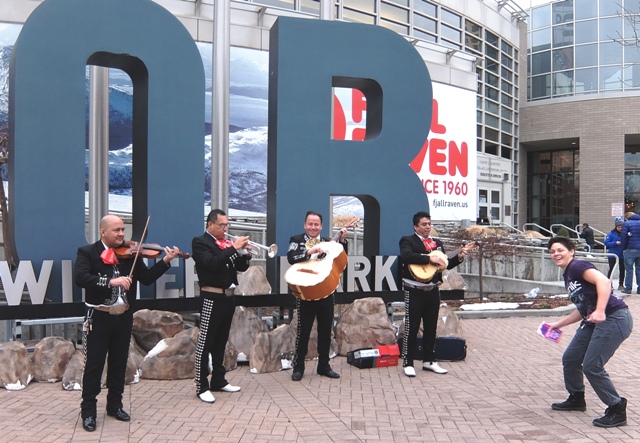
A mariachi band gets people dancing before the Outdoor Retailers show opens.
Credit: Harriet Wallis
[authors_page role=contributor]