

From One Ski Pole to Two
A Personal Experience As Told To Alan K. Engen.
Early One Pole Skiers
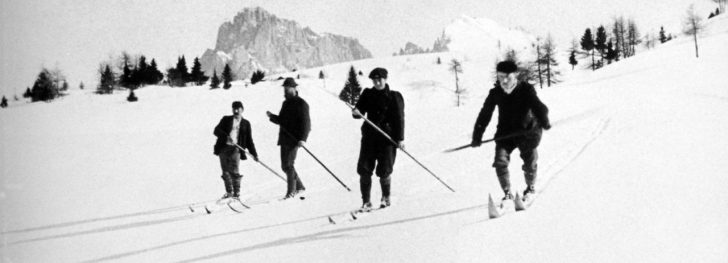
The late Ruth Rogers Altmann, a good friend and longtime Alta skier, was born in Vienna in 1917. She learned to ski in the Austrian Alps. Ruth’s earliest ski lessons involved the transition from Mathias Zdarsky’s (1874-1946) turning technique using one ski pole and leaning into the mountain to Hannes Schneider’s (1890-1955) turning technique using two ski poles and leaning away from the mountain.
Zdarsky transformed cross-country skiing to downhill skiing during the late 1800s and the early 1900s. He is recognized as the father of alpine (downhill) ski technique.

Young Ruth Altman in Austria
In the early ’20s, Ruth learned to ski in Zdarsky’s Ski School using a single, 5′ to 6′ metal-tipped bamboo pole for balance, turns, and to stop. With this technique, Zdarsky could teach people to ski in about five days.
The following excerpts are from Ruth’s recollections, which I recorded in 1988:
“The one long pole generally was made of bamboo and had a sharp metal point at the bottom. It was light and slightly flexible. Its purpose was to balance and support the skier. It was supporting when climbing up hill. One leaned on it with each step. When trails were too narrow for stemming or wedeln turns, we placed the pole between our legs and sat on it lightly, using it as a brake.”
“As skiing became more popular and developed from a means of transportation to a sport, games and racing competitions came into being. The popular game was a fox hunt on skis. A group of people had to find and catch the human fox’s red zipfel mūtze [long red night cap with a pom-pom]. The fox had an earlier start than the hunters so he could hide and flee from the hunters. ”
“As speed control became a factor in this new sport, the Zdarsky technique was challenged by Hannes Schneider’s speedier technique, which developed according to the law of physics and gravity. The weight had to be changed to lean downhill in turns, and two shorter poles, with baskets, replaced the one pole.
“We, the younger generation, and our older teenage brothers and sisters went with the new. A new division (of the ski school) was formed for two-pole skiing. Even some of the elders would use two poles, which when needed could be batted together to form one pole.”
Ruth Rogers Altmann skied every year at Alta well into her 90s and was a member of the “Wild Old Bunch,” Alta’s ski ambassadors. She passed away in the fall of 2015 at age 98 in New York City, where she lived most of her adult life.
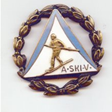
Several years ago, she presented me with the instructor pin she received in the 1920’s by the Austrian Ski School. That pin on permanent display in the Joe Quinney Winter Sports Center/Alf Engen Ski Museum, at Utah Olympic Park, shows a skier with a single pole.
Long Pole Skiing
What Is Old Is New Again.
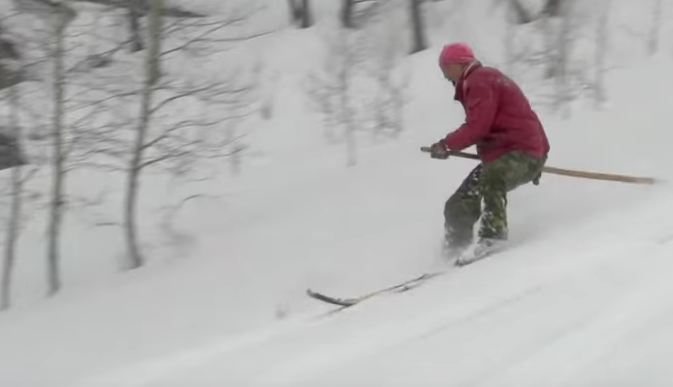
This Hok from China skis what we see as the old way, but for him, it’s a way of life.
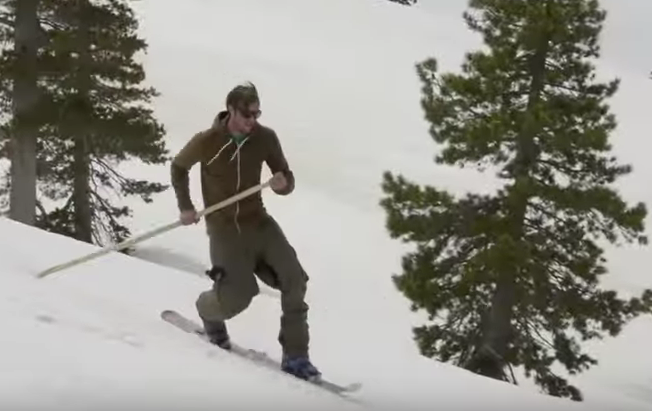
Last season, 38-year-old Ma Liqin visited Norway to demonstrate an ancient skiing style still used in the Altai Mountains, a range located at the intersection of China, Kazakhstan, Russia, and Mongolia. People in that region ski daily for hunting and transportation. Their equipment is fashioned from wood and has animal fur tied to the base. As part of the technique, they use a single long pole.
“The skiing technique is very attached to the traditional life of hunting, trapping, and reindeer herding. We do not know how long this activity will be kept alive,” said archaeologist Espen Finstad, archaeologist for Norway’s Oppland county.
Readers interested in long pole skiing might consider the personal experience of 67-year old Dennis Murphy, from Chester Springs, PA.
“I was first introduced to long pole skiing approximately three years ago by my son, who experienced the use of a single long pole while investigating techniques used in telemark skiing. I found that the use of a single long pole provides a novel and enjoyable adventure. The technique enhanced my turning, provided a new rhythm and, perhaps most importantly, as a senior skier, provided a more stable and secure ride. In fact, last season I skied a double diamond that I would never have tried with two poles.
“The technique for long pole skiing is easy to learn. It is a natural movement that involves holding the pole horizontally in front of you and, as you turn, placing the pole tip on the surface at the rear end of your up-hill ski. When turning right, for example, the tip of the pole would be placed near the end of the right ski. It is similar to a kayak paddle to maneuver when moving down stream.
“The enhanced turning and rhythm resulting from using a long pole results from the natural tendency to lean back (uphill) during turns. Placed behind, the pole adds support and helps the skier go back even further. I find myself skiing higher on my edges, making more secure and rounded turns. I have found that putting significant pressure on the pole tip significantly improves the ability to control speed and balance. It has provided me with the confidence to ski trails with steeper inclines. “
Dennis now manufactures two-piece long poles under the name ThirdEdge. The product is explained and demonstrated at www.longpoleskiing.com.

Finding Plus-Size Clothing A Problem For Skiing Senior Women
SeniorsSkiing.com’s Correspondent Yvette Cardozo Tells Where To Get Decent Clothing For Plus-Size Women.
Correspondent Yvette Cardozo decked out in Obermeyer plus-size ski wear at the top of Mammoth Mountain’s expert runs, ready to put the technical skiwear through its paces.
Credit: Yvette Cardozo
This is a story of success and failure. And progress. Sort of.
I am not svelte by anyone’s measure. But I ski. I cycle. I scuba dive. And I once rode my bike across the state of Florida … 174 miles in one day. The average temperature was 95, by the way.
Many, many years ago when I got into serious cycling and wanted shorts, I was laughed out of the shop and resorted to cutting off polyester pants. Those of you of a certain age will remember those pants. They had a hideous seam down the front and stretched horribly when wet.
Sadly, it rains a lot in South Florida, where I was living at the time.
My ski wear consisted of men’s very large sizes tailored to fit. Eventually, someone came out with skiwear for “fat ladies.” The coat was neon pink. Be real guys. Nobody that size is gonna wear something that makes them look like Lake Superior. And it had hardly any pockets.
Women’s sportswear back then was notorious for not being technical. Fat women’s sportswear? You can imagine.
Enter Obermeyer. Go to the company website, click on women, then plus size and you actually get a choice. Mine that season boiled down to a pant called the Birmingham with all sorts of nice techie add-ons…fleece lining, storm flaps, high back, scuff guards, sturdy zippers, pockets. POCKETS!
By the time I decided to get them, the only color left in a size 20, yes, I am a size 20, was white. That is not a color someone my size EVER wants to wear in public. Sigh.
But they arrived, and they were four inches too large. I put them on, held them at the waist, let go and they fell to the floor by themselves.
Which is when I discovered another thing about clothing. The more expensive the clothes, the smaller the claimed size at a particular measurement. In other words, two pants that measure the same might be a 20 in something less expensive, an 18 in a mid-range and maybe even a 16 if it’s REALLY spendy.
Being rich, I guess, means you never have to admit to one of those embarrassing fat sizes.
There were none of my first choice left, but in my next choice, I was a size 18. Yay.
These things have style. They have pockets … lots of pockets. They fit. I could actually bend and squat in them while still managing to breathe.
Then, off I went to Mammoth Mountain in California to put the pants through their paces. And yes, they did the job. Our first day, despite the April date, it was still full on winter with enough wind to close the top of the mountain. I wondered if it was possible to get frostbite on your tongue (you pant a lot at 11,000 feet). But the pants survived and kept me toasty.
Then the next day, spring arrived, with 50 degree temps. I expected to sweat my knees off. But, oddly, I did not. Somehow, I stayed cool while diving into Mammoth’s famous Cornice Bowl.
I finally have a smart, technical pair of ski pants.
Now all I need is a jacket.
With lots of pockets.
Editor’s Note: Sourcing athletic, technical clothing for plus-size women is a real problem. A recent Washington Post article describes the frustration and discouragement women feel when they can’t get decent, well-made technical clothing for sports or business wear. What is available is not stylish, ill-fitting or wildly expensive. We thank our new correspondent Yvette Cardozo for telling us, with humor, about what must have been a exasperating search for competent clothing. Have you ever experienced this? What is your solution? Are you a retailer or manufacturer? What’s going on?
[authors_page role=contributor]