


Better Quality Skiing – Tribute to Contributor Bob Trueman
 Editors Note:
It is with great sadness that we learned of the recent passing of one of our very popular contributors, Bob Trueman, a retired ski instructor and coach based in Europe. Every one of his many articles about how to ski better and enjoy it more struck a chord with SeniorsSkiing readers, always eliciting a spirited conversation in the comments section. We are republishing one of his last ones, about the simple pleasures of just enjoying skiing without worrying about improving or not. Richard Lambert
Jean Claude Killy, one of the greatest ski racers of all time, reminded us that “skiing is always a trip to the edge of what is possible. But it is not an obligation – we don’t have to improve if we don’t want to; skiing should always be a pleasure.
It’s in our nature that only a small percentage really want to improve the quality of our skiing, and for those who do, that’s one of the ways we enhance our pleasure. For others it can more beer in the mountain restaurant. Both are valid.
What IS better quality skiing? Put at its most concise, it’s best described as “more skillful skiing”.
Skill is a much misused word. “Carving” a ski, or pitching a baseball are often referred to as “skills”. They aren’t; they are techniques, which can either be executed skillfully or not. Watch me pitch a baseball and you’ll know what I mean.
So the next questions in this cascade of questions are – what is skill, and how is skill improved?
The most concise definition of skill I know is this – “Skill is the learned ability to bring about pre-determined outcomes with maximum certainty; often minimum effort”. (Emphases added).
My job over the last 35 years or so has been to assist skiers to enhance their ability to do this. Not to “show” them what to do. Not to “demonstrate” perfect skiing (which I can’t do anyway). Skill cannot be enhanced by watching someone else, particularly if they are especially proficient – super skillful skiers do things so subtly that you can’t see what’s going on anyway.
Our personal make-up guides our beliefs, which give birth to our thoughts, which drive our actions – what we actually do – and what we do brings about our outcomes.
To achieve better skiing outcomes we need to change what we do. I’ll repeat that – it’s what you DO that matters.
“Doing” in skiing, involves a lot.
As a skier, you already know full well that we have to exercise control over every part of our bodies – our heads, torsos, arms, hips, legs, feet, even toes!
Because the only person who can improve your skiing is you, you are the one who needs information coming to you in real time letting you know how close to your desired outcome your performance is. Once, that is, you have defined your desired outcome of course – which is where fellows like me come in.
Since we have only a limited number of senses acting as pathways for this information, we must ask which is best. As a longtime instructor and coach, I can tell you that it’s what you feel , it’s not what you smell, taste, or hear though once already highly skilled, hearing may well be useful, but it’s not the number one.
Importantly, it’s not what you see, though that can help you avoid a tree. One reason for this (there are many) is that you cannot see yourself as you ski.
You need to develop a high level of skill is assessing what you feel. As a simple example of this – imagine you’re my pupil. We decide a specific desired outcome and what you’ll attempt to be aware of. You ski, I watch. At the end of your very short run I ask “What did you feel?” If you’re like 99% of skiers you will say something like “It felt good”. Or “Yeah, I felt ok”,or “I didn’t really feel confident”, or whatever.
At which point you will hear me say “I didn’t ask you that – I asked you what you felt (as you skied) I wasn’t asking you for a value judgement, just what you felt.
We are likely to have agreed that you would seek to feel, say, some pressure under a toe, or feel your shin pressing against your boot, or to feel if any pressure came under your heel, etc etc. Just one thing, never two.
I will tell you that I don’t want you to think or anticipate or even make anything up (you’re not being judged). All we are doing is working together to help develop your awareness. Very few skiers have it, and watching other skiers will not develop it.
You can do it on your own though when you know how. Until you know how, it provides a living for good ski coaches like me!
I wrote a paper somewhere in which I made up two new English words that help us here – the paper was called “The Kneed to Knowtice”. To enhance our skill at pretty much anything we need to be focused, and more importantly to notice a chosen specific that will enable us to know what is happening concurrent with its happening.
The simplest example is my most frequent exhortation when starting with any skier, however good already, which is “Let’s agree before you set off that you will do your best to be aware at all times of nothing other than feeling the amount and quality of the pressure under your big toes – if you like just under one big toe”.
And I promise in return that after your practice run, that I will refer to nothing other than that about your skiing on that run.
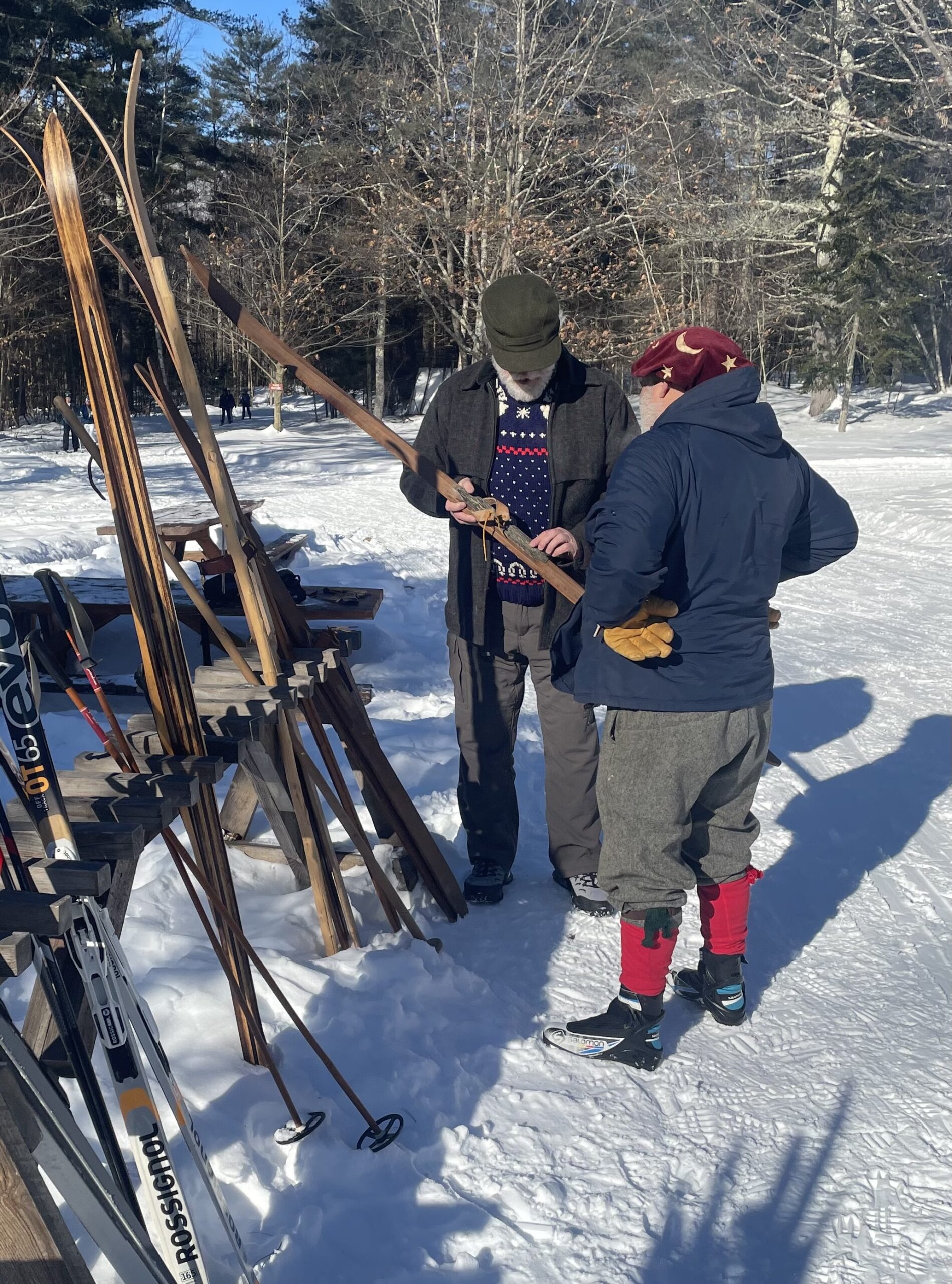
Wooden Ski Day Held At Carter’s XC Ski Center
Maine Ski Museum’s Glenn Parkinson shared his knowledge about vintage gear with folks at the Wooden Ski Day
The traditional way of skiing (from the 1920’s on) was celebrated at the annual Wooden Ski Day at Carter’s XC Ski Center in Bethel, Maine. The event has been run for about 40 years at Carter’s, which began operating in 1984. In the early days of skiing everyone used wooden skis because synthetics had not begun to be used in ski manufacturing. Soon after the Carters started the family XC ski business, they acquired a pair of 12-foot long wooden skis, which they believe is the longest pair of wooden skis in New England! And there are stories about Dave Carter, who has since passed away, joining some relay team members to race on those 12-foot skis.
Nowadays, wooden skis are often used as wall decorations but there are still a few skiers who love the feel of wood under their ski boots. Many people refer to wooden skis as vintage or retro but while it may be fun on any type of XC skis, when compared to most modern skis, their performance is not in the same league. Keep in mind as we aggrandize the past ski equipment, that new equipment including skis, boots, bindings, and poles will significantly outperform wooden skis, light leather boots, 3-pin bindings, and so on. For example, the pair of Bonna 1800 skis that I borrowed for the Wooden Ski Day parade were terribly warped in the ski tail, which is common for many pairs of the wooden skis that still exist.
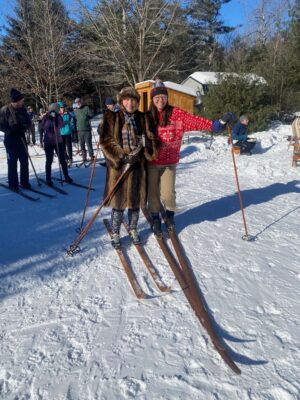
Carter’s XC Ski Center owners Anne and Jess Carter celebrate Wooden Ski Day. Jess is on the 12 foot skis, the longest skis in New England!
Ski historian, Glenn Parkinson, currently the president of the Maine Ski & Snowboard Museum, shared his knowledge of ski history at the event and he is one that knows about it. In 1995, Parkinson published the book called “First Tracks” that traced skiing in Maine back to the 1870’s. The book covers Maine’s skiing heritage from the time when Swedes immigrated to the state and brought what they called “skees” to clear snow-covered forests for settlers. In those days ski wax was known as “dope.” Parkinson’s book covers all of Maine’s ski history with photographs, skiing characters, ski trains and winter carnivals, lost ski areas, and a chronological chart of the historical highlights between 1870 and 1938.
Carter’s XC Ski Center complimented folks who participated on wooden skis with free trail passes. All the people who donned wooden skis held a short parade and prizes were given based on most “old-timey” or traditional Nordic ski wear, retro 70’s/80’s ski wear, and finally, most overall creative. There was live music with a local jazzy folk band, a bonfire, and Norway Brewing Co. served beer. A portion of the day’s profits at Carter’s benefited the Maine Ski & Snowboard Museum.
ICYMI for February
In case you missed it, here are bits and pieces from here and there about several of our favorite winter resorts East and West, to help you plan your downhill or XC time and your time before, during or after. See you on the slopes!
Birding on Skis at Alta
This is a unique winter adventure. Alta’s Birding on Skis program let you glide through breathtaking snowy landscapes while expert guides birding from Tracy Aviary lead you to discover the diverse avian species that thrive in the Wasatch Mountains in winter. Immerse yourself in the tranquility of nature, learn about the fascinating behaviors of winter birds, and create lasting memories against Alta’s beautiful snow-covered terrain. Registration required.
Birding tours are 9am-Noon on the 2nd and 4th Thursday of each month. Meet at the bottom of Collins lift by 8:50am with a lift tiket or season pass, all your gear and ready to ski. Participants must be at least 12 years old and able to ski intermediate, groomed runs.
- February 8th and 22nd
- March 14th and 28th
- April 11th and Alta Earth Day (TBA)
Jackson Hole Kings & Queens of Corbet’s Competition – Cancelled
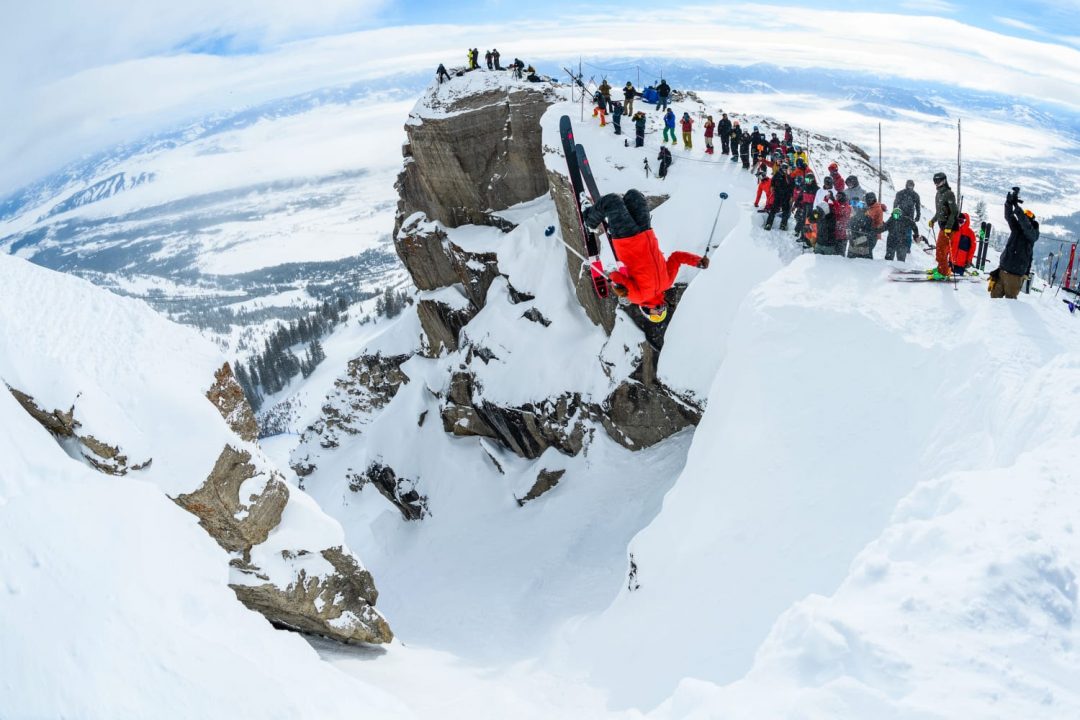
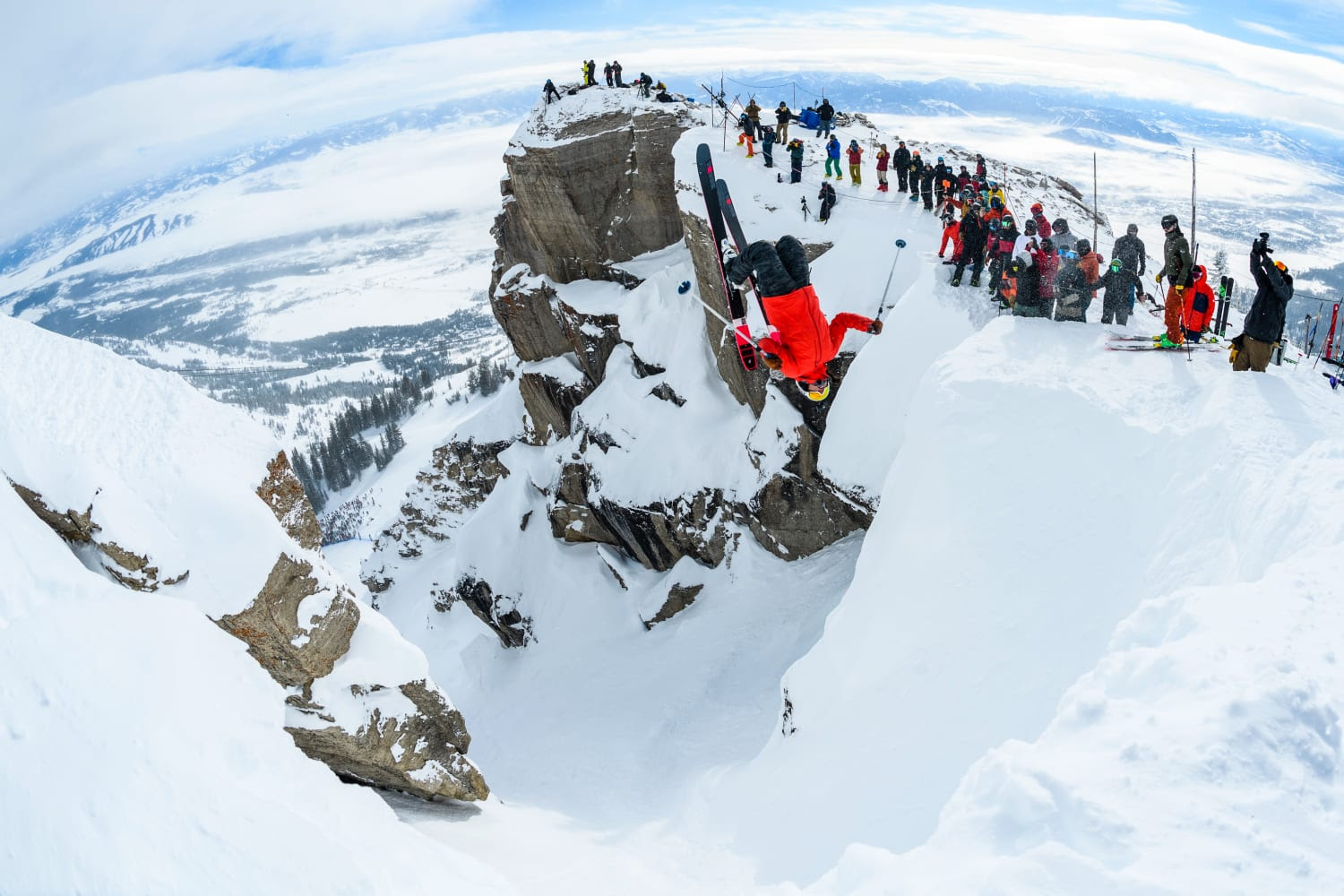
JH Kings and Queens of Corbets Veronica Paulson first womans backflip
Jackson Hole is saddened to announce that Kings & Queens of Corbet’s 2024 is cancelled.
The Jackson Hole Ski Patrol, Mountain Operations, Event Leadership, and current/former competitors have been working together to assess conditions in the Couloir for the competition scheduled for Feb. 3-10. 80” of snow has blanketed the Resort in the past two weeks and the mountain is open wall-to-wall.
However, Corbet’s Couloir requires specific weather factors to fill in properly and create a competition-worthy environment that supports landing mind-blowing tricks and carrying high speed through it. Unfortunately, this last storm didn’t deliver what we needed. Upon first-hand inspection of the snowpack within the Couloir, the competitors agreed that conditions are not at the level needed to run an elite competition. However, they all agreed that it is skiable for those with expert abilities. We are working to open Corbet’s to our guests very soon and will update you when it’s ready.
Kings & Queens veteran Veronica Belle says, “Corbet’s is skiing great, but conditions are not there to do what we want to do. As athletes, we all want to show off our best skiing, and right now the conditions are not safe enough for us to put on the show we usually do. I’ve trained all year for this and now I have another year to keep training and dreaming about my run.
Also see our recent article on where to ski and what to do in Jackson Hole.
https://seniorsskiing.com/seniorsskiing-guide-jackson-hole-not-for-experts-only/
[authors_page role=contributor]