

What A Ski Instructor Wants You To Know About Keeping Warm
Rescued male Labrador mix wearing his winter scarf ready to go! Credit:Stephanie Phillips
by Stacey Smith
I have been a ski instructor for 18 years. I am also a parent to two grown adults who learned to ski as children by going to work with me. Keeping all of us warm and comfortable for entire days on the slopes was my responsibility, and I make sure my clients, at any age, are warm and comfortable to ensure they have their best day on snow.
Layers
There’s one word to describe how to stay warm – layers. Today’s materials and fabrics are so much thinner and warmer than the heavy knits of decades ago.
Start with a base layer consisting of a long sleeve top and long underwear bottoms or even yoga pants. Long underwear is made in so many different materials and weights, such as fleece for cold, sub-zero days, and thin polyester blends for warmer spring skiing days.
Stay away from anything with a tight ankle cuff as you will want the ability to pull your pant leg up and over your calf when getting fitted for ski boots.
Socks Are Important
If your feet get cold, that will be enough to distract you from your ski experience. Find a good pair of synthetic/wool blend socks. Just make sure they are long enough to go over your calf.
Stay away from cotton socks and anything shorter than crew length. Anytime bare skin rubs against the inside of the boot, it creates friction and becomes very uncomfortable. The more coverage you have on your foot and calf, the better.
Fleece
Keeping your body’s core warm is key if you’ll be outdoors for any length of time. Depending on the weather forecast, you may want to wear a thin fleece pullover or vest under your jacket or coat. They can always be taken off if you get too warm.
Snow Pants
Either bibs or standard snow pants, will do. Do yourself a favor and wear the most
comfortable pair of winter boots you have to the mountain. You’ll thank me for that advice at the end of your day!
Mittens or Gloves
Which you choose is an individual preference. In my experience, a thin glove liner in a mitten can help to ensure even more warmth on cold days. If you use hand warmers, the liner acts as a barrier to your skin preventing any burns if the handwarmers get too hot.
Helmets
I cannot stress enough the importance of a helmet, for two reasons, first to protect your head. Secondly, you will find it much warmer than a hat. You don’t need to buy a helmet; you can rent them at most ski areas and most ski schools require them with lessons, including for kids.
If you are renting and feel funny putting your head in a helmet worn by others, wear a balaclava (combined neck warmer and cap) or a thin hat/cap underneath the helmet. This will add an extra layer of warmth. Just be sure the hat is thin enough, so the helmet fits properly.
Neck Warmers
These are a great way to close the gap between neck and helmet. Depending on the weather, choose toasty fleece or something thinner. A scarf can work, too, provided the ends are tucked securely into your jacket. The last thing you want is your vision obstructed by a scarf fluttering in the wind as you’re sliding on snow, or – worse – caught in the chairlift when you exit.
Goggles
These are important all winter, especially when weather conditions are snowy, windy, or just brilliantly sunny. It’s difficult to listen and watch your instructor if you must constantly turn away or cover your eyes because of blowing wind and snow.
Boots
I mentioned handwarmers with gloves or mittens and it should be noted, toe warmers are also a great thing to have on very cold days. They are best applied when you put on your ski boots, or right before you go to the rental shop to save time.
When fitting your ski boots, do not place any other clothing in the ski boot other than your sock. The single biggest complaint I hear from “first time” clients when we meet on the snow is “My feet hurt, my boots are too tight”. It’s usually because they have their underlayers and pants tucked into their boot and then the boots are buckled tightly, causing their circulation to be cut off.
I hope this helps you prepare for your first time or perhaps your grandchild’s first time on the slopes. Positive experiences on snow create future skiers and that’s always been my goal!
Bio
Stacey Smith grew up in NH not far from the Mt. Washington Valley. I realized when mychildren were young, that I could become a ski instructor and at the same time they could learn to ski. I spent close to 18 years teaching all ages and abilities to make their first turns on snow. These days, I live in southeastern MA with my husband. He doesn’t ski but loves apres ski, and we both enjoy all things related to skiing, travel and food.
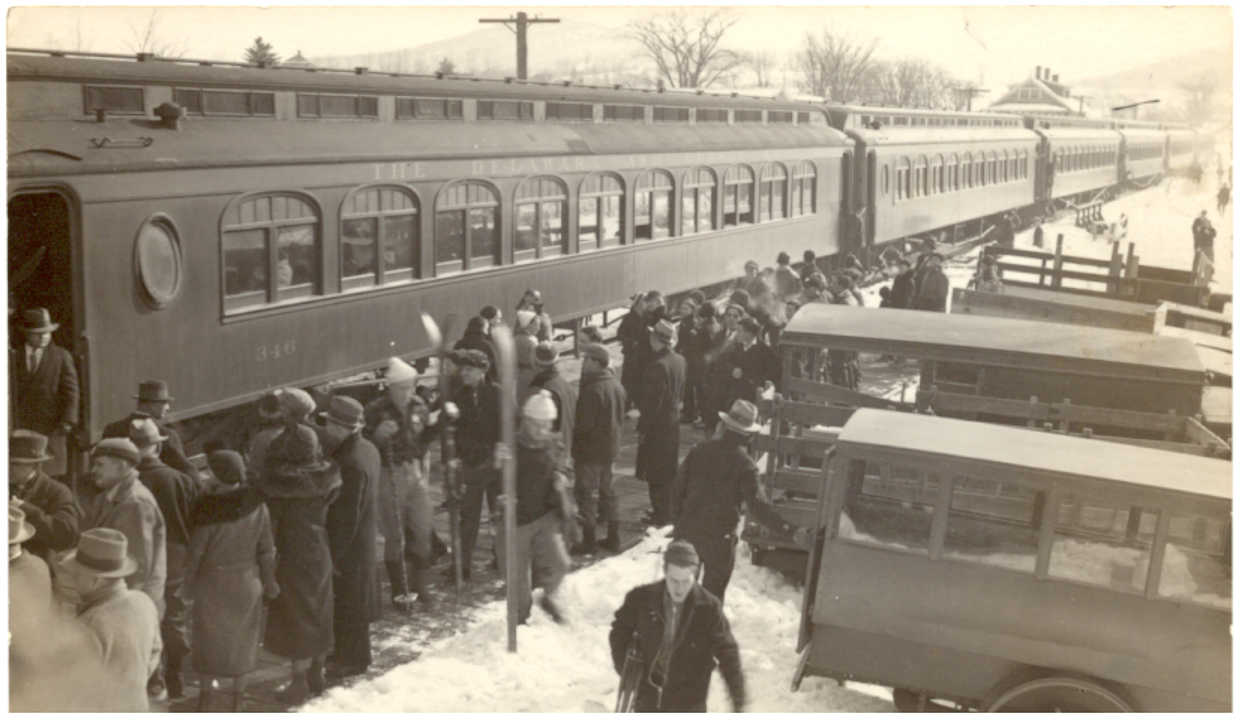
90th Anniversary of the First North Creek Snow Train
Photo Credit North Creek Depot Museum
There was no Alpine ski racing at the first Lake Placid Olympics in 1932 – the first downhill competition in the winter games was held four years later at Garmisch-Partenkirchen Germany. But that didn’t mean there wasn’t plenty of enthusiasm for winter sports in the US at the time and it was shared by skiers throughout the Northeast.
One group that was especially active was based in Schenectady N.Y. where the General Electric Company had gathered engineers and other scientists from throughout the world. Notable among them was Nobel Prize winning chemist and avid outdoorsman Irving Langmuir and his protege at GE, atmospheric scientist Vincent Schaefer who became the first president of the newly organized Schenectady Wintersports Club.
From the start, skiing was a part of the group’s focus and trails were cleared on local hills. Looking farther afield, Langmuir, with Schaefer alongside, flew his plane over the region looking for a place where there was was snow and train tracks. There was little snow in the winter of 1933 but at the suggestion of a Delaware and Hudson Railroad executive, the pair scouted hills near train tracks that ran alongside the Hudson River leading to the hamlet of North Creek NY.
Following the 1932 Olympic Games the local American Legion had cleared several trails on local hills, and after several postponements, on March 4, 1934, the first snow train traveled from Schenectady to North Creek carrying 378 passengers who paid $1.50 for the same day round trip ticket.
The first trip was Sunday only. But starting in 1936, the trains originated in New York City, loading at 11:59 PM Friday evenings and arriving in North Creek at 8 AM Saturday. From there, it was “Ride Up, Slide Down”, the popular slogan coined by Wintersports Club member Bill Gluesing. People were transported by car, or truck, or school buses with ski racks attached, from the village up to the nearby Barton Garnet Mines where they skied back down, mostly on logging roads 10- 20′ wide.
In addition to area hotels, accommodations were often provided by local residents who would meet passengers on arrival at the railroad station offering rooms for the night.
An early hero of this adventure was Schenectady nurse Lois Perret who formed the Safety Committee on site. A precursor to the National Ski Patrol, the committee provided first aid at the site and swept the trails when it was time for the train to leave in the afternoon. The train trip home was often a highlight with baggage cars cleared and musicians and dancing on board for entertainment.
The ski trains continued through the 1930s but were halted with the start of World War II. After the War, busses replaced trains for group travel to North Creek and The North Creek Ski Bowl, known as “Little Gore” . New York State opened the current “Big” Gore Mountain ski area just outside the village in 1964 and skiing remains a popular activity in North Creek today.
The 90th anniversary of the first snow train has been featured throughout the winter with the highlight set for a three day celebration March 2-4 in North Creek. An extensive collection of snow train history is maintained by the North Creek Depot Museum located on the site of the original train terminal in the village. It is open to the public daily from May through October.
France vs. Italy: And It’s Not About Soccer
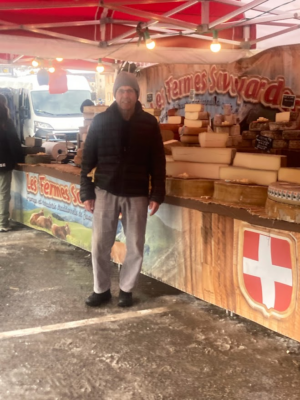
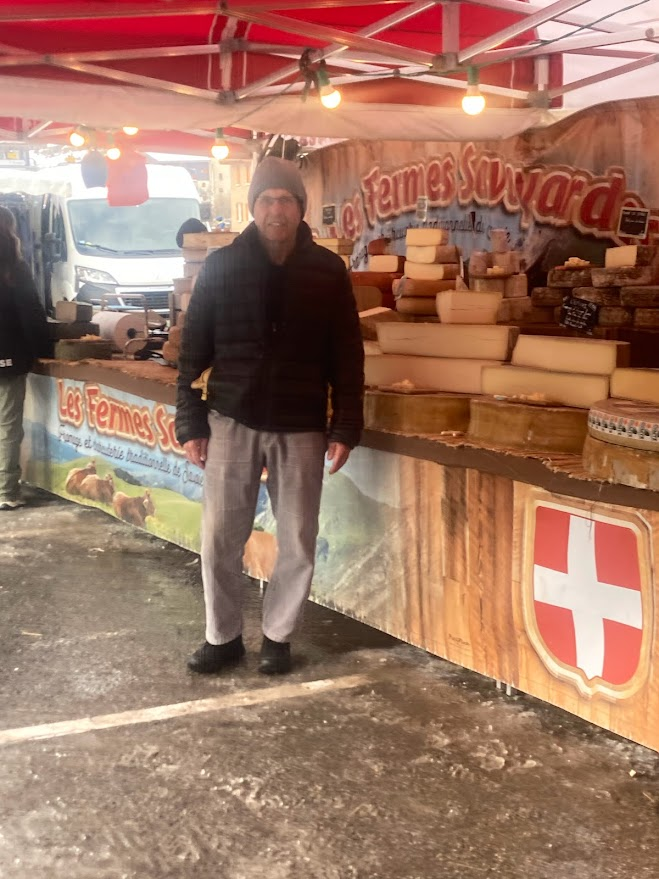
Market day in Val Cenis
Looking for a traditional French village with a ski resort, I came across Val Cenis in Savoie, at the southern side of the highest paved mountain pass in Europe, Col de l’Iseran, 2,764 meters. In winter the closest airport is Turin and then the Frejus Tunnel. Flying to Geneva is also a possibility.
We sought the French atmosphere of a traditional village. On the recommendation of a friend, we stayed in the village of Lanslevillarde. The Arc River flows through the town which is on the north bank, whilesouth side, where the skiing is, has hundreds of ski-in ski-out vacation apartments. The town is at 1,500 meters and the highest lift goes up to 2,850 meters. We rented a cozy two-bedroom apartment with a fire place in the center of town on the north side of the river. The owner was an alpine guide and very French, that is, not as accommodating as he might have been. More on him later. Scouting out the restaurants we found traditional Savoie fare, Fondue, Tartiflette, and Pizza.
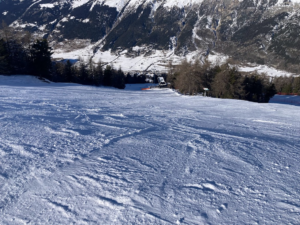
Skiing down to the restaurant in Val Cenis
The skiing can be divided between, the tree lined trails starting at 2,100 meters and going down to the village and the open areas above the tree line up to the top. This is an area of untapped potential. The skiing above the tree line is has great potential. For the most part it’s natural snow and the red runs with a 700-meter vertical are really great for cruising: the excitement of a good pitch without moguls. The drawback is that the lift going up to 2,850 meters is an old fashioned non-detachable chairlift that takes forever to get to the top. On a sunny day this could be plus, but in inclement weather going up is an unpleasant experience. Also, there’s only one mountain restaurant in this sector.
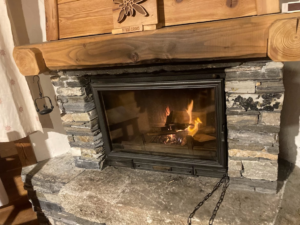
The fire place in our rented flat
We were there for two weeks, half of the time enjoying the sunshine but experiencing poor visibility on the other days. But on the days with poor visibility, I skied the runs below the tree line down to village taking advantage of the better visibility and enjoying the uncrowded non-stop runs with verticals of 500 – 600 meters. Artificial snow provided good cover all the way down to the village.
Oh, about the owner. Two days before our planned departure, he alerted us to the chance that French farmers protesting against the government might block the Frejus tunnel on the day we had planned to drive back to the airport in Italy. We couldn’t take the chance of missing our flight, so we revised our plan and left a day early. But where to go for these remaining days? A quick look at the map pointed me to the Sauze d’Oulx, part of the huge “Milky Way” ski region linking Sestriere with Montgenevre. We left Val Cenis on a grey Friday morning and two hours later arrived in sunny Italy. The local tourist office found us a pleasant hotel for one night. We checked in, and got dressed for skiing. A short walk up the hill to the lift and I was back in my element. Long red runs, great for non-stop cruising and sunshine, with a plethora of restaurants on the piste offering a wide range of Italian cusine. While I was skiing my partner was surveying the possibilities for dinner. She found a great restaurant with tapas and gourmet Piedmont delicacies plus a selection of Piedmont’s famous Barolo and Barbera wines. Rising early the next morning, I got in another few hours of fabulous skiing, before getting in the car for the drive the airport.
The score: Italy 1, France nil.
[authors_page role=contributor]