

On The Threshhold of Winter 2015-16
So It Begins
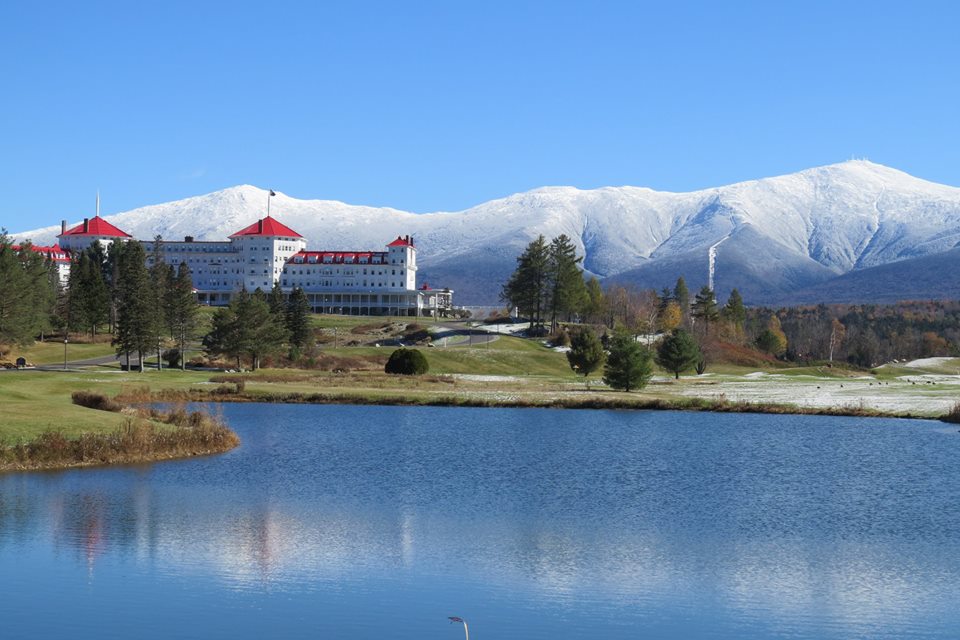
The White Mountains frame Bretton Woods resort with a first dusting in mid October. Credit: Bretton Woods
We’ve been watching reports of snow in high altitude places in the West and East which makes the coming of winter seem a bit rushed this year. There are still leaf-peepers on the roads of Vermont and New Hampshire, and snow on Halloween decorations doesn’t seem to ring true. For those of us in New England, the snow fall brings a reflexive response conditioned by last year’s Snowmaggedon. Yes, bring it on, but hopefully let it regress to the mean.
By now, you’ve probably heard that Killington opened on Oct 18 with a small army of zealots skiing on manufactured snow. (BTW, Killington was the last ski area in New England to close last spring. The last run of that elongated season was in late May.) Sunday River followed a day later with 750 season ticket holders playing hookey from work and school to record their first of presumably many days of snow sport to follow. Our friend and colleague, The Ski Diva, puts these early days of enthusiasm in perspective. See her astute advice on surviving what she calls the White Ribbon Of Death here.
And yet, according to NOAA, this year’s El Nino has become a stronger predictor this year. OpenSnow, our favorite snow forecaster, explains that despite the early showing, this year might be less snowy than we’d like.
Nevertheless, now is the time to:
- Start/continue your conditioning program,
- Bring your gear into your local shop for a tune-up,
- Consider a season pass while early bird specials are still available,
- Read the ski magazine reviews of new equipment and ponder your next possible purchase,
- Think about a destination resort where you can find senior-friendly specials,
- Re-convene your ski club and start getting excited about the season ahead,
- Check out deals and discounts at the Snow Shows coming to your city or town,
- Wash/dry clean last year’s contents of your stowed away ski bag.
Meanwhile, let’s remember winter is a special time for senior snow enthusiasts. In describing winter, Robert Frost says,
Ski Younger Now: Retraining Program At Vail
Ski Younger Now is a retraining program for older skiers, and skiers returning to the sport after recovering from an injury. Developed by veteran instructor, Seth Masia (Seth is on the SeniorsSkiing.com Advisory Board), Ski Younger Now teaches low-impact, low-torque techniques to enable efficient skiing in all kinds of terrain.
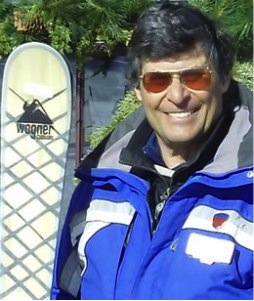
Veteran Instructor and SeniorsSkiing.com Advisory Board Member Seth Masia re-teaches seniors to ski at Vail.
The approach works for anyone recovering from an injury and for those getting back on hill after a long absence.
The program is available as a three-day workshop through the Vail Village Ski School (see dates/contact info below). Seth specializes in the 60+ crowd, including grandparents seeking the skills and confidence to ski with the kids. Seth helps them with those skills, including some they can pass on to the youngsters.
His clientele often face similar physical challenges: slowed reactions, weaker muscles, fragile joints. His goal—and theirs—is that retraining will give them another ten or twenty years on the hill.
He gets people skiing smoothly, using ski shape instead of muscle to start turns, guide skis and control speed. One area of focus is reducing torque on knees, hips and lower back. He does this by emphasizing edging as facilitated by shaped skis.
He starts his “retrainees” with the “patience turn.” It’s simply an exercise of flattening shaped skis on the snow, allowing the tip to find the fall line. The process requires a slight upper body motion in the correct direction. Some of us simply move our hands in the direction of the new pole plant. It works!
He teaches simple lateral motions that flatten and edge the ski and remove both steering torque and body unweighting from the act of skiing. It saves muscle energy and leads to a longer, more relaxed day. These skills and other useful exercises don’t produce heavy breathing, even at higher elevations.
The workshops are scheduled for December 15-17, 2015; January 12-14, 2016; February 16-18; and March 8-10.
To schedule or learn more, email sethmasia@gmail.com or call Vail Village Private Lesson Desk (800) 475-4543 and ask for Seth Masia.
Op-Ed: SAR In The Mountains
Debit or Credit?
If you head out on the Atlantic Ocean in a canoe and run into trouble, the U.S. Coast Guard (USCG) will send a 110 foot cutter to rescue you. End of story.
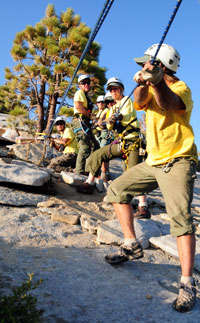
A SAR team practices at Yosemite.
Credit: US Park Service
This is not always the case here on land. The U.S. Park Service also maintains Search and Rescue (SAR) teams in each of the National Parks that have large wilderness and mountainous tracts. It costs each park visitor one and a half cents to maintain the SAR teams. These government agencies are supported by our tax dollars, and it seems well worth what we pay. The USCG has other responsibilities and is considered part of our armed forces. With the largest defense budget in the world, expectations that they conduct SAR activities seem reasonable. But, there’s more to it than that. There is a tradition of rescue at sea that dates back 200+ years. It’s part of our nation’s History and our values.
A comparison of SAR at sea and SAR in the mountains seems apt. However, several states have passed legislation to charge rescued individuals. Colorado was one of the first to pass a “hiker responsibility” law. If you require a rescue and are subsequently deemed to have acted in an “irresponsible” manner, you must pay the cost of the rescue. New Hampshire, in July 2014, changed a law which had been on the books since 1999 to lower the threshold for when to bill hikers for rescues. Under the original law, hikers had to engage in “reckless” behavior; now they need only be “negligent.”
Cost is a key consideration. Many of you senior snow enthusiasts out there have observed the ski patrol rescue injured skiers. Many of these are paid professionals but many also are volunteers.
The Knoxville Tennessee News Sentinel reported, “In Great Smokey Mountain National Park, total search-and-rescue costs for 2012 reached $253,550 with 104 incidents, two involving fatalities.” Hikers and climbers in European countries can purchase rescue insurance.
The results of these laws have seen two teenagers billed for $30,000 dollars for a rescue in New Hampshire’s White Mountains. In Arizona, a lost trail runner hid from SAR teams to avoid being billed.
I disagree with these laws and would like to see SAR in our woods and mountains take a more courageous stance like the USCG’s. There is a strong tradition of helping those in need and the nobility of such attitudes enriches us all.
New Hampshire’s Hike Safe program exempts holders from repaying SAR costs, except where reckless or negligent.
Another answer is education. “Hike Safe” programs like New Hampshire’s are great safety tools. A hiker can apply for a hike safe card which validates they have been through proper training. This card, however does NOT protect them from being billed for a needed rescue.
The goal is to insure safety in our back country locations and not to “shame” individuals who may have taken a calculated risk and lost. Many mountain communities have selfless volunteers who participate in SAR. Let’s follow their lead and act on our values to care for those who need help. We can adopt the concepts and traditions of the Coat Guard to back country and mountain rescues. Get rid of “hiker responsibility laws”.
Editor Note: These comments reflect the views of veteran mountain and hiking expert Steve Hines and are not those of SeniorsSkiing.com. Steve is a wilderness guide, Wilderness First Responder and a volunteer trip leader for the Appalachian Mountain Club.
[authors_page role=contributor]