

Women-Only Snowshoes: Vive La Difference!
Special Thanks to Roger Lohr, Editor and Publisher of XCSkiResorts.com for allowing us to post this article which first appeared on that site.
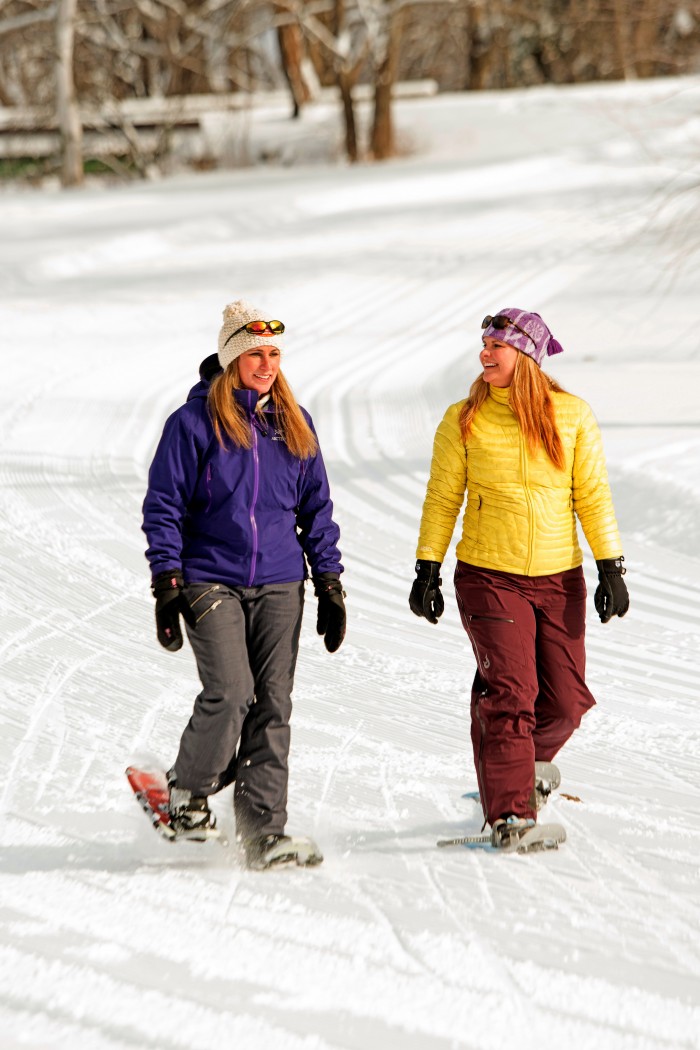
About half of all snowshoers are women, who snowshoe to experience nature, to exercise with friends and family, for backcountry access, and to have outdoor fun throughout the winter. The various snowshoe companies have been catering to this market by offering a broad selection of women’s-specific snowshoe technologies recreation and fitness, but do the women’s snowshoes go beyond just a change in cosmetics?

Woodstock Inn attracts women snowshoers who can step along in women-only gear.
Credit: Woodstock Inn
Tubbs Snowshoes pioneered the development of women’s-specific snowshoes by offering patented binding technologies that custom fit women’s boot sizes and by ergonomically engineering frames that are tapered at the tip and tail to accommodate women’s shorter strides. The result was lightweight, comfortable, high-performance snowshoes and many of the other brands have followed suit.
There are a few differences between Tubbs’ men’s and women’s snowshoes. On average, women have a narrower stance and shorter gait, so women’s snowshoes are narrower in width. Women’s average weight range is both more light weight and a smaller range than men’s, so they provide snowshoes in a shorter size for women, longer for men. The Tubbs men’s and women’s bindings differ, providing the optimal fit for the average women’s boot size and volume range, versus a larger average men’s boot size and volume range. Foot size also affects the optimal position for the heel lift, so the placement of the heel lift on men’s snowshoes varies from the placement on women’s snowshoes.
The Atlas Snowshoes Company conducted gait studies and biomechanics research to create snowshoes that enable women to hike and run with the most natural stride possible, while making the snowshoes both comfortable and lightweight. The research revealed that women have a greater Q-angle (at the knee where the thigh bone angles in from a woman’s wider hips) and abducted gait that create specific issues when snowshoeing. Women also tend to pronate (collapsing arches) pointing to the need for bindings to support the arch of the foot.

MSR snowshoes for women balance a naturally narrower gait and the need to “float” on the snow. Credit: MSR
According to the people at MSR, the studies conducted by Tubbs clearly showed male/female anatomical differences. However, when these differences are translated into physical products the design changes are not as noticeable. For example, women generally walk with a narrower gait than men. Therefore, a very narrow snowshoe would suit women better, but the snowshoe width has a direct impact on flotation so the final design can’t be too narrow. The ideal width snowshoe for women is a balance between very narrow to accommodate gait and wider for adequate flotation.
MSR believes that it is important to look beyond the measurements and understand how the snowshoes feel. Thousands of hours of field testing showed that subtle differences are noticeable. The major male/female differences with men’s and women’s versions of MSR are with decks and bindings. The women’s deck shape is optimized for snowshoe performance (traction & flotation) and a female gait. The bindings are sized to meet the proportions of a women’s footwear. There is also specific MSR technology such as Axis™ Gait Technology (Women’s Lightning Ascent Snowshoes), which allows women to compensate for varying degrees of toe-out or toe-in. This technology provides laterally adjusting the bindings independently of the frame, ensuring efficient, parallel-tracking snowshoes regardless of a women’s natural toe-out or toe-in stance. This means that the binding itself can swivel on the snowshoe to adjust for varying degrees of natural toe direction allowing binding alignment with your natural stance rather than forcing you to point your feet directly ahead.
Yukon Charlies Snowshoes has the YC Pro II Series women’s snowshoes, which are designed with features specific to the needs of the female snowshoe enthusiast. The rockered V shape tail enhances performance and allows for a more natural stride. These snowshoes are lighter, stronger and more reactive than any of the company’s other women’s snowshoes.
Yukon Charlies’s Advanced Series for women is a feature-packed “go anywhere” snowshoe is designed by women, for women. The rocker V tail allows for a natural stride from a walk to an aerobic sprint, while the integrated heel lift and the axle system makes Yukon Charlie tout them as their best women’s snowshoe ever.
Redfeather Snowshoes has three styles of Hike snowshoes with the SV2 pull handle binding. There’s also a choice to get the snowshoes in a kit with poles and a bag. The Redfeather Hike has sizes of 22, 25, 30 (inches) for women up to 150, 175, and 200 lbs.
Tubbs Snowshoes and Atlas Snowshoes have shown the greatest commitment to women’s snowshoe products and they are probably the largest snowshoeing product brands. Tubbs Snowshoes has 11 models for women (in seemingly every snowshoe category) including Flex ESC, Flex TRK, Flex ALP, Flex RDG, Flex Vrt, Wilderness, Mountaineer, Frontier, XPlore, and Xpedition.
Atlas Snowshoes has six options for women including the Electra 8 and 9, Endeavor, Fitness, Race, and Run.
Few of the snowshoe companies invest in marketing directly to women but the Tubbs Snowshoe event “Romp to Stomp Out Breast Cancer” Series, is very popular focused on women. This year’s event at Frisco Nordic Center in Colorado was attended by more than a thousand people! The series, which has been hosted at sites across North America has raised funds and awareness since 2003 bringing in more than $2.8 million for the fight for a cancer cure.
Whether the trail conditions are light fresh snow, crust, slush or ice, women want to trust their snowshoes for all-condition durability, excellent traction, flex for control, and comfort. Women are coming to expect that their snowshoes are specific to their needs and built to withstand frequent use offering many seasons of recreation, fitness and adventure.
My Fitness Journey Continues: Part Six
The Battle Of The Bulge Rages On! (Thankfully, Reserve Forces Are On Their Way.)
Getting back into shape is a combination of courage, knowledge and just doing it.
As I enter the sixth month of my personal (and public!) journey to fitness, I continue to make slow, steady progress toward my goal of being in great shape for the slopes come the first snowfall (and it IS supposed to snow in the Sierra this winter). Faithfully attending my four weekly exercise classes? Check. Doing weights three times a week? Check. Continuing to lose up to an inch in my measurements each month? Check. Drinking more water? Check. Getting more sleep? Check. Getting on the scale once a week? Check. Losing weight? Not so much. Since I started this journey, I’ve lost a total of 14 pounds, but I still have 26 pounds to go. So three pounds a month instead of two pounds a week is a bit disappointing. But the good news is that I haven’t gained anything back, and I have established a few good eating habits, such as snacking on edamame instead of salami and crackers. But I need to crank it up!
So it was quite fortuitous for me when a special issue of the highly respected University of California, Berkeley, Wellness Letter arrived in my mailbox a few weeks ago. The entire Special Fall Issue 2015 is devoted to body weight and all its attendant issues. It includes an overview article that looks at our nation’s battle with obesity, and sidebars on BMI (body mass index), why it’s so hard to keep the weight off that one’s lost, and a brief analysis of recent diet studies.

Watching what you eat is the key to weight loss. Ix-nay on the donuts.
But the article that really caught my eye was “18 Keys to Healthy Weight Loss: Tried-and-true advice that can help tip the scales in your favor.” I did a quick check and found that I was adhering to nine of them, which was encouraging, but I plan to add a few more to accelerate my weight loss. Some of the pointers are well-known, such as eating a healthy diet that’s tilted toward vegetables, fruits, whole grains, fish, and lean meats and away from sugary foods and saturated and trans fats, and being a conscious eater (eating smaller portions, eating more slowly, and keeping a food diary). But there were several less-intuitive but scientifically proven pieces of advice that I’m going to add to my arsenal of weapons to help me win my battle of the bulge. For instance, “Key #7: Go for volume (low-energy-dense foods)” recommends
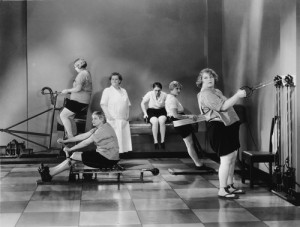
Exercise is only part of the picture. Diet plays the most important role in weight loss.
eating foods with lower calories relative to their weight and volume, in other words, foods that have high water and high fiber content such as fruits and vegetables and broth-based soups rather than low-moisture, denser, high-fat foods such as crackers, cheese, cookies, etc. Case in point: a cup of grapes is the equivalent of 1/4-cup of raisins. In short, think “watery” foods! “Key #10: Limit variety at meals” points out that “you’re likely to eat less if you have less variety, since foods similar in taste and texture dull the palate (a phenomenon called sensation-specific satiety).” It offers a good suggestion for buffets and parties, just in time for the upcoming holiday season: when facing a whole array of appetizers, choose just the two or three that most appeal to you and limit yourself to one trip to the table. It will keep your appetite from accelerating.
Accompanying the article are several useful sidebars that help you calculate your daily calorie count, outline which kind of diet will work best for you (surprisingly, genetics and individual proclivities play a major part in what will actually result in the best outcome for you), offer a critical look at diet supplements, and discuss the part exercise plays in losing weight.
To calculate your BMI, go to to this NIH site.
Editor Note: SeniorsSkiing.com salutes Correspondent Rose Marie Cleese for chronicling her journey back to fitness. She continues to be an inspiration to those of us who wonder about our conditioning as we age. Keep going, RMC. We’re all rooting for you!
Time To Get Moving: Now
Five Ways To Start Your Fitness Program.
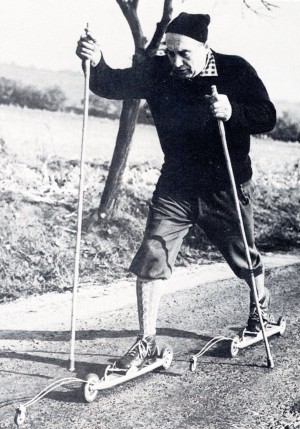
Motion helps muscles, joints, ligaments limber up for snow season.
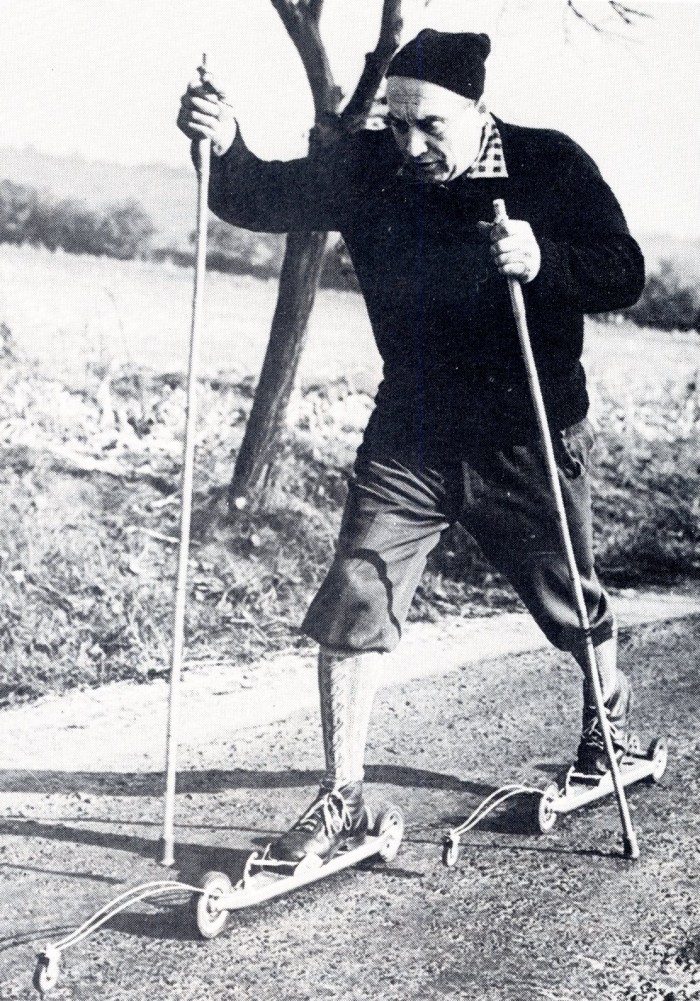
No more procastination. You have from six weeks to three months, depending on where you live, to get ready for snow season. If you are a year-round sports activist, then good on you. If you are a part-timer, weekend warrior, you probably have to start getting more diverse muscles toned up. If you are as not as active as you could be, reflect on your habits. You will be safer and feel better when you head out to slopes or trails if you are physically toned. It is a huge mistake to go from zero to a ski run or cross-country trail without being physically prepared, especially if you are one of those people who distinctly remember the Beatles on their first Ed Sullivan Show appearance.
Here are five ways to begin, especially if you’ve been off your program for whatever reason this summer.
1. Walk. Simple. Morning, lunchtime, or evening. Walk fast, swing your arms, work up a sweat, carry light weights (2 pounds) or walk with ski poles (Nordic walking burns more calories), use a pedometer, keep a record of how far and how many steps. After a week or so of daily walking, the “training effect” will kick in, and you will feel looser, more steady and, guess what, you’ll be outside in the beautiful Autumn weather. Here are some guidelines for getting started.
2. Stretch. Loss of elasticity of connective tissue, an effect of the aging process, can be nasty. Muscles tighten up, and back and joint problems ensue. Stretching makes a difference. Learn to stretch your hamstrings, quads, hip flexors, and lower back. There are many resources you can access for how-to. Here is a good starter from the NIH. There’s always yoga. This is really, really important: If you aren’t using it, you’re losing it.
3. Gym Class. Going to a class led by a trainer provides structure, discipline and challenge. An hour-long class will probably keep you in more motion than the same time spent alone in your basement. In a good gym class, you will also learn about the muscles you are exercising, how to stretch them and gradually build up strength and flexibility all over your body, not just your favorite parts. Probably most important, you will learn proper form so you get the most out of your efforts and help prevent injuries. SeniorsSkiing.com’s Harriet Wallis wrote about Silver Sneakers, a national program sponsored by insurance company targeting seniors. There’s probably one near you.
4. Focus on four essentials. No gym nearby? If you do head down to your basement or studio for exercises, here are four to get you going: Lunges for legs, lower back, hips, Plank for core and probably one of the two top exercises of all, Pushups for core, upper body and arms, and the other top exercise, and Squats, a fundamental leg and back strengthener. You must learn to do these correctly; form counts for everything. Doing a zillion reps without proper form is not that effective and could get you hurt.
5. Get an app or two. There are many apps you can get for your smartphone that can be your training buddy. This link has a few of many. Point is you will able to get feedback on how you are doing and see progress using a cool app. And in a strange way, the app builds an expectation. Just like the GPS voice in your car, you can have a relationship with your app.
As usual, see your doctor before trying any of this, or if you start a program, and it doesn’t feel good. Remember this is meant to be a starter kit. Stay tuned for more advanced fitness activities.
Now, don’t hesitate, get going. What’s your advice?
[authors_page role=contributor]