

Product Update: ThinOptics Now has Bold Colors, New Magnification
You’ll Always Have These Readers With You.
Finally, you can read your cell phone, trail maps and restaurant menus with ease because you can always have these very cool reading glasses with you. And the case snaps onto your Smartphone for ready access. Now isn’t that novel!
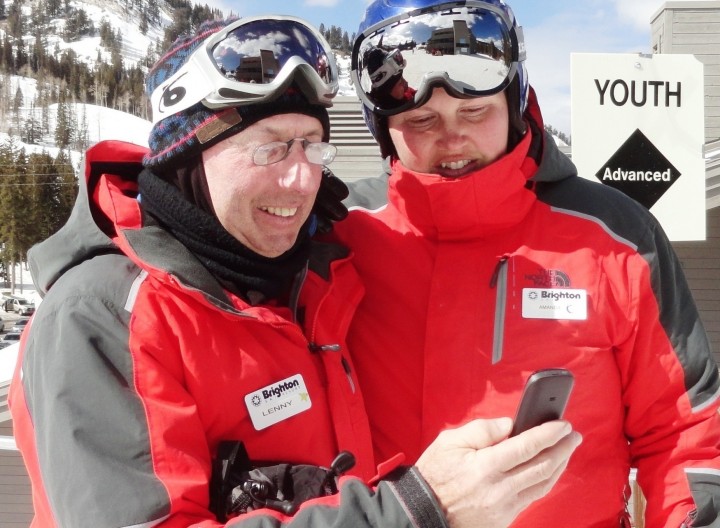
Brighton Resort ski instructors Lenny Bernstein and Amanda Cimini check the phone. Lenny is wearing ThinOptics.
Credit: Harriet Wallis
ThinOptics readers solve the problem that has plagued seniors since Smartphones were invented. The phones are smart, but the info is too small to read. ThinOptics to the rescue. These tiny glasses perch comfortably on your nose then store away on your cell phone. No more fumbling for bulky reading glasses or passing glasses around.
After millions of dollars of research, these virtually indestructible readers were introduced last year, and they rocketed to popularity with seniors. Now they come in vivid frame colors as well as traditional black and clear. In addition. a new magnification level has been added.

There’s Snow In Them Thar (California) Hills
Although Snow Conditions Have Been Less Than Golden This Season,
There IS Some Great Skiing To Be Had In California’s Northern Sierra Nevada.
Northstar California has been operating full blast since Thanksgiving.
Credit: Northstar California
While much of the U.S. has gotten battered all winter long by massive dumps of snow and other inclement weather, California’s Sierra Nevada has been having a tough time living up to its name (“snowy mountain range” in Spanish). But, a crazily configured jet stream and a persistent giant high off the West Coast notwithstanding, most of the mountain resorts of drought-stricken California have been able to carve out a decent wintersports season.
As of March 8th, most Northern California resorts, particularly those in the Lake Tahoe region and at the higher elevations, have more than half of their lifts running and terrain open to skiers and boarders, thanks to a storm during the first weekend of March that dumped as much as 28 inches of snow on the slopes and to colder temperatures that have allowed for accelerated snowmaking.
Squaw Valley, with a base of 22″ to 52″, has all but five of its 29 lifts going, and its neighbor area, Alpine Meadows, has nine of its 13 lifts operating on a base of 19″ to 47″. Heavenly Mountain Resort, which boasts “the West Coast’s largest snowmaking” operation, is running 19 of its 28 lifts with an average snow depth

Heavenly Mountain Resort has been making snow, producing outstanding conditions.
Credit: Heavenly Mountain Resort
of 39″. Says Heavenly p.r. coordinator Liesl Kenney, “Everybody is surprised at how good conditions are when they get up here.” Convincing skiers and boarders of this is probably one of the biggest challenges facing many resorts, seeing as how the San Francisco Bay Area has been experiencing perennially sunny skies and basking in 70° temperatures week after week this winter!
Northstar California is “thriving” this season, according to senior communications manager Rachael Woods. “Every chair is served by our snowmaking system, which can be controlled by a smart phone!” The resort has been operating top to bottom since opening shortly after Thanksgiving and hopes to do so until its planned April 19th closing date. The resort currently has an 18″ to 49″ base with 18 of its 20 lifts operating. The higher-elevation resorts, Sugar Bowl (base: 6,883 feet) near Donner Summit, Sierra-at-Tahoe (6,640 feet) near Echo Summit, Kirkwood (7,800 feet) near Carson Pass, and Bear Valley (6,600 feet) near Ebbetts Pass, can all crow about their healthy snowpacks that stack up to as much as 72” (Sugar Bowl).
The two resorts located northeast of Lake Tahoe in Nevada can’t complain this season either. Mt. Rose, with the Tahoe region’s highest base elevation at 8,260 feet, has all 60 trails and all eight of its lifts going, with snow depths of 32″ to 66″. Diamond Peak, at 6,700 feet, has two to three feet of snow with five of its seven lifts in operation. And SoCal favorite Mammoth Mountain off US-395 in Central California has 19 of its 28 lifts running, a base of 30″ to 60″, and a planned closing date of May 31st. Its fellow Central California resorts, alas, have not fared as well. China Peak, Badger Pass in Yosemite, and Dodge Ridge are all currently closed due to a lack of snow cover. Up near Tahoe, Donner Ski Ranch, Tahoe Donner, and Homewood are also temporarily closed—permanently for the season if that high ridge doesn’t budge!
With most currently open Sierra resorts planning to close the third or fourth weekend in April, West Coast skiers 65 years of age and older still have at least six weeks to enjoy some quality spring skiing or boarding and to catch some senior savings. Most resorts offer discounted lift tickets (65+) and you can even ski for free if you’re 75+ (Bear Valley) or 80+ (Diamond Peak). Several resorts offer clinics for 55+ skiers early on, but that’s a story for next season. May it be ever so snowy! Like Boston-snowy!

Serious Stuff: There Is No Such Thing As “Side Country”
And There Is No Such Thing As Being A Little Bit Dead.
Back country warnings are there for a reason.
Credit: Harriet Wallis
Yesterday we rode the chairlift with a bozo. Okay. Maybe he wasn’t a bozo. Maybe he was just clueless. All the way up he yapped about his skiing prowess. And near the top he phoned home to give his wife his location. “She worries about me,” he said.
She should worry. He planned to duck under the boundary rope and make some turns in the deep, unspoiled powder beyond.
“Take your avy gear,” we said.
“Don’t need it. It’s in the car. I’m just doing side country,” he said.
Somehow he missed hearing that there is no such thing as side country.
The term “side country” hit the scene a few years ago, and it was quickly squelched by the ski industry’s leading avalanche experts, snow science experts, the U.S. Forest Service, ski area risk managers, mountain patrollers and others. It was likely a marketing brainchild used to promote the newest boots and powder-specific skis and boards.
The term had obvious appeal to intermediate and advanced skiers and riders. They could buy the latest gear and try their skills beyond the rope line thinking it would be okay. They could be a little bit naughty.
But the ski industry took a stance saying you’re either within a resort or else you’re in the unmonitored, ruthless back country. You’re either in bounds or you’re out of bounds. There’s nothing in between. There is no such thing as side country. There is no such thing as “kinda” out of bounds.
“We all must focus on educating skiers and snowboarders that backcountry terrain accessed from a ski lift has the same risks as any other back country or out-of-bounds area,” says the National Ski Area Association.
Later in the day I caught the TV news. A skier died after being caught in an avalanche. The avalanche occurred in the very out of bounds area where a guy— with too much macho and too little knowledge—went to ski. There’s no such thing as side country.
There’s no such thing as being a little bit dead.
[authors_page role=contributor]