

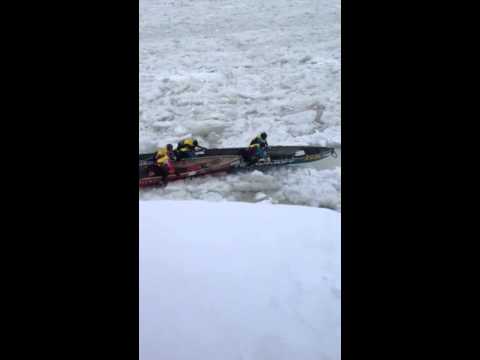
Quebec Winter Carnival: Canoe Racing On The Frozen St. Lawrence
A New Extreme Sport Emerges For Those Who Really Love The Cold
Hearty, are we? Well, these lads surely are. These garcons are one of a dozen or so teams, some of them professionals, who are canoe racing on the St. Lawrence during Quebec’s Winter Carnival. The amateurs included a women’s team, mixed men and women teams and a few folks who just wanted to have some fun. You might wonder why this is a good idea for a sport. Don’t bother. It’s about The Extreme. And learning to love the magnificent cold. This was taken on Feb 8, 2015 when the temps were -20 C and the wind was blowing at least 25 knots. What’s the wind chill? Anyone? Anyone?
Quebec’s Winter Carnavale was the site of the North American Snowsports Journalist Association Annual Meeting. More to come on Ice Hotels, ski trains and memorable “versants” (ski areas) just outside Quebec.
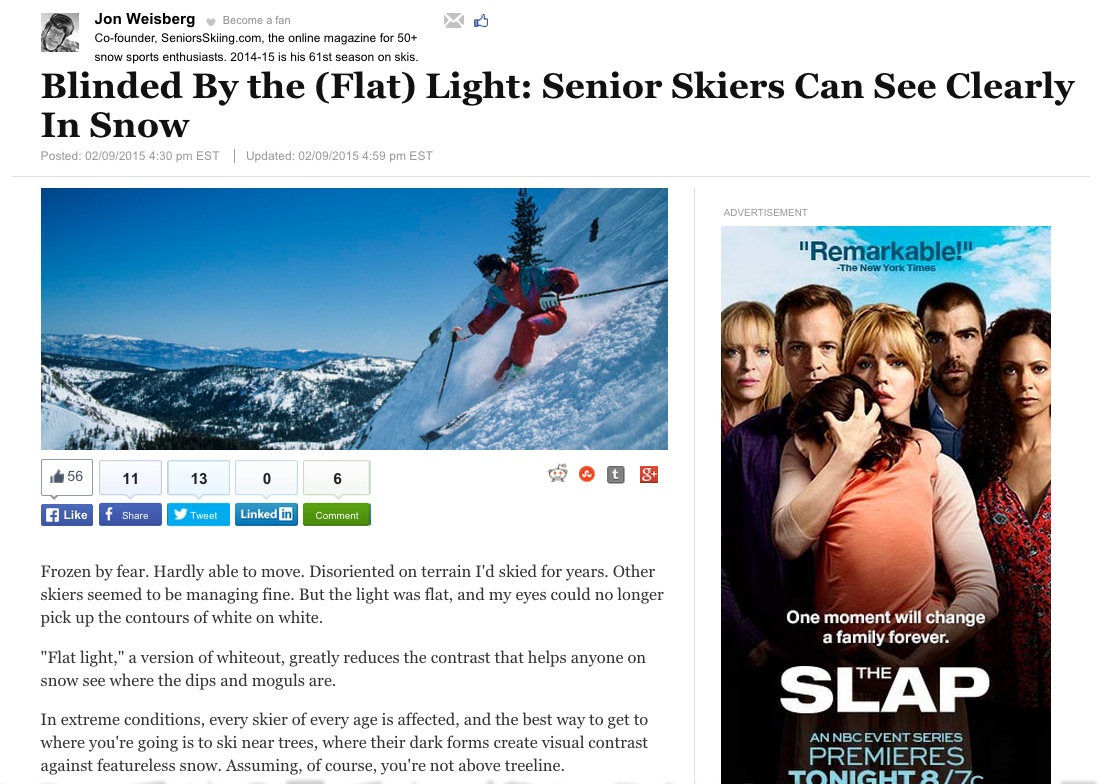
Huff Post: Skiing With Senior Eyes
Huffington Post Features SeniorsSkiing.com’s co-founder Jon Weisberg On Light, Goggles and Lenses
We’ve all been there. Flat light conditions, slow down, stop. Take your goggles off and put them on. Peer down the slope. Proceed slowly, cautiously down, perhaps calling it a day. In his latest Huff Post Post-50 article, SeniorsSkiing.com’s co-founder Jon Weisberg explores the impact of aging eyes on seeing and skiing.


Managing Fear, Building Confidence
Ski Instructor: “Encouragement Is The First Lesson For Returning Skiers”
It makes no difference whether a skier has just recovered from joint replacement, traumatic accident, ski injury or is returning to skiing from a long hiatus. There is going to be some level of anxiety.
Walt Lattrell, ski instructor at Smugglers Notch (VT), teaches a clinic on managing fear for other instructors. “We see people coming back to skiing who are harboring apprehension, negative thoughts and low expectations for performance. The good news is that they take a class from a professional instructor. That’s an indicator they want and need help.”
Thinkin’ about it. Revelstoke, BC, cornice has some folks wondering.
Credit: Walter Latterell
The goal of ski instructors is to help their students to acknowledge their fears. “Our first challenge is to help returning students believe they are capable of higher performance. Self-limiting beliefs lead to self-defeating behavior. The instructor has to inspire their students, provide a vision of success and lots and lots of positive reinforcement,” says Lattrell.
Lattrell tells students not to expect perfection, to pay attention to their thoughts, and to visualize success. He provides clear goals for each lesson, and explains how the student is going to get there through a series of small steps.
There are some stages that Mermer Blakeslee, in her book ,“In The Yike! Zone” sees some students going through as they gain confidence. It seems it is key for the instructor to positively reinforce the student at each step:
- At first, the student doesn’t want to try. Small attempts are guided and reinforced by the instructor.
- Then, the student will try a skill, but only on “safe” terrain. Success will bring the student confidence to try again at a higher level.
- Next, the student will try a more ambitious skill, but bails out. Now, the instructor demonstrates, guides, and encourages again.
- Finally the student tries again and follows through with sense of relief, joy and accomplishment. The instructor points out what the student did right and acknowledges the progress.
“The goal of any lesson needs to be a progression from simple skills to more challenging ones. Each step is built upon with growing confidence,” says Lattrell, a PSIA Level 2 instructor.
As we have learned from Harriet Wallis’ series on Knee Rehabilitation, some returning skiers need a run or two by themselves to adjust to the slopes after illness, injury or rehab. Others could benefit from a supportive lesson or two. Lattrell, himself, had bilateral knee replacements.
To paraphrase the great Yankee Hall of Famer Yogi Berra: “Half this game is 90 percent mental.”
[authors_page role=contributor]