


First Female Snowboarders Being Inducted to Us Ski and Snowboard Hall of Fame
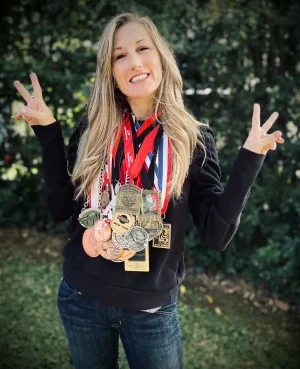
Tina Basich
This year marks the first-ever induction of female snowboarder athletes to the US Ski and Snowboard Hall of Fame. The honors go to to Shannon Dunn-Downing and Tina Basich, both icons and pioneers of women’s snowboarding.
The induction is at the annual awards event at Big Sky in April. Both SeniorsSkiing Publisher Richard Lambert and Editor Evelyn Kanter are attending.
Few athletes have had as much impact in paving the way for women in Snowboarding as Tina Basich and Shannon Dunn.
Both experienced the challenges of being women competitors early in the sport, competing together from 1991-1996 on the World Cup Tour.
Sponsor support and contest prize money was nominal, and the norm of the day was that girls were equipped with men’s clothing and boards. Getting any magazine coverage was equally challenging. Together, these two women made it their goal to be the agents of change for women in the sport.
Both were chosen by their respective board companies to launch a Pro Model board, launched in 1994. At the time, the women’s snowboarding market was unproven, and few companies would take the risk to support it.
Shannon’s model, the ‘S.Dunn 150’, with its Sunflower graphics, had a huge appeal to the market and was launched by Sims Snowboards, and by no coincidence, had a female Marketing Director behind it. The ‘S.Dunn 150’ was the most successful selling women’s Pro Model of its time, reaching numbers equivalent to the Sims men’s Pro Model, the ‘Shaun Palmer’.

Shannon-Dunn
Gaylene Nagel, Sims Marketing Director at the time says, “It was so exciting to see the sales numbers come in so far above our expectations! But even more rewarding was to give Shannon a check that rivaled what the top pro men were making.” This was a landmark event as the women’s place in Snowboarding had been established.
Tina’s first Pro Model was launched by Kemper Snowboards, also in 1994. The following year, Tina moved to Sims, where she had two Pro Model designs and her boards were equally well received.
With the success of their Pro Model boards, Tina and Shannon joined the ranks of the top earners in the sport. Their worldwide visibility expanded their sponsorship opportunities, as well as their influence, opening the door for future pro women snowboarders.
Shannon and Tina took the opportunity of having these successful women’s boards under their feet as a springboard to actively push even more boundaries – which absolutely existed in the early days of the sport – like magazine and film coverage, contests, and clothing!
Tina and Shannon became iconic ambassadors for female Snowboarders, promoting and welcoming women through interviews, personal appearances and by working with all of their sponsors to design new products for women.
They joined creative forces with snowboard clothing company Swag, to start a women’s line of outerwear and street wear, calling it Prom. Sales/Marketing Director Lisa Hudson recalls, “The girls weren’t afraid to make a statement – from wearing pink to posing in the first Prom ads in prom dresses! They certainly got everyone’s attention – making the Prom launch a huge success and establishing women’s outerwear as a viable category.”
On the competition front, Tina and Shannon together challenged the organizers at an International Air + Style event that would not allow women to compete in the Big Air, citing it was too dangerous for girls. Risk aside, they seized the opportunity to make a change for the future.
After doing a practice run with the boys, they convinced the organizers to allow them to compete. They both stuck their landings at the big event, for a cheering crowd and a stunned announcer. History was made that day for women in Big Air events. They raised the bar on the perception of what women could do – paving the way for future aspiring athletes like Jamie Anderson and Chloe Kim.
The board launches of 1994 were only the beginning for these two champions.
Shannon Dunn went on to win Olympic Bronze in Women’s Halfpipe in Nagano Japan (1998). Tina Basich was the first woman to land a 720 in competition, winning X Games Gold in 1998. Both of these events were internationally televised, further solidifying a place for women in competitive snowboarding for future generations.
Today the legacy continues.
Tina Basich recently launched a Pro Model with Capita Snowboards in 2021, for which she designed all of the graphics And now, almost 30 years later, they are celebrating being inducted into the US Ski and Snowboard Hall of Fame together, and being the first female Snowboarder athletes to do so.
Shannon Dunn recalls, “What a gift it has been to have a friend like Tina to share the journey through this male dominated sport– I feel like we were able to achieve much more by working together. Instead of being competitive with one another, we complimented each other, wanting the other to succeed. It was always, “Let’s do this!”
Congratulations to these two trend-setting athletes.

How Alta Has Changed in the Past Fifty Years. Or Not.

Connie Marshall
I am often asked how Alta has changed in the past 40 or 50 years. This question always excites me, as my career began at Alta in 1974, so my personal journey weaves into the larger tapestry of the Alta story. That includes several decades as the resort’s public relations manager, working with the media.
In a November 1970 article for Holiday Magazine, David Thomas wrote, “Alta is for skiing. A little-known resort in Utah has the simple claim to fame…. probably the world’s best skiing. Alta’s popularity has been limited by its relatively restricted accommodations and the relative absence of the sort of frantic ski life that draws winter vacationers to the Alps and some of the more social western resorts.”
What would a journalist muse about today? From my perspective, she would begin by penning, “Alta is for skiing. A well-known resort in Utah has this simple claim to fame…. the world’s best skiing. Alta’s popularity has grown as skiers have come to seek out and cherish authentic experiences both on and off the slopes.”
Skiers from the 1970’s returning today would feel immediately as though not much has changed. The lift system, while modernized – including the brand new Sunnyside lift on the Albion side – still respects the desire for every skier to find his own way around the mountain. Many of the buildings on and off the mountain surely are recognizable, albeit most have been remodeled to satisfy the changing needs of skiers and their families.
While Alta has embraced evolving lift technology, best practices in snow and avalanche management, progressive ski school philosophies for all skiers, convenient RFID lift access and management of the ski experience in a world that is ever growing in population that has led to required parking reservations on Fridays, Saturdays, Sundays and holidays, the vistas and uncomplicated layout of the mountain remain steadfast.
 #Altamagic has evolved as a popular hashtag for all things in the social media world.
Those who stay on-mountain cherish their experiences in lodges that harken back to the culture of the elegant simplicity of the early romance of skiing. Most lodging has been independently owned and operated by the same linage of family members since they were built, creating a sense of family the moment one walks in the door.
Many lodges have a guest return rate of 70% percent who return year after year, with emerging generations of family and friends to spend time with other guests who they have grown over time to know. Few resorts or individual hotels or lodges can match that, anywhere in the world.
From my perspective, after a 44- year career with Alta Ski Area, I would like to speak about the community of employees and the skiers, both local and all who come from places all over the world. While this menagerie of humans has changed over the years, the same pull that brought all of us together to experience the insatiable thirst for the magic that befalls us and for the spirit of the mountain itself has not changed.
Not one bit.
Editor’s Note –
A visit to a cousin who had grown up in Alta led to a job as a ticket seller, with Connie advancing quickly to sales manager, then to decades as the resort’s first Marketing and Public Relations manager. Along the way, she married, raised three children, and inspired and mentored scores of people – especially women – to influential careers in the world of winter sports. Connie also was a pioneer in forging bridges between the sometimes-contentious relationship between some resort managements and their local communities, and is widely respected throughout the ski industry.
Before her recent retirement, Connie received the Lifetime Achievement Award from the North American Snowsports Association (NASJA), nominated by SeniorsSkiing editor Evelyn Kanter. Connie continues to live close to Alta, volunteers for local and regional community groups, and still skis often at Alta.

The Connection between Diet and Longevity Skiing/Riding

Photo by amoon ra on Unsplash
Congratulations, your passion for skiing/riding has rewarded you. If you are reading this, you are a quinquagenarian, sexagenarian, septuagenarian, octogenarian, nonagenarian, or even a centenarian. That’s a lot of “-genarians”, and a question we all face is how long we want to or intend to ski or ride.
A few seasons ago, I met a 91-year-old man who skis 120-130 days per season. He told me the Grim Reaper will need better skis than his to find and catch him. The comment attests to his positive attitude and upbeat personality, both important to longevity, on the slopes and off.
If you distill the research on longevity, three factors stand out – genetics, attitude and lifestyle. You are your genetics, so reading this checkmarks attitude. That leaves lifestyle, diet and exercise.
More and more longevity research shows that social connections with family, friends and a community such as the community of skiers/riders, are among the most significant indicators of longevity. We navigate the hill as individuals, however, choosing to do so with family, friends, and other skiers makes us an integral part of the mountain community.
Your doctor probably has told you the same thing as mine, that “your running days are over, so swim or walk.” We all know aerobic capacity is essential for skiing, and recent research has shown that muscle mass and strength are much more a factor in longevity than previously.
So go take a walk or for a swim or to the gym. Not crazy about the gym? Use your ski boot to exercise at home or in your hotel room or condo. Raise a ski boot from the floor to over your head, first with one arm, then with the other; use both boots for a two-arm press, together or one at a time; hold the boot in front of you and do squats.
Diet is perhaps the most confounding factor in longevity. Unfortunately, government dietary guidance over the last fifty years has been confusing, misleading, and in some cases flat-out wrong. We lived through the low-fat years eating unsatisfying baked cardboard. Now we know that fats are dietary essentials, but the right kind of fats – the unsaturated ones found in fruits, vegetables and nuts.
Many of us switched to diet drinks and “diet” foods in the belief that artificial sweeteners contribute zero calories, which is mostly true. Consequently, we think we can eat more low-cal whatever because each one contributes fewer calories; we end up consuming even more total calories. As that old advertising slogan goes – “Bet you can’t eat just one ….”
Now we know that artificial sweeteners stimulate appetite and promote weight gain. We also now know that they make us crave sweeter food by overstimulating our sweet taste receptors. Plus, they affect our gut biome, which can trigger even more serious health consequences.
What should a longevity skier do about diet? It’s easy to be overwhelmed by all of the diet recommendations and their justification. But most research, and your physician, still point to the benefits of the Mediterranean diet – fresh, minimally processed, seasonal, local vegetables and fruits; meats and fish in moderation; olive oil as the primary fat; and most importantly, wine in moderation.
Your guidepost is easy – don’t eat anything your great-grandmother would not recognize as food. Sadly, the industrial agriculture-based food supply and distribution system makes it hard to do that, to eat for longevity.
So here’s your test – how much time do you spend in the center aisles of the grocery store? The center aisles are where you find industrially-processed foods, so-called Frankenfoods, that do not contribute to longevity. The fresh foods you seek are on the peripheries. Also, grocery store shelves are stacked with the most appealing packages at eye level, so bend down or reach up for the better choices.
Walking around the outside of the supermarket, and reaching up and bending down is good exercise, too.
[authors_page role=contributor]