

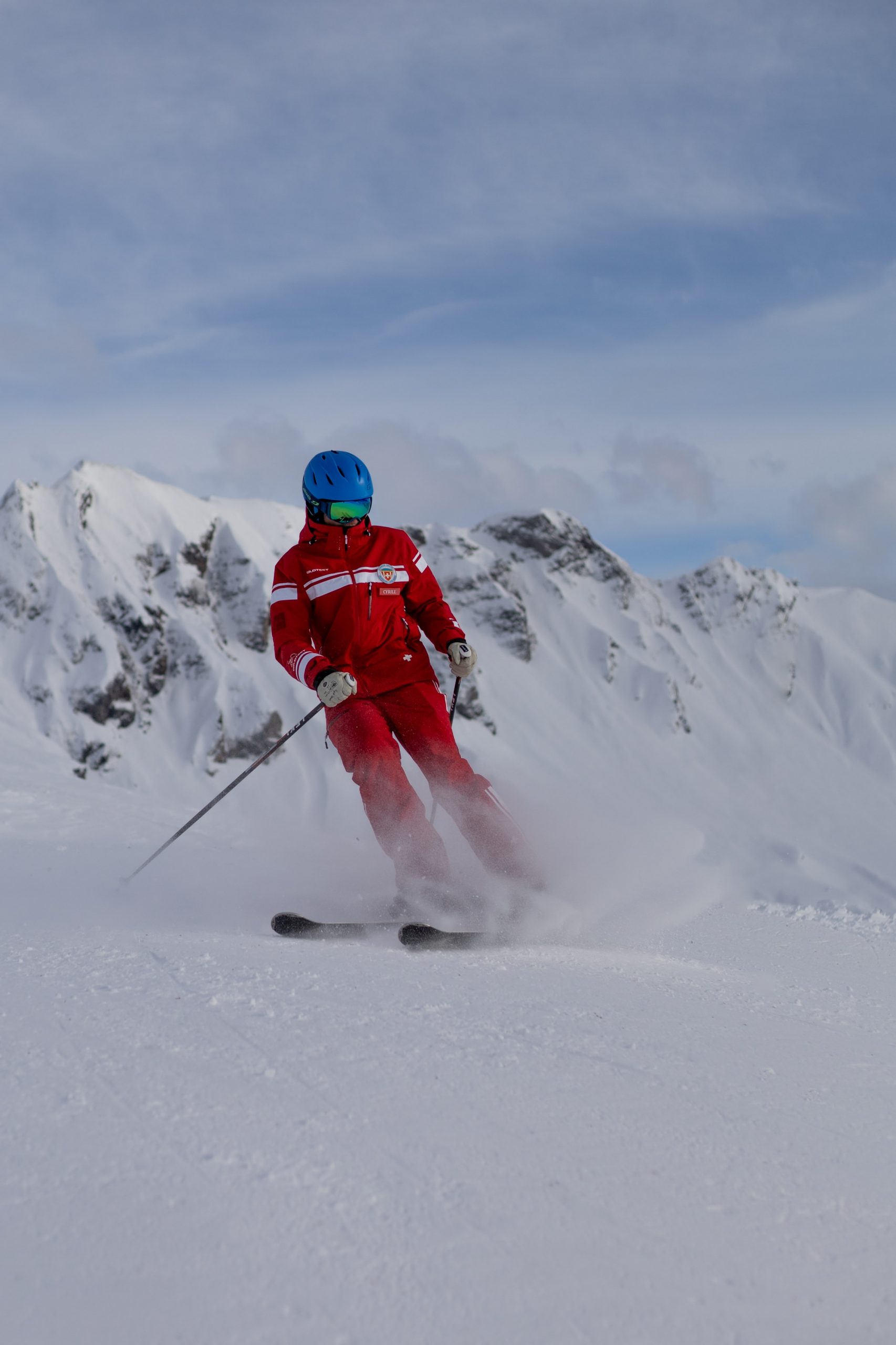
How to “Knowtice” and Improve Your Skiing

Photo by Kajetan Sumila on Unsplash
Here’s a new word for you – “Knowtice”. It describes the mental process combining knowledge with noticing. Learning to do this is essential to developing skill, including skiing skills.
No system can purposefully change without accurate, prompt, feedback. If feedback is delayed, inaccurate or simply not noticed, any change will be random, and probably short lived – perhaps thankfully!
I have mentioned elsewhere of my own miserable experiences trying to become a better skier by spending three nights a week for years at a dismal artificial slope ski school in the West Midlands of the UK, and managing only to make slow progress. I came to believe that the fault must lie with me rather than with the instructors I worked with.
Since I took up skiing around middle age, I became convinced that I must simply not be sufficiently athletic, or fit, or whatever it took to be a good skier. The fault obviously lay with the teachers, not with me.
Then one year, in the Alps, again with not much expectation of improvement, in just one week I made huge transformations in my skiing. Just seven weeks later I went again with the same teacher, and again made terrific leaps forward. Indeed, immediately after this experience I started on my own journey through the instructor training program and on to coach and to be an instructor trainer. That’s how much impact one teacher can have.
So what made the difference?
It was the rare ability of an exceptional communicator and coach. But just what was it he did that was the essence of the difference? He put effort into making the whole thing simple not mysteriously arcane. He didn’t demonstrate or show-off; he explained that only I could effect the changes, but he took responsibility for helping me.
What made the difference was noticing.
He constantly and repeatedly encouraged us to “be aware” – of our toes, or perhaps our shins, or our legs, or our hands. For a long time I did not internalize the simple power of this. Only gradually did I begin to perceive that in all the practice before meeting him, the key element which none of my instructors had ever brought into the mix, was “to have a clearly defined intention, and to notice what I was getting”.
Instructors had always told me to watch them and copy. When I was unable to emulate their own performance, they mostly got frustrated, or jeered, or urged me to try harder. But it was pretty hopeless, and the reason was that I was never helped to develop an ability to notice what I was getting as a result of what I was doing, and why.
Without that ability my development was all but completely stifled, and yours will be too. In my case the pain lasted eight years until I met this life-changing coach. The lack of the desired outcome was painfully obvious, but there was no connection in my mind between intention and outcome. Something was missing, and it wasn’t my mind. Does this in any way echo your own experiences?
So, what is “knowticing” and how is it done?
To develop skill there is no better process than the “Intention-Attention Feedback Loop”. It was developed by John Shedden and others and is now applied to almost all top level sports.
“Knowticing” is the ability to become aware of one highly specific physical manifestation, through the medium of one selected sensory channel. Sounds fancy, but it’s simple. For example, first you and your coach agree on one simple action you will do, such as just flexing your ankle a bit more. Then – and this is key – to become aware as you ski, of where there is pressure under your foot, or maybe your shin. It’s simple and it’s powerful.
You first decide jointly that “pressure under your foot”, or against your shin is the manifestation you will select, and the sense of touch, is how you will appreciate it. It is crucial to its successful application that only one manifestation is to be noticed, and that only one sensory channel is used to “knowtice” it with.
Deciding what you’ll do is your intention, and the “know” bit of my new word gives you your attentional focus, and understanding. The “knowtice” bit comes from having made a conscious decision to employ one sensory channel – feeling, or seeing, or hearing, or one of your other senses.
The “know” part is founded on an understanding of how skis work, and is expressed in the form of simple physical tasks or goals, such as the example above.
If you employ this simple powerful model at least some of the time when you are skiing, you will begin to make significant changes to the way you ski, and also to your understanding of skiing, especially your own skiing.
The Skiing Weatherman November 25, 2022
By the time you read this you may have already made your first turns in the new season. Mother Nature has been generous with cold and natural snow from coast to coast, with the West favored in late October and early November and then the Midwest and East over the past couple of weeks. The East is where I am going to focus my reports this season. It makes sense because I have skied at most every resort east of the Appalachians over the years and the vast majority of my forecast clients are in that same area.
It might surprise you to know that the FIRST resort to open in the East this year was Sugar Mountain, NC. When early season cold is short supply, elevation matters, and Sugar’s base is right around 4,000 feet. Since they started turning lifts mid-month, several dozen resorts have joined in the fun, and many of them are already sporting double digit trail counts with multiple top to bottom routes open. Everything is set up for one of the busiest Thanksgiving weekends in many years, but there is just one problem…the weather.
The early season cold outbreak from Canada has just about run its course, and for the next ten days or so…through roughly 12/6…any cold air masses that move through the East will be transient, and generally confined to the resorts of NY and New England. As Black Friday gets underway, a weakening low pressure system and cool front are moving across the spine of the Appalachians and the passage of that system will lead to a round of light rain. Saturday will be the best day of the weekend to get out on the slopes, but another low will cut up through the eastern Great Lakes and then cross central New England Sunday and Sunday night. There won’t be cold air around to support snow, so Sunday looks wet…not the greatest news for Day 2 of the Women’s World Cup at Killington.
Temperatures will be quite variable over the next ten days as relatively weak disturbances track into the Lakes and then run along the U.S. Canadian border…an unfavorable track for snow and cold except for northern Ontario and northern Quebec. Snowmaking windows will be small, but there will be several along the way. The pattern will change at the end of the first week of December, though. Why? Well, first there is the EPO, or Eastern Pacific Oscillation. The EPO is an index based on the relative positions of upper level ridges and troughs over the northern Pacific Ocean. When it is negative, we find a ridge over Alaska and British Columbia and a trough downstream over central North America. The clockwise flow around the ridge directs very cold air from the high latitudes southeastward into the counter-clockwise circulation around the trough, leading to an intrusion of very cold air into the lower 48. Even if the main thrust of the cold is into the center of the country, it will spread out and reach the east coast. Here is the forecast for the EPO over the next two weeks…
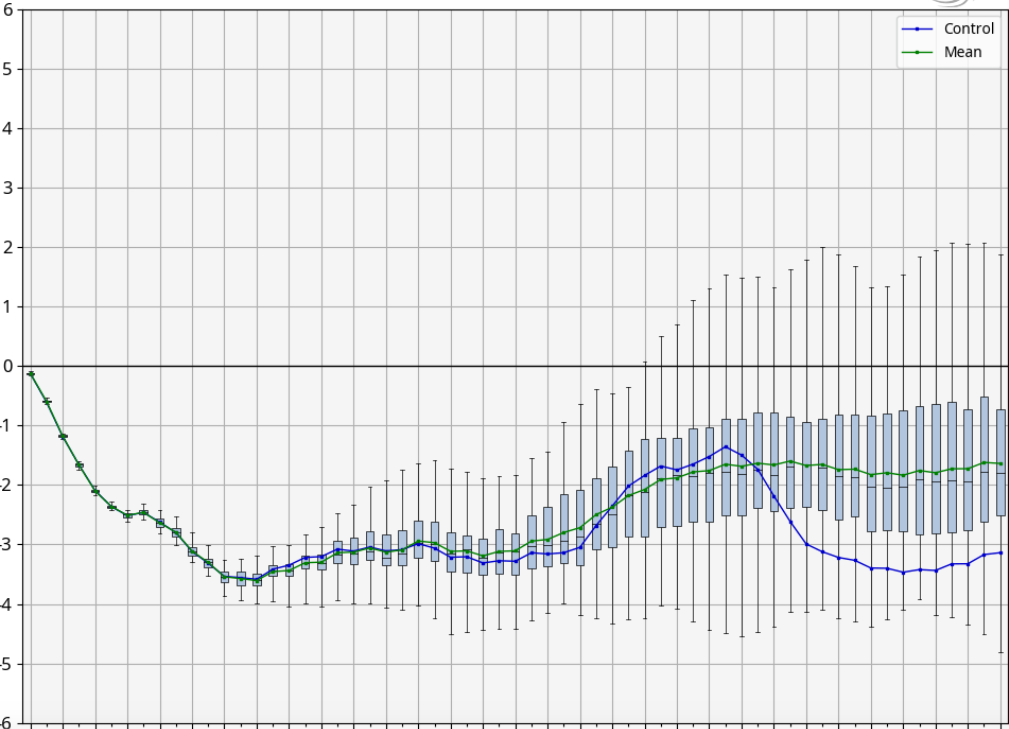
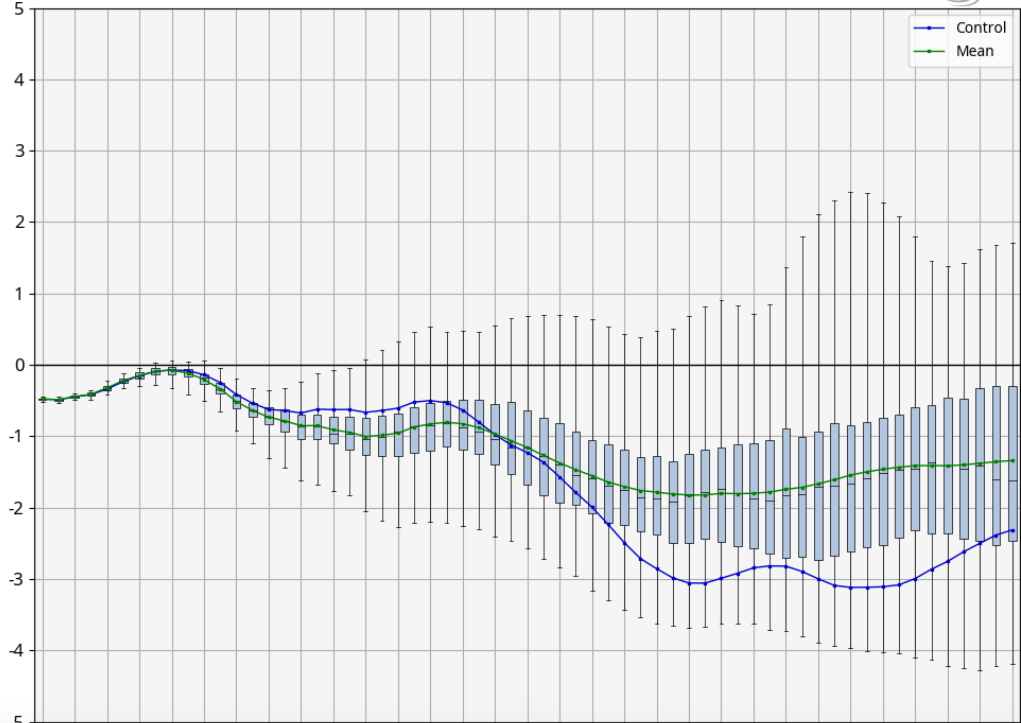
The correlation between a negative EPO and cold in the East is a strong one and you can see that the EPO is consistently negative, suggesting a change in the temperature regime. Supporting that idea is the outlook for the NAO, another ingredient of the “alphabet soup” of indices that I use to sort out winter pattern changes. The North Atlantic Oscillation is built on the pressure differential between Greenland and the Azores. When pressures are high over Greenland, the jet stream pattern gets blocked up, often with an upper trough setting up shop over the Northeast, where it can draw cold air south from Canada. Here is the two-week forecast for the NAO…
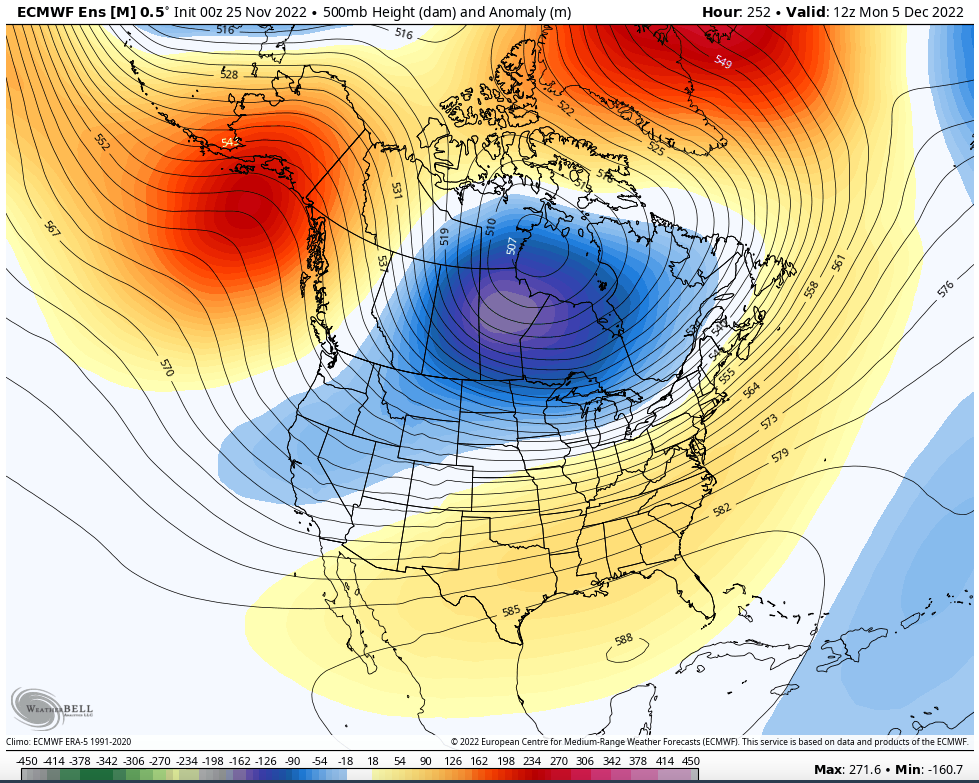
If we take a quick look at the jet stream setup anticipated for 10 days from now, you can see that the pieces are in place for a return to colder weather…the ridges over Alaska and Greenland, with a trough over central Canada poised to deliver a fresh cold air mass to the eastern U.S. as it tracks southeastward.
The season is off to a fast start, but trail count expansion will pause before picking up the pace again about ten days from now.
How Okemo saved Thanksgiving

photo credit: Harriet Wallis
“Quick. Look over there. Do you see what I see?”
The fog was as heavy as a wet blanket. I’d already been driving for 3 hours and most of it was in the pea soup as I headed north up the Connecticut River Valley. High beams were too much. Low beams weren’t enough. Just stay on the road.
Destination: Killington, Vermont.
We left home in Connecticut in the middle of the night with the intention of being first on Killington’s slopes. It was the late 1970s, and Killington was the only New England ski area that was open – on just a few trails on the top of the mountain. We’d have to ride several chairlifts to get to those trails. We built in extra time for that, but we hadn’t expected heavy fog and slow travel.
It was the first Thanksgiving that I was a divorced mom. The three of us – Craig, 12; Alison, 10; and I – agreed that it wouldn’t be any fun sitting around a turkey by ourselves, so we decided to start a new Thanksgiving tradition. Let’s go skiing!
That’s where we were heading. It was vaguely becoming daylight as I left the fog-bound interstate and headed north on 2-lane roads toward Killington. Fog was thinning a bit, but I still had a white-knuckle clench on the wheel. I was beginning to wonder if we’d get to Killington in time to make the long drive worth it.
Waves of fog continued. Horses looked over pasture fences and exhaled plumes of frosty breath. Little farm houses appeared ghostly and then quickly dissolved away. The images were magical, but we wanted to get to the slopes.
Just beyond Ludlow, the wispy curtains of fog opened for a moment and we saw snow guns blasting snow at Okemo.
“Quick. Look over there. They’re making snow!”
It was still another hour to Killington, but I needed a break. I drove to Okemo and we took a look. Snow guns were pounding the beginner slope – and skiing was free for anyone who dared to ski it.
Skip Killington. We’re here. Let’s ski Okemo’s beginner slope. The price was right and the drive was over. The snow guns turned us into frosted doughnuts on every run. We crinkled from our wool hats to our ski boots, and we had to chip the ice off each other after every run. But we’d started our new ski on Thanksgiving tradition.
[authors_page role=contributor]