


Les Deux Alpes: Top-To-Bottom
One Heck Of A Long Run.
Amazing vistas on a long, long at Les Deux Alpes
We’re getting hooked on these top-to-bottom videos. For one thing, they are showing us ski resorts we have not visited. That alone is interesting in a vicarious vacation kind of way. For us New England-oriented skiers, this video of the French Alps resort of Les Deux Alpes opens up a whole new world of skiing. Open piste, fantastic views, webs of lifts coming and going. Truly different from the narrow, twisty, pine and hemlock lined ice tracks we have become used to. So interesting. Although, one wonders where one should go if and when the fog and clouds descend.
For another thing, we are seeing, in this case, a run that goes from an altitude of 3600 meters to 1600 meters, roughly a mile of vertical. And it takes 13 minutes without a stop. Tell that to your quads.
We hope you enjoy these “vacations”. You can read a view of Les Deux Alpes (or L2A, as it is called) here from SeniorsSkiing.com’s collection of resort reviews.
Thanks to Alexandru Comsa for posting this video. (Note: this video is 13 minutes long. You may have an ad pop-up at the 1o-minute mark. Just click “Skip Ad” to get back to the run.”

The Skiing Tune Up Pack
DIY: Prepare And Repair Ski Bottoms. Here’s What It Takes.

Crowded ski tool box: There must be a pony in there somewhere. Credit: Marc Liebman
Way back when I used to drive to ski resorts, I used to slide a toolbox into the back of the car with everything needed to tune a pair of skis, fix a gouge in the P-Tex and wax the bottoms. The biggest and most important item was my Toko hot waxer.
Between ski trips, each pair of skis received a coat of paraffin dripped onto the bottom, spread, scraped off and buffed. This was done three times and made the P-Tex rock hard as well as providing a base for any additional wax for the conditions or none at all. The treatment also made the bottoms much more scratch resistant.
As a back-up, or to allow someone called children to do their own skis, I had a simple travel iron. Another vital item was a 12-foot extension cord.
Also in the box was a brick of paraffin used in canning. Back before the turn of the century, each box had four, ¼ pound slabs.
In the box there were a collection of P-Tex “sticks” of varying colors to drip them into gouges. They sat in the same tray in the toolbox with a scraper and butane cigarette lighters I’d use to melt the P-Tex sticks and a soldering iron used to help clean out some of the gouges.
Several flat files were in the bottom for sharpening the bottom part of the ski’s edges. To take burrs off and to sharpen the edges to a perfect right angle, over the years, I’d acquired several different “planes” or edge sharping tools. Then once I was finished with the filing I had small whetstones to take off any microscopic burrs.
Most shops have belt sanders to grind off the bottoms and that just grates on my nerves. For one thing, the sander takes way too much bottom off. And two, the sander leaves burrs that need to be carefully filed off. Too much pressure during a careless pass down the belt sander could ruin a ski.
When finished, the edges could slice paper, which if you ski or race in New England a lot, is very helpful.
Every night after dinner, the family’s skis were waxed. My kids started helping around age eight and by the time they were teenagers, they could wax their own skis (!) And, yes, they could feel the difference between a tuned ski and one that wasn’t. The ritual also gave me a chance to check my family’s skis and bindings.
Also in the box was a box of helicoils which can be inserted in holes to enable a screw to be tightened. Having started skiing way back when metal plates were not built into the ski, they were handy to have around.
Ski tuning, or even de-tuning is an art as well as a science. Today, I can’t tell you how often a shop has given me a pair of high-performance rental skis that was desperately in need of a tune-up.

Okemo Mountain Resort: A Mom And Pop Success Story
The Muellers Saw The Potential And Took The Risk.
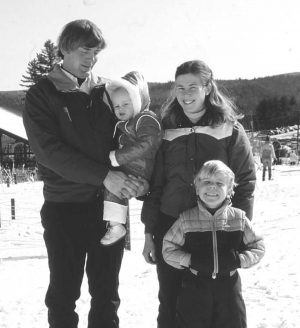
The young Mueller family in their first season at Okemo. Credit: Okemo Resort
When Tim and Diane Mueller purchased Okemo Mountain in August 1982, it was a ski area with six Pomalifts and three double chairlifts. Under their mom-and-pop hands-on leadership, it became a year-round destination resort with summer activities and programs as well as a vastly expanded two-mile wide ski area with 667 acres of terrain, 46 miles of trails, 98 percent snowmaking, 121 trails and glades, a 2,200 foot vertical, and 20 lifts.
Attorney George Nostrand characterized the purchase as “a struggle and a monumental risk. They had limited funding and if it failed, they would have lost everything they owned. I told Tim that I wouldn’t have had the stomach to take this kind of risk. He said to me, ‘Well, George, that’s the difference between an entrepreneur and a lawyer.’”
Referring to a Sno-Engineering 1981-82 Master Plan which concluded Okemo could become “a major destination resort,” with $8 million in improvements, mountain expansion and additional condominium complexes, Tim cited “the potential” as worth taking that risk.
“We assumed we would be successful because that is part of being an entrepreneur, but never in our wildest dreams did we foresee Okemo becoming what it did. Tim thought going from 90,000 skier visits to 200,000 annually would be doable, and that was our idea of being successful. We never thought we would reach 600,000 or operate three resorts — that was not a goal then,” Diane said.
Hospitality and Service Orientation

The Classic Red Poma Lift in 1956 which the Muellers replaced. Credit: Okemo Resort
With their background operating and expanding a beach resort on St. Thomas — and a Vermont home construction business prior to that — they had “a lot of energy and experience. There were good employees here with experience so it wasn’t as if we were wildly entering some field blindly,” Tim noted.
Still their first season was a struggle. With no time to research a chairlift, they focused on sprucing up with paint, new signs (saving money because Diane did them), and fixing the lifts as fast as possible when they broke down.
With natural snow not falling until mid January, the Muellers relied on snowmaking and had six trails by Christmas with two from the top, contributing to loyal skier appreciation and a “we can do it” attitude among staff.
They also focused on service. Diane cited their beach resort experience as giving them “a jump on the ski industry” in terms of offering quality service. The emphasis on Okemo and its employees providing top notch service was part of Okemo’s core values that enabled the ski area to grow to such a success, she added.
Their hands-on management style was impressive as they worked alongside their staff and management team . They listened to staff suggestions and were able to delegate responsibilities, which eventually allowed them to add Mount Sunapee (NH) in 1998 and Crested Butte (CO) in 2004.
Expansion and Success
Sunburst Six as it approaches the summit. Credit: Okemo Resort
With employee input as to where the replacement chair for the main Pomalift should go, the Northstar Triple was installed in 1983 (later a quad and then a sixpack). The development of the Clock Tower reception area and base village followed in 1984, creating excitement and a growing confidence in the mountain and the Muellers.

Hands-on resort operators Tim and Diane Mueller shown at the 2005 start of the Spring House at Jackson Gore. Credit: Karen Lorentz
The continuing addition of chairlifts, snowmaking, and new trails was impressive. The expansion to Solitude Peak in 1987 provided the Muellers’ first new lift-and-trail complex on 225 acres and was enhanced by a lodge and trailside units.
The development of convenient trailside condominium complexes — on private land the founders had purchased and on land the Muellers acquired — enabled profits to be invested into mountain improvements, including lodges, halfpipe and terrain parks, another new trail-and-lift complex at South Face (1994), a novice area at lower Solitude (1995), and the Jackson Gore complex (2004-06).
The offering of children’s daycare and ski instruction programs combined with an early welcoming of snowboarding in 1987 enhanced the area’s appeal as family friendly and an avant garde ski and snowboard school further propelled its growing popularity. By 2009, Okemo ranked in the top two in Vermont and the East and top 13 in the nation by skier visits!
When Vail Resorts acquired Okemo Mountain Resort September 27, 2018 it may have been the end of the Mueller era at Okemo, but thanks to their success, it was also the beginning of an Epic era that pays homage to their legacy of creating a great family-oriented resort.
[authors_page role=contributor]