

Skiing Weatherman: Transition Month Trials
Late Season Powder. Rain And Snow.
Although astronomical spring begins with the vernal equinox later in March, “meteorological spring” begins on the first day of March. That’s when the questions start to arise about how long the season is likely to extend. Those questions are more common for resorts over the eastern half of the country, where injections of milder Pacific air have been present at times in the past week, and they will continue to come east at times during the first two weeks of the new month. Surfaces have become more variable, especially on sunny days when trails with full exposure to the sun start to soften up and moisten by midday, thanks to the increasing seasonal output of Old Sol.
Transitional months are the most difficult for forecasters as the battle between warm and cold expands both in area and magnitude. It is still mid-winter cold in Canada, but the South is steadily warming up in spite of what we witnessed in Texas a week or two ago. The contrast in air masses can lead to some blockbuster late season snows but if the low center happens to cut up over the Great Lakes rather than run up the eastern seaboard, some of the early spring warmth from the South can rush northward and deal a nasty body shot to snow conditions. However, back in 2014-2015, three Nor’easters came up the coast and the Northeast got three significant dumps of snow. While it is great to see a late season parade of storms like that, more often than not, the air mass fight leads to more variety in terms of temps and precip types. For the next couple of weeks, the pattern will be quite changeable over the eastern half of the country. With colder air a little harder to find, elevation will play a big role in the snow vs. rain equation.
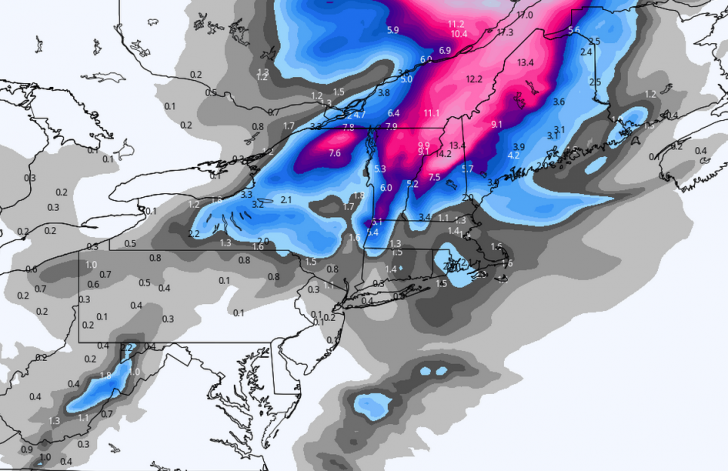
Overall, the pattern currently does not look like as productive in terms of significant storm threats as what unfolded during February. The best shot at a meaningful snowfall would appear to be at the end of the first week of the new month. Here is a surface map for Friday the 5th that shows a storm impacting the central and northern Appalachians.

The track is hugging the coast, which would allow enough mild air to spread into the mountains to start the precip as rain. However, as the low tracks northeastward, the rain would change back to snow and a sizable “backside” accumulation could be in the cards, as suggested by this snowfall map for the 5th and 6th.
Longer term, I tend to think that the pattern will deliver enough cold air to keep the season going. March in La Nina years tends to favor a continuation of winter across the North and for now I am going to lean on that analog.
In the West, weather worries are minimal, as transient upper level troughs will swing through the region at times and those systems will produce some late season powder days and sustain outstanding conditions.
REGIONAL HIGHLIGHTS:
Pac NW/B.C.:
The hits just keep on coming. After very heavy snow to end the weak, weaker systems sustain the snowy pattern next week; quieter in OR.
Central and southern Sierra:
Windy weekend for Tahoe and SoCal resorts. Quiet week coming up, best shot at snow next weekend.
Rockies:
Light snow this weekend; ridging leads to quiet week thereafter. Next shot at snow next weekend.
Midwest:
Seasonable weather overall for next week. Passing weak systems produce light snow in northern Great Lakes.
Northeast:
Light mixed precip this weekend. Elevation matters! Early week cold shot, then milder. Potential for sizable late week storm.
Mid-Atlantic/Southeast:
Damp weekend; colder with high elevation snow Monday. Snow potential mid to late week-north. Challenging upcoming week of weather in southern Appalachians.

Skiing In Norway: 1956-57
Jan and Judy Get New Ski Gear, New Snow Adventures In A Land That Loves Skiing.
After breaking her leg on our disastrous first ski date in Michigan, my wife Judy was still a bit stiff in the left leg when we arrived in Norway in late June 1956 to begin my Fulbright-student year studying Norwegian folklore. But we had all summer to get in shape—walking around Oslo, hiking in the forests and mountains, and taking some long bike trips.
In the fall, we bought ski gear: wooden skis, cable bindings, leather boots, and bamboo poles. State of the art stuff. I had my favorite ski clothes, including the Norwegian striped cardigan I had been using since 1953; Judy bought a spiffy new outfit (maroon ski pants and grey jacket) that she occasionally still uses.
Oslo was a great place to practice. The tram lines run right up to the edge of Nordmarka, the vast wooded park above the city, and there were ski racks integrated into the sides of the old wooden cars. (I assume they have metal tram cars by now.) This photo of Judy loading her skis was taken on a weekday; on weekends and holidays the whole side of the car would be covered with skis.

Judy racks skis and boards tram to suburbs of Oslo.
I believe the only ski lift we rode all year was a T-bar in Nordmarka; the rest was cross country. After touring up there we could glide right back down to the area where we lived via ski tracks maintained between houses and businesses.
Early in the winter we took a train to Lillehammer, stayed in the youth hostel, and skied both in town around the open-air folk museum and in the surrounding countryside.
Next we did a weeklong trip with some friends to Numedalen, staying in a rented cabin (hytte) above the treeline. The snow was great, and we got lots of practice and exercise climbing up hills and sliding down. Judy, only in her second season as a skier, got pretty good, despite having little coaching beyond “Follow me!” Here she is enjoying some powder.

Judy in powder on her new skis and outfit.
One day on that trip I skied down to a village to buy some food, expecting a long slog back up with a heavy rucksack. But just as I was starting up, a group of Norwegian army men came along in a tracked vehicle. They tossed me a rope and pulled me back to the level of our cabin. Sweet!
In March we attended the annual jumping meet at Holmenkollen with my uncle and his family. It was a foggy day, and the jumpers came sailing out of the murk, most of them sticking the landing as if it had been a clear day.
Easter was late in 1957 (April 21st) so when we made another mountain trip, this time to a cabin in Telemark, the weather was balmy and snow was thin except in the shadows. Here we are enjoying the traditional Norwegian Easter ski trip, me still in that favorite sweater.

Jan and Judy, Easter ’57.
In June when we returned to the States we had enjoyed a great year of study and skiing in my ancestral home, so to speak. I brought back an article that got published in the Journal of American Folklore, kicking off my academic career. And, of course, we kept our Norwegian ski gear.
But would there be much skiing in our immediate future? After all, we were headed to Bloomington for my graduate work at Indiana University. Not exactly in a major ski zone, but who knows?
To be continued . . .

Make More Tracks: Yellowstone Expeditions
A Rustic Retreat In Remoteness.

Yurts and heated tent cabins accommodations in remote corner of Yellowstone.
When skiers talk about great backcountry, they often cite the Tenth Mountain and Braun systems in Colorado; Sierra Club huts in California; Skoki Lodge, Assiniboine and Shadow Lake in the Canadian Rockies. I’d like to add a new destination, near Canyon in Yellowstone National Park. (Check an atlas, find Yellowstone in the northwest corner of Wyoming; Canyon is in the north central part of the Park.)
Actually, Yellowstone Expeditions is in its 38th season. And to be honest, they use yurts and tent cabins, not log huts or lodges. But “great” is perfectly appropriate, whether it’s skiing or snowshoeing, staff, dining, or the amazing landscape of the world’s first national park (1872).
Yellowstone isn’t exactly a winter secret, but skiers visit the Canyon area only when they’re passing by in enclosed heated snowcoaches or on snowmobiles, mainly because there’s no lodging within 35 miles except Yellowstone Expeditions.
The company was founded by Arden Bailey, who in summer works as a geologist who once specialized in radioactive waste disposal. (There’s a theory Arden is such a bright guy that no one in his vicinity needs a headlamp.)

The high point of my winter used to be running winter trips in the U.S. and Canadian Rockies, so it was a joyous thing to be a guidee around Canyon. Most of the time I skied with Erica Hutchings, a Renaissance woman who’s been office manager, snowcoach driver, PSIA-certified instructor, and super-guide. Come summer, she’s been a river ranger in Grand Teton National Park.
Who Are Those Guys?

Dining room and kitchen yurts glow at sunset.
All the guides are a hoot. They’re also naturalists, dishwashers, and talented cooks, working crazy hours with all kinds of clients, and carrying it off with humor and panache and quick wits. What a work ethic!
Arden’s talents include amazing stories and still more unbelievable jokes. This sense of humor seems to inspire guests, who tend to be crazy-diverse in their professions and interests anyway. Our group on one visit included a doctor from New Mexico, a writer from New York, and the owner of a trucking firm in Texas. I learned something about publishing fiction, summer weather around Houston, anatomy, movies, Superfund sites, national politics, and succession tree species after the Yellowstone fires of 1988.
A typical four-, five- or eight-day trip begins with a snow van ride from West Yellowstone to Canyon with skiing near the rim of the Yellowstone toward the end of the day. We enjoyed a novel experience along the Gibbon River—a herd of maybe 200 slow-moving bison. We couldn’t pass them for almost two hours. It was a photographer’s dream, including the chance to take pictures of fuming snowmobilers who revved engines but still didn’t intimidate the beasties.
And There’s Skiing

Here’s why people come to Yellowstone.
You can visit the park for its beauty, for wildlife, for geysers. I did it that time for long tours, powder, and downhills. It’d been a long time since I’d really skied hard in the backcountry. It’s easy to forget how few miles a small group can REALLY go in eight hours when you’re breaking trail through two feet of fresh snow.
The Yurt Camp is based at 8,000 feet, so it gets and holds 200-250 inches of snow, usually the light stuff Montanans call “cold smoke.” It’s in a spectacular area, minutes from the deep canyon of the Yellowstone. Terrain runs from long-open-steep to wooded-gentle.
I’ve always been a so-so unenthusiastic telemarker, never quite found that ideal combination of grace, strength, and technique. After that trip, I’m a certified Wannabe.
It stood to reason that 205 cm light touring gear would do the trick for touring, even for low-angle telemarking. This might have worked if the heels of my boots hadn’t kept jamming with snow. It’s demoralizing to start a turn, come round just far enough that skis are pointed down the fall line, and find the only part of the boot/binding system meeting its obligations is the toe.
Humility is a great teacher.
Yeah yeah, I know, “It’s the equipment.” But the next day I used mid-length general touring gear with a 3/4 metal edge with backcountry boots and bindings. Spectacular improvement! Even carrying a full pack, those skied floated and came around on request.
Actually, we could have skipped hills almost entirely. There’s a huge variety of trails—groomed, ski-set, or just marked—taking off right from camp, including gentle tours to places like Inspiration Point and Cascade Lake.
Wilderness luxury
Guests stay in warm, comfortable hut tents, a moments walk from the kitchen and new dining yurts. Here’s the thing you sweat for and dream of on skis or snowshoes: getting home at twilight and trying the new cedar sauna before dinner. Or better yet, a backwoods (indoor) shower—rapture!
Among my favorite moments were the intermittent thunder of the Yellowstone’s Lower Falls (much higher than Niagara); walking around Washburn Hot Springs (it’s a map-and-compass trip in); watching a park ranger skate at dusk beside the Grand Canyon of the Yellowstone, just after a grooming machine came through; learning the differences between fisher and coyote tracks; digging a snow pit for evaluating avalanche potential; and the pleasure of a heated outhouse.
Now, that’s livin’!
More Detail
Packages include delish meals, lodging, snowcoach, sleeping bags and sheets, and guiding. The season runs December 17-March 7th. Four-day/three night visits run $1,260 per person, double occupancy. The camp holds 10-12 guests. Check out the dynamite web site by clicking here or call 800-728-9333.

Late afternoon along the thermal waters of Alum Creek
[authors_page role=contributor]