

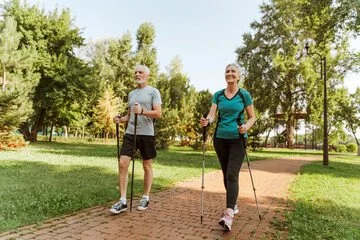
Nordic Walk for a Fitness Option
Over 17 million Europeans are walking with special Nordic Ski Walking Poles (ALL ages and ALL fitness levels) as a fitness activity that turbocharges the typical walking campaign. For those who are unfamiliar, Nordic walking is a fitness recreation that combines walking with specially designed poles to engage the upper body muscles. It can be practiced for exercise and wellness on neighborhood and city sidewalks, mountain trails, city parks, sandy beaches and on hiking trails.
Nordic Walking burns up to 40% more calories than regular walking. Using the Perfect Length Poles automatically improves walking posture. Walking with the Perfect Length Poles tricks us into standing taller and helps to radically reduce the stress to the shins, knees, hips, and back. Nordic Walking is ideal for athletes, kids, adults of all ages, and even those with balance issues.
Pete Edwards of SKIWALKING.COM LLC has been coaching runners and skiers of all ages and fitness levels for over 40 years. Edwards is a former ski school director, ski coach, running coach and the owner/founder/coach of his company headquartered in Empire, Michigan. He has also introduced Nordic Walking to thousands of Americans through Nordic Walking clinics, radio interviews, newspaper interviews, and TV interviews. Hosting Nordic Walking clinics is extremely enjoyable for Edwards, and he especially likes hosting Nordic Walking clinics for MS, Parkinson’s, and Diabetes support groups, plus Wounded Warrior Programs.
Nordic walking can help individuals with bad/new knees, bad/new hips, back problems, balance, and other issues. A SkiWalking.com customer asked if it would help improve her balance problems stemming from an inner ear issue. By using the correct length poles, she was able to navigate even the roughest terrain with balance and security provided by the poles.
Nordic Walking has a winning combination of improved posture, unique 4-Wheel-Drive type action, and shock absorbing benefits. Nordic Walking Poles can help individuals with balance issues, knee issues, hip issues, back issues (including those with rods in their back), weight issues, multiple sclerosis (MS), Parkinson’s (PD), amyotrophic lateral sclerosis (ALS), diabetes, neuropathy, arthritis, bursitis, scoliosis, lumbar stenosis, fibromyalgia, post-polio, osteoporosis, stroke recovery, cancer recovery, and other limitations to walking. Nordic Walking is getting thousands of Americans off the couch, outside, walking safely, and helping to effectively launch much-needed walking campaigns.
The perfect length poles can actually trick us into walking with a super straight back and better walking posture which is biomechanically a good thing. This improved walking posture, when combined with the unique 4-Wheel-Drive type action of walking with poles, radically reduces the stress to the shins, knees, hips, and back. Nordic Walking is low impact and yet provides a highly effective workout burning more calories and working more muscle groups than regular walking.
Edwards reviews details about Nordic walking from advantages of metal pole tips in the snow and rubber pole tips for walking on pavement to appropriate sizes of pole straps which enable walkers to keeping relaxed fingers so as to avoid gripping the pole too tightly. He suggests walking with a normal stride and gait while planting the poles at an angle.
According to Edwards, one-piece poles are safer, lighter, and much more durable than adjustable/telescoping/collapsible poles and he states, “We recommend quality one-piece poles that won’t collapse unexpectedly.” Using the correct length poles can radically improve balance, stability and gait and there are 32 different lengths of one-piece poles ensure a perfect fit.
Trekking (hiking with poles) and Nordic walking are two different activities that use very different poles and techniques. It may sound silly, but perhaps “walking is not just walking.” The pole angle, weight, grip, and straps are different between the aforementioned modes of walking. The Nordic walking pole is designed to allow your hands to relax in order to target the larger wrapping muscles of the back. But using poles of any kind automatically stimulates your spine and all of the muscles around it, even with inefficient technique. When walking, the key postural muscles of the core and upper body are engaged.
I’ve (Roger of XCSkiResorts.com) been a Nordic Walker for many years and found the claimed attributes regarding posture and exercise to be true. I’ve always been in search of a way to decrease the amount of time spent exercising, so I was sold when I heard that using the poles increases caloric burning by as much as 40 percent. Being a cross country skier, it is easy to quickly master Nordic walking. After a summer of Nordic walking, I noticed a marked improvement in my cross country ski poling in terms of strength and timing. It also seemed that I increased the amount of forward momentum that was attributable to poling and I was able to pole stronger and longer when skiing.
For more information such as how to get started Nordic Walking and how to buy poles – contact Pete Edwards, the owner/founder at the website: WWW.SKIWALKING.COM
If uncertain about Nordic Walking for your health level, check with your doctor. For additional specific information and exercise plans for Nordic walkers, see the Human Kinetics book entitled “Nordic Walking for Total Fitness” by Suzanne Nottingham and Alexandra Jurasin which has got it all covered. “Nordic Walking for Total Fitness” is available in hard cover, ebook or PDF versions from Human Kinetics at www.humankinetics.com or a paperback version at $7.98 from Amazon.
Photos from Pete Edwards, SKIWALKING.COM
Nordic walking for all ages
Nordic walking on a brick path
Nordic walking on the beach
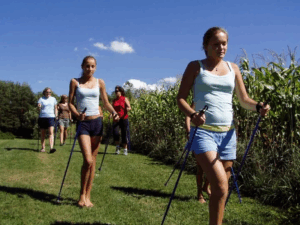
Nordic walking barefooted

More on Safety, My Favorite Subject

On trail signage at Park City Mountain Resort Photo: Jon Weisberg
As I sat around this summer counting the days until ski season begins again, I started thinking of my most favorite subject. SAFETY!
While I was out on the bike path for my run (more like walk!) someone approached on their bicycle, and as they were getting closer to my back side they announced, “on your right”. That was a good sign, much appreciated and just good common sense, and I started thinking about other instances outside of ski season when such politeness is expected, even required.
When one plays golf to pass the time between ski seasons, someone will shout FOUR if they think a ball might have a possibility of hitting you. It’s a warning, to protect everybody’s safety.
A couple incidents while driving my car also got me thinking. When we drive, we use – or should use – directional signals when preparing to turn. Agan, it’s for everybody’s safety. When someone is a reckless driver, there is a chance they can get a ticket, get in an accident, even lose their license.
Driving on the Garden State Parkway in New Jersey recently, a pickup truck sped past me on the inside lane at 80+ mph and suddenly cut in from of me with no directional signal. So I flashed my lights, in case this driver was trying to run me off the road. He hit his brakes and tried to edge me off with a few birds flipped at me.
That was extreme and only happened twice in my life of 82 years, both times young and crazy drivers.
Luckily, there are few such these incidents – including on the slopes when a reckless skier or boarder cuts you off and you yell and get the bird.
Recently also, two motorcycle drivers sped by me on the inside at an extreme speed weaving in and out of traffic to a point that I expected to see them somewhere off the road in an accident. Such young drivers on crotch rockets are the basic statistics of motorcycle accidents and deaths – although they won’t stop me from riding my motorcycle or downhilling on my skis.
Driving is dangerous and lethal at high speed and is a weapon of sorts, so you must pass a skill test to get a license, and insurance to own, even rent, a car.
What else requires a license? Boating. You need to take a safely course before you can operate a boat, of course all reason disappearing when one drinks, but that never happens when out boating! Now the waters are patrolled by the local jurisdiction frequently.
Hunting – the same goes, with safety courses required before getting a license. Also scuba diving. Because recklessness can cause injury and/or death.
So, let’s talk about what we could do to improve our chances on the slopes, which appear to be the most under regulated situations. Possible introduction to skiing should be a safety course. It should be requried when newbies rent ski equipment.
There must be other ways to get the message out. An article here on SeniorsSking about “Ride Another Day” aka “Snow Angel” promotes safety education to know to give the skier in front of you the right of way. In my opinion of all the safety rules that is the most important because it deals with the other person and not just yourself. Technically the other skier is a weapon, and you are the target and with limited protection it can and has been lethal.
I have had many instances when someone passed me too close, but when I caught up to them and said something, I was yelled for getting in their way, instead of apologizing for nearly causing an accident.
Recklessness is a common issue on the slopes, whether that’s caused by alcohol, cannabis, or a simple lack of education and courtesy.
The big question is what and how can we do something about it?

Shipping vs. Schleppng Your Gear

Photo by Lala Azizli on Unsplash
If you recall wooden skis that broke in half if you land too hard on a bump, leather boots and cable bindings, then you know how long I have been skiing – and schlepping – my gear around the globe.
While I stay in decent shape, I’ve reached the point when schlepping skis, boots and rolling duffle a few blocks to a bus, trying to get them into a taxi, or asking someone to drive me to the airport is something to be avoided. Ditto waiting for my stuff at the baggage carousel and then schlepping it to the taxi line or van pickup is just too much for me now, as a senior passing eighty.
Since sherpas are not always available, I now ship my “stuff”. It’s the price of convenience. Shipping is pricey, but it’s worth it to me.
There are several methods – and costs – depending on destination. Sometimes I spend as much time planning the shipping as I would waiting at the baggage carousel.
Commercial courier services such as DHL, USPS and FedEx ship skis, boot bags and suitcases, pricing each one separately by size, weight and other factors including distance.
There are also intermediary companies – middlemen – that specialize in sports equipment and will ship skis, golf clubs, bikes, surfboards and luggage wherever you want. They often use the larger, commercial couriers, who apparently have made volume arrangements with them for lower prices. They will hold your hand and assist, and handle all the large carrier interactions. How much and how well differs from company to company.
The cost of shipping is its biggest negative, and depends on such variables as where you are shipping from and to, weight and size of what being shipped, packaging and the number of days between pickup to delivery. I’m guessing they also add in the remoteness o pick-up and delivery locations.
There also is usually a small additional charge for pickup from your location vs you bringing it to a carrier drop-off point, whether that is Manhattan or Mammoth, and additional fees for oversized skis or luggage.
Here’s a hypothetical round-trip shipment from my home in NYC to Big Sky and back, as I’ve done for real on trips with the 70+ Ski Club, with a general package that a skier like me) might ship for comparison: skis/poles at 25 lbs and a suitcase/duffle/roller bag of some kind at 65 lbs (oversized because I ship my boots in the duffle). I would ship on Monday and want it all delivered by Friday, with a return trip for pick-up Monday and delivered home by Friday.
Based mostly on my use of each company’s online calculators and reasonable assumptions, here’s a price comparison. Shipping is pricey, no question.
FedEx $615.00
DHL $904.00 For Luggage alone
USPS $718.00 (Luggage is most of this)
Lugless $815.00
Shipgo $520.00
EasyShip (Does not ship to Big Sky)
ShipSkis $560.00
SendMyBag $683.00
Seriously, you could rent for that price – but you won’t have your own skis, which you obviously love and trust enough to pay the shipping price. Also, you won’t have them to use during the shipping periods, which can be an issue if you plan on skiing elsewhere while your gear is traveling without you.
Sometimes I use a carrier-middleman, other times I ship direct. It depends on the location, but I always ship out on Thursday or Friday, for Sunday delivery.
Bad weather can slow down carrier deliveries, just as they slow down flights. One time FedEx was two days late, because of undrivable weather conditions; trucks simply could not get through. I kept calling them and they always responded, but weather is weather.
The point is, whether you fly to Big Sky, Cortina d’Ampezzo or Portillo, or any other destination, domestic or international, all you need to take on the plane (or cruise ship, for that matter) is a backpack or other carry-on, and/or your beloved boots you don’t trust to check or ship.
Shipping avoids schlepping anything heavy to the airport or train station, checking your baggage or equipment, picking it up from the carousel to a car or bus or train, dealing with risk of bodily harm due to heavy lifting or moving stuff around, and certainly not hanging around an airport to find your lost luggage.
The carrier-middlemen rarely lose items, and their Customer Support is consistently better than that of the larger carriers.
Shipping allows my arms, back, patience and temper remain unstressed and calm for the trips. Again, it can get pricey, especially on faster delivery times, but nothing like a hospital bill for compressed discs. If you’re anything like me, it is 9worth the price for my back, arms, hands and patience.
[authors_page role=contributor]