


Incidents & Accidents: 8
[Editor Note: SeniorsSkiing.com is asking our readers to contribute to support our online magazine. Yes, we have grown in the number of subscribers and advertisers. But our expenses have also grown. You can help us defray some of these expenses by helping us out with a donation.]
Support SeniorsSkiing.com by clicking here.
______________________________________________________
It Might Be Wise To Skip That Last Run.
 Who: Arlene Condon Maginn
Where: Bretton Woods, NH
What Happened: On the third day of our ski week, Bretton Woods had a two-for-one ticket day. The crowd, still very modest, was noticeably bigger than earlier in the week.
John and I were skiing the last run of the day around 3 pm. John followed me down from the top, and, at the very bottom run out, he zoomed past me. At least three trails led into the base area, marked by a big “Slow” sign. No one was slowing in the slightest. Suddenly, a boarder crossed directly in front of me and went right over the back of John’s skis, not 15 feet away. John launched into the air without his skis and landed head first in a snow bank off the trail. The boarder also fell and lost his board.
Both John and the boarder stood up and shook themselves off. John said he saw stars and was thankful he was wearing a helmet. The boarder also said he was okay and was very apologetic to have caused the mishap.
I am a nurse with a recent head injury, so I was very careful to ask John several times about any symptoms, like blurred vision and headache. The boarder stayed with us while John put his skis back on. We went down the 50 or so yards to the base. We were done for the day and headed back to the lodge.
Lesson Learned:
1. We should have asked for identification from the boarder, just for future reference. And we should have reported the incident to the resort. Later, in the lodge, we learned from an employee that there is a formal process for reporting accidents. Since we never exchanged information with the boarder, reporting didn’t seem that useful.
2. The last run of the day can often be problematic. We had fatigued muscles, slowing down our response time. John should have curbed his enthusiasm and his speed at the bottom of his last run.
3. Skiing in crowded areas—merging trails, near the base, or where there are lessons—requires more diligence and focus on what’s going on. Clearly this is where the risk for collisions is highest.
4. As a senior—especially someone who is recovering from a head injury—I try to be very careful about injuries. I stay in shape, stretch, wear a helmet and bright-colored parka. My lesson is to ski defensively, especially in tight places and at the end of the day.

Mystery Glimpse: Celeb In NH
[Editor Note: SeniorsSkiing.com is asking our readers to contribute to support our online magazine. Yes, we have grown in the number of subscribers and advertisers. But our expenses have also grown. You can help us defray some of these expenses by helping us out with a donation.]
Support SeniorsSkiing.com by clicking here.
______________________________________________________
All The Way From Television Land.
Was she a skier?
Here’s a famous television celebrity you should know if you grew up in the 50s. We took this from a picture displayed in the lobby of the venerable Mittersill Alpine Resort, Franconia, NH. We think the famous person was visiting the Baron von Pantz and his family, who built the resort in the mid-40s, modeled after his “castle” in Austria. Enough clues.
Last Week
 This is iconic Tuckerman Ravine, located across from Wildcat Ski Area in NH. There were many interesting guesses as to the artist. We can see a little Wyeth in there. However, this watercolor is by G. Lewis Hodgkins (1906-1972), an architect who lived in nearby North Conway. Hodgkins eventually became keeper of Ye Coach and Four Inn on Oak Street. He gave daily painting lessons that were quite popular.
He is known for his bold strokes and his ability to interpret his subjects simply and impressionistically. This water color was most like done en plein air.
Curiously, as an architect, Hodgkins designed homes and buildings in and around the area, including the North Conway Community Center which eventually became the North Conway branch of the New England Ski Museum where this work is currently displayed.
Many thanks to the New England Ski Museum for permission to use this photo.
Recipes For Toes And Nose
[Editor Note: SeniorsSkiing.com is asking our readers to contribute to support our online magazine. Yes, we have grown in the number of subscribers and advertisers. But our expenses have also grown. You can help us defray some of these expenses by helping us out with a donation.]
Support SeniorsSkiing.com by clicking here.
______________________________________________________
Nifty Tricks For Your Feet And Schnoz.
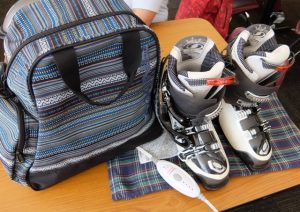
Just three ingredients for warm feet and dry boots. Credit: Harriet Wallis
I like to get to the lodge early, meet new skiers, and visit with old friends.
Recipe for your toes
One day I met John Bridgwater and Joan Kent who travel continually to ski. They invented a way to dry their boots night after night in hotel rooms and keep them toasty warm on the drive to the mountain. They find this works better than the expensive, highly marketed systems. Here’s the boot drying recipe.
List of ingredients:
- One inexpensive boot bag that will hold your boots side by side.
- One heating pad that will stay on continually rather than turning itself off within a short time. They found CVS carried such a heating pad.
- One pair of ski boots that have been worn all day.
How to do it
Put the heating pad in the bottom of the boot bag and leave it there.
At the end of the day, buckle your boots and put them side by side inside the boot bag.
When you get to the hotel – or home – unzip the boot bag and leave it open. Plug in the heating pad. You only need one outlet for this.
Then go out to dinner and enjoy the evening. Your boots are drying themselves.
“It’s a chimney effect,” said John. “The boots heat from the bottom and the moisture is driven out the top.”
And tomorrow
Unplug the heating pad and put the cord into the boot bag. Zip up the bag and the boots will stay warm on the way to the mountain.
Recipe For Your Nose
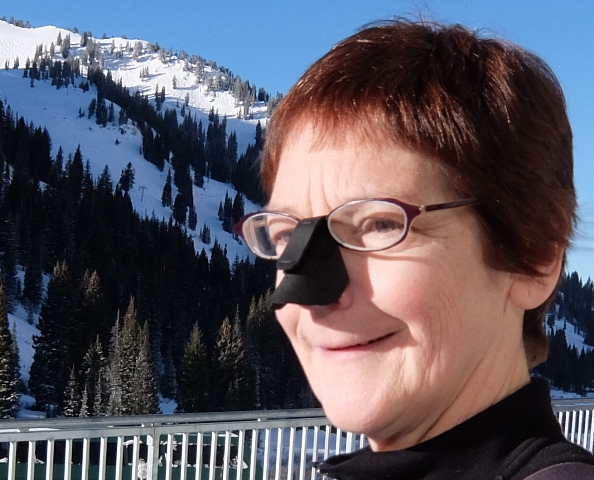
My friend Marypat Schreibman wears a nifty little nose protector. It secures to her glasses, protects her nose from the sun, and it keeps her nose warm even on the coldest days. It’s called a “nose cone.”
So I Googled nose cone, and the internet gave me nose cones for planes and rockets. Wrong ones!
Ingredients
Marypat’s came from NozKon. It’s made of light weight, flexible material and comes in a variety of colors and models. Some attach to goggles. As the springtime sun grows stronger, many skiers are now wearing the protector.
Or protect your beak with beko gear. Protecting noses from sun damage is an entire industry for bicycling, yard work, and water sports. How’s your nose?
Nose cone fashion statement? Credit: Harriet Wallis
[authors_page role=contributor]